

Why should we pray to Virgin Mary? The reasons are many.
Why do Catholics pray to Mother Mary? Is Rosary really powerful?
The intercession of Mother Mary is very powerful as Jesus cannot neglect His mothers commands.This can be proved by the first miracle Jesus did at the wedding at Cana. – (John 2:1-11). Mother Mary told Jesus “They have no more wine.” And what was the final result? He turned water into wine.
In “The Poem of the Man-God” by Maria Valtorta, she says that Jesus told her about this incident as “I did it for Mary”. This proves that the intercession of Mother Mary is very very strong.
Mother Mary was blessed with Holy Spirit abundantly. We can see this as we read “At that time Mary got ready and hurried to a town in the hill country of Judea, where she entered Zechariah’s home and greeted Elizabeth. When Elizabeth heard Mary’s greeting, the baby leaped in her womb, and Elizabeth was filled with the Holy Spirit.” (Luke 1:39-41) ; just by Virgin Mary’s greeting.
Listen to the talk from Apologetics on Mary, Purgatory and The Bible
What the angels thought on this matter:-
When angel appeared before Zechariah,father of John, angel just greets him by his name ,nothing more although he was “upright in the sight of God, observing all the Lord’s commandments and regulations blamelessly.” – (Luke 1:6)
When angel appeared before Joseph, the greeting was like this: “an angel of the Lord appeared to him in a dream and said, “Joseph son of David, do not be afraid to take Mary home as your wife, because what is conceived in her is from the Holy Spirit.” – (Matthew 1:20). Angel greeted him ‘son of david’, thats all.
Now let us see how did the angel greet Virgin Mary. It goes like this: “The angel went to her and said, “Greetings, you who are highly favored! The Lord is with you.” (Luke 1:28). See the difference….
Also read the article Mary, The Mystical Rose

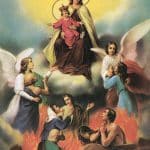

I Pray to mother mary because. We love our mother like wise mother mary also mother of jesus christ. So she is mother of world. Please don’t misunderstand. With out mother we are not at here. Please remember every one. Thank you
Catholics do’t pray to mother Mary we just ask her to pray for us and hence the “term praying to mother Mary” is a big mistake. We just accept her as a mediator or an advocate.
John,
Addeline:
Do you think Mary,mother of Jesus is Virgin???
Answer is NO!!
Mary is virgin till she give birth to Jesus. Then how James, Jesus’s borther existed in earth?
What does this have to do with what Addeline said?
Where does it ever say in Scripture that James is the son of Mary, the mother of Jesus? It doesn’t. It’s an assumption based upon a particular understanding of brother and an additional assumption that Joseph had sexual relations with Mary after she gave birth to Jesus. Even if James was the son of Mary, this would only make James’ Jesus half-brother, biologically speaking. Because Christ was conceived without the semenal aid of a human father, no one, not even James’ can claim to be Christ’s brother in the full sense of the word, if by brother, we allow for no other understanding than, son of the same parents.
@John (400) – why do want to start up another discussion? You are going of the topic that is being discussed on this page, is it because we are not sitting back & allowing people like you to say & be disresepectful to our dear Mother or is it that you feel so righteous about yourself that you want to make up things so that you feel better about yourself… cleary this page is not for you!!! so maybe you should just stay off & out off it. AND, Yes, Our Mother Mary is a Virgin to us, so stop disrespecting Her, because your comments is just a reflection of you & the type of person that you are…are you so disrespectful to you own mother? I wonder….May God bless you
I take the liberty to answer to your question put to Addeline.Since all we Catholics believe in the same doctrine.
I guess you are referring to:
Matthew 13:55 55 “Isn’t this the carpenter’s son? Isn’t his mother’s name Mary, and aren’t his brothers James, Joseph, Simon and Judas?
120 “brothers” in Acts 1:15 – 15 In those days Peter stood up among the believers (a group numbering about a hundred and twenty) 16 and said, “Brothers and sistersâ€.. does not mean they had same mother.
Neither in case of Lot and his uncle Abraham, who were called “brothers” (Gen. 11:26-28, 29:15).
Early Christians knew the usage of brother could mean cousins, nephew or uncle etc.
If you point out the word “until†in Matthew 1:25 which states that Joseph had no relations with Mary until she bore a son.
2 Samuel 6:23, we read that Michal, the daughter of Saul, had no child “until” the day of her death. (Rest assured that she didn’t have any children after that day, either.)
Also,
Hebrews 1:13
13 To which of the angels did God ever say,
“Sit at my right hand until I make your enemies a footstool for your feetâ€
1 Timothy 4:13
13 Until I come, devote yourself to the public reading of Scripture, to preaching and to teaching.
Hope now you understand the word “until†may not necessarily mean the action in question happened after that.
As we all said to you earlier please do not read Bible keeping one passage in mind. Because, When we interpret any passage, we must consider what the author was trying to say. Matthew’s intent in Matthew 1:25 is not to explain what happened after the birth of Christ. He is only concerned with the fact that Joseph and Mary had no relations before then. It is the virgin birth, not later siblings, that Matthew is concerned with.
And about your question, who is James?
We know that James the younger’s mother was named Mary. Look at the descriptions of the women standing beneath the cross: “among whom were Mary Magdalene, and Mary the mother of James and Joseph, and the mother of the sons of Zebedee” (Matt. 27:56); “There were also women looking on from afar, among whom were Mary Magdalene, and Mary the mother of James the younger and of Joses, and Salome” (Mark 15:40).
Then look at what John says: “But standing by the cross of Jesus were his mother, and his mother’s sister, Mary the wife of Clopas, and Mary Magdalene” (John 19:25). If we compare these parallel accounts of the scene of the crucifixion, we see that the mother of James and Joseph must be the wife of Clopas.
(Matt. 10:3) James described as the son of Alphaeus. FYI , Aramaic name for Alphaeus in Greek is Clopas.
So it’s probable that James the younger is the son of Mary and Clopas. The second-century historian Hegesippus explains that Clopas was the brother of Joseph, the foster-father of Jesus. James would thus be Joseph’s nephew and a cousin of Jesus, who was Joseph’s putative son.
Refer the following: Hope you will understand bro.
Ezekiel 44: “This gate shall remain shut; it shall not be opened, and no one shall enter by it; for the Lord, the God of Israel, has entered by it; therefore it shall remain shut.” Mary had become the dwelling place of the Almighty, like the Ark of the Covenant in the Old Testament. Uzzah was struck dead for touching the Ark (2 Sam. 6:6–8)
Phew John. I just repeated whatever was in the earlier comments, if you had read them this question wouldn’t have put forth again.
Anymore questions? Shoot please. We are glad to have a discussion the way you want it- scriptural references.
Peace
Jean,
I must politely disagree. Take for instance the popular “prayer” said to St. Michael:
St. Michael the Archangel, defend us in battle. Be our defense against the wickedness and snares of the devil. May God rebuke him we humbly pray. Do Thou, O Prince of the Heavenly Host, by the power of God, thrust into hell Satan and all the evil spirits who prowl about the world seeking the ruin of souls. Amen.
Also:
O virgin, spotless, undefiled, unstained, all-chaste and Pure Lady, Bride of God, who by the glorious birth-giving hast united God the Word with Man and linked our fallen nature with Heavenly Things; who art the hope of the hopeless, the helper of the oppressed, the ready protection of those who haste unto thee, and the refuge of Christians; despise me not, who am defiled and sinful, who by my wicked thoughts, words and deeds, have become an unworthy servant, and by my slothfulness have turned into a slave to evil affections. O Mother of the God of Love, have mercy and compassion upon me, a sinner and a prodigal. Accept this prayer which is offered to thee from my impure lips; and putting forward thy maternal influence with thy Son, my Lord and Master, beseech Him to open unto me the loving kindness of His grace; beseech Him to overlook my countless transgressions, to give me true repentance and to make me to be a zealous doer of His commandments. And thou, being gracious and compassionate and tender-hearted, be thou ever present with me in this life as my defender and helper, so that I may turn aside the assault of my enemies, and guide me into salvation; help my poor soul at the hour of my death, and drive far from it all the dark forms of the evil ones. And in the dreadful Judgment Day, deliver me from everlasting punishment, and present me as an inheritor of the ineffable glory of the son, our God. From :http://www.orthodoxnet.com/worship/occasionalprayers.html
Like I mentioned before, the phrase, “to pray” is simply another way of saying, “to beseech”.
gen_bam:
Even Hindus who worship stones r Blessed in their life..then do you think that stones are answering them?
NO!!
its not like that..though you are ignorant in seeking the only God..by His everlasting Love for you,Jesus answers ur prayers though u bow to stone or to anyother person!
it hurts Jesus when u not seeking Him..Repent for He is your only mediator.
NIRMAL TONY:
Dont fool urself and others by telling that Mary is mother of world…
Mary is the chosen vessel to bring out God to earth.
Even Mary nor Jesus nor Apostles didnt tell anywhere in Bible that Mary is the mediator or intercessor…
Read Bible clearly.
Jean Donald Thimothy Gomez:
You do one thing…go to nearby graveyard and give your prayer request to the dead people who are in the tomb..they too be as mediator by your idealogy..
Open your eyes man..Bible clearly states that crucified and resurrected Jesus is the only mediatior between God and Man…and we are the intercessors between Christ and man(for whom v pray)..
no People,stones,belief,princples can take the Jesus position.
Cheryl:
hmmm…then by the same biological terms i can say that Jesus is not the son of Mary..
James is the brother of our Lord..
you can see that by Mark15:40,Mark16:1,Mathew27:56,Gal1:19
Tania:
I give respect to Mary,mother of Jesus as she was the chosen one for God.
But i wont keep Mary in place of God,intercessor,mediator,virgin..
am not rightoeus..
I continue to stand for wt scriptures says and not stop for anyone! and i respect my parents more than u do.
John,
I guess you have told everything which comes to your mind already. Thank you for providing a lot of content to have a “constructive” conversation/discussion with.We heard it. Have a good time browsing around TBTG.
Preethi
Hai,
you want to be a good man, you must attach with GOD
Cheryl:
hmmm…then by the same biological terms i can say that Jesus is not the son of Mary.
John,
We know that Mary is Christ’s mother in the “biological sense” of “birth-giver”, because Scripture tells us so.
In the same vein, we know the term brother does not necessarily mean “son of the same parents”, because Scripture tells us so.
John, I’m not trying to be mean, but all of this has been hashed about–again and again. This thread is already 414+ posts long. Let’s just agree to disagree okay?
can we ask dead people to intercede for us
The word “Prayer”, according to the dictionary has more than one meaning.
1. a personal communication or petition addressed to a deity, esp in the form of supplication, adoration, praise, contrition, or thanksgiving.
2. a similar personal communication that does not involve adoration, addressed to beings venerated as being closely associated with a deity, such as angels or saints.
3. an earnest request, petition, or entreaty.
We are requesting them to Pray for us and help us with the “Power of God”(as both prayers states).
It is always God that works through them for us.
Again, i have posted a website earlier in one of my comments. I will post it again. It is called http://www.biblechristiansociety.com.
Choose free mp3downloads under apologetics and you can listen to them.
It has several talks on catholic beliefs(with bible references).Especially, if you would like to know about Mother Mary and Scriptural references, it is explained on the talk by John. If you have a question about brothers of christ, he talks about it. So, please please listen to the talk. Dont just hear it and ask the same questions over and over again. Please Listen. This talk is also availabe on this website, but i am posting the above website because there are lot more Catholic teachings that you might question and if you would like to know where The Church stands on all of them, this would be a great place.
God Bless!
We’ve all repeated ourselves Jisha. We’re even repeating each other! What more can be asked? What more can be said? Thanks for the links btw and the dictionary citation.
jai:
haha:-)
NO!
You are the intercessor when you have a heart to live and do His will.
Cheryl:
Yes..Mary is the mother of Jesus and James is the Lord’s brother.
why you are worrying about Comments count?Even Admin is not worrying:-)
Preethi & Cheryl:
Dont give childish reply that since we call other people also “Brothers & Sisters”,Bible says James also in that way..
we call our own brother also as brother rt??
thats wt it mentioned by St.Paul
“But I saw none of the other apostles except James the Lord’s brother” Gal1:19
So i conclude this topic that Mary is not Virgin!
hyils:
Thats correct..
Cheryl:
for ur Comment #407:
I know only one prayer which my Jesus taught me in Mathew6:9-13.
And i dont know how Jesus taught you alone to pray to St.Micheal and other people..
Please find nearby good God fearing people and ask them how to seek God..
I seeked help from my good spiritual friends to understand the Bible better when am in College..still am seeking their help sometimes to know more and more :-)
Thank you Jisha. Link you had provided ( http://www.biblechristiansociety.com ) is a great resource. That was actually the beginning of my quest then I also stumbled across resources by Archbishop Fulton Sheen.
Thanks for the share & inspiration.
You are not letting Scripture interpret Scripture. I (and others) have already said that Scripture uses the term ‘brother’ in a wide range of meanings. So it does no good just to cite a passage where James is called the Lord’s brother. You’re not taking into account the whole of Scripture. You’re interpreting this and that passage according to the way you think it ought to be interpreted, without taking into account the way Scripture speaks and then harping on us for not knowing the Scriptures. It is you who need a better grasp of Scripture! We’re going to narrow this down to one question:
When Paul says, in Roms 9:3, “For I could wish that I myself were cursed and cut off from Christ for the sake of my brothers, those of my own race…”
Are his brothers (his adelpho):
A: Merely sons of his mother (and father)?
B: The Jewish race at large?
As for thread count-I could care less how long a thread is, so long as it’s productive, but this one ceased to be along time ago. We are just rehashing the same arguments. How long are we going to continue to do this? How long are we going to repeat ourselves–for fifty more posts-a hundred? Heck, let’s go for a thousand!
John, curtesy dictates that I respond to you. Nevertheless, I am getting frustrated, tired and angry. It’s my fault that I ever came back to this discussion, but some of the comments here infuriate me. John, you know very little of why we believe and act the way we do. I’m not trying to be cruel, that’s just a simple fact-you do not know more about a person’s faith/religion than the person actively practicing it!!!! Quit angering people with judgments based upon what you do not know and educate yourself if you wish to engage Catholics further. I’m done arguing with you. I can go no further without saying things I know I’ll regret. I’ll only respond, if you answer my question regarding Paul’s “brothers” above and only then, if you respond, “A” or “B”. If you skirt the question in any way then this (lack of) conversation between you and I, is finished. God help and forgive us all!
Posting a quote here:
“Those in the Catholic Church, whom some rebuke for praying to Saints and going on pilgrimages, do not seek any Saint as their savior. Instead, they Seek saints as those whom their Savior loves, and whose intercession and prayer for the seeker He will be content to hear. For His Own sake, He would have those He loves honored. And when they are thus honored for His sake, then the honor that is given them for His sake overflows especially to Himself.”
St. Thomas More
One more:
“You say you see no reason why we should pray to the Saints since God can hear us and help us just as well, and will do so gladly, as any Saint in Heaven. Well, then, what need, I ask, do you have to ask any physician to help your fever, or to ask and pay any surgeon to heal your sore leg? For God can both hear you and help you as well as the best of doctors. He loves you more than they do, and He can help you sooner. Besides—–His poultices are cheaper and He will give you more for your words alone than they will for your money!”
St. Thomas More
God Bless!
Dear All,
By the way may i know who is the Woman that will appear in the sky that God has reffered in the Book Of Revelation??? ( ” New Testament” )
Cheryl:
Option B
Ange:
The woman represents in Rev12 is the Church of Living God…
You can also see that the Church is represented by “her” in Ephesians 5:25.
That church is not as Pentacostal or CSI or Catholic as foolish people claims..
Jesus as our Advocate and mediator.
Mediator
The word “mediator” is a verb translated from mesites, and literally means “a go-between,” in which it’s used two ways relating to Jesus (Vine’s).
Jesus is the mediator between God and man, producing peace (1 Tim. 2:5).
Jesus is the mediator of the new covenant, which man could not secure for himself (Heb. 8:6; 9:15; 12:24).
Jesus: Mediator Between God and Man
In one respect, the word “mediator” is used of Jesus as one who mediates between two parties to produce peace (Vine’s).
“For there is one God, and one mediator also between God and men, the man Christ Jesus” (1 Tim. 2:5).
We have peace with God through Jesus, having been purified with His blood, and no longer enemies of God (Ja. 4:4).
“Therefore, having been justified by faith, we have peace with God through our Lord Jesus Christ” (Rom. 5:1). So then, we have the peace of God in Christ Jesus.
“And the peace of God, which surpasses all comprehension, will guard your hearts and your minds in Christ Jesus” (Phil. 4:7).
Jesus: Mediator of the New Covenant
In another respect, the word “mediator” is used of Jesus mediating the new covenant.
“And to Jesus, the mediator of a new covenant, and to the sprinkled blood, which speaks better than the blood of Abel” (Heb. 12:24).
“For this reason He is the mediator of a new covenant, so that, since a death has taken place for the redemption of the transgressions that were committed under the first covenant, those who have been called may receive the promise of the eternal inheritance” (Heb. 9:15).
It wasn’t possible for man to mediate this new covenant for himself. Thus, God sent Jesus to mediate it by offering Himself as a sacrifice and shedding His blood, which is the blood of the new covenant (Matt. 26:28; Heb. 12:24).
JESUS CHRIST is alive and HE is our High Priest…-
HE is a spiritual high priest after the order of Melchizedek. No one followed Melchizedek in HIS priesthood. No one follows JESUS in His (Hebrews 5:10; 6:20; 7:3). Jesus is the forerunner of His people. He has gone before them in order to intercede (plead on their behalf). This is the reason He was made a High Priest.
however, we are talking about the people who are dead, remember JESUS CHRIST said that I am going to my Father’s House there is many place and then I will come back and take you with me. So, the disciples of JESUS CHRIST, where are they, are they in Heaven…. No, they are in Paradise, waiting for JESUS CHRIST to come and take all of us to HIS Father’s House.
WHEN HE RETURNS, NEW BODIES OF ALL OF GOD’S PEOPLE WHO HAVE ALREADY DIED WILL RISE UP OUT OF THEIR GRAVES, right out of the ground!–And all of those who are still alive will suddenly be changed! In one moment, the body you have now will suddenly become a new kind of super-body that will fly up into the sky to meet the Lord! (1Cor.15:51,52; 1Thes.4:16,17)
“For there is one God and one Mediator between God and men, the Man Christ Jesus ” (1 Timothy 2:5). A mediator is one who reconciles opposing persons or parties.
There is no other way to go to Heaven except through Jesus. He is “the way, the truth, and the life” (John 14:6).
You have the direct access to the high priest…………..
Advocate
The Greek word parakletos appears five times in the New Testament, and is only used by the apostle John.
It’s used four times referring to the Holy Spirit in the gospel of John, and is translated “Helper” (NASB, NKJ) or “Comforter” (KJV) (John 14:16, 26; 15:26; 16:7).
It’s used once referring to Jesus in First John, and is translated “Advocate” (1 Jn. 2:1).
Parakletos literally means “called to one’s side” for aid (Vine’s).
“It was used in a court of justice to denote a legal assistant, counsel for the defense, an advocate; then, generally, one who pleads another’s cause, an intercessor, advocate, as in 1 John 2:1, of the Lord Jesus” (Vine’s).
“In the widest sense, it signifies a ‘succorer, comforter’ . . . (Vine’s).
In John 14:16, Jesus promises to send “another” Helper, thus also referring to Himself as a Helper.
“‘I will ask the Father, and He will give you another Helper, that He may be with you forever'” (Jn. 14:16).
And in 1 John 2:1, the apostle John uses parakletos of Jesus as our Advocate.
“My little children, I am writing these things to you so that you may not sin. And if anyone sins, we have an Advocate with the Father, Jesus Christ the righteous” (1 Jn. 2:1).
Jesus, Our Advocate
Jesus is our parakletos (Advocate). He is the one who comes to our aid when we sin, to stand by us and plead our case before God, interceding for us upon the throne of God, as we confess our sins (1 Jn. 1:8-2:2).
Jesus’ blood cleanses us from all sin (1 Jn. 1:7).
Jesus is the propitiation for our sins (1 Jn. 2:2).
Therefore, as John indicates with the word parakletos, Jesus is our Comforter and Helper in heaven, as the one who pleads our case before God.
why don’t we have St. David or St. Joseph….- ok b’se they were rulers
well then why don’t we have saint Elijah or St. Elisha or St. Samuel or St. Moses
well Elijah and Moses came to JESUS CHRIST to give the message of GOD to HIM.
We need to understand that, after JESUS CHRIST was ressurected-
all 12 apostles, Paul and other disciples were not present at all places mentioned in Bible.
People used to pray and they never waited for Paul to come or Peter to come or to Mary to come to their place so that they can pray, whether that place is Chorinths, Colossians, Ephesians, Thessolonians, Phillipins.
Apostles went to this places and shared the good news to them and stayed with them for some time and then left the places.
Then these people used to pray the same way how some of the other brother and siter do now…. Pray directly to GOD Almighty through JESUS CHRIST.
why through JESUS CHRIST b’se all power and authority has been given to HIM
Remember brothers and sisters GOD has been seeking a relationship with HIM directly like a Bridegroom with Bride, like a husband to his wife- We trying to have relationship with husband’s friend or husband’s mother where as we can directly go to the husband…..and that makes sense too.
All of us have become like one who is unclean,
and all our righteous acts are like filthy rags; we all shrivel up like a leaf, and like the wind our sins sweep us away. Isa 64:6
As it is written: “There is no one righteous, not even one; Rom 3:10
All are born sinners except one – Psalm 51:5 states that we all come into the world as sinners: “Behold, I was brought forth in iniquity, and in sin my mother conceived me.”
All the people in this world- all the people who are born they are all born with sin……., all inherit the sin…….., sin is the nature which is present in us……., as the genes of parents is present is us……, same is the sin present in each and everybody who is born with natural phenomina as the genes from our forfethers Adam and Eve.
look to the teaching of Paul the Apostle in Romans 5:12-21 and 1 Corinthians 15:22 for its scriptural base,[2] and see it in Old Testament passage Psalm 51:5 too.
All people who so ever is bron with natural process whether i.e., you, me, our hindu brothers or sisters or muslim brothers and sisters or all the apostles or even the mary.
We are made right with God by placing our faith in Jesus Christ. And this is true for everyone who believes, no matter who we are( everybody).
When JESUS CHRIST was going back to HIS Father’s House, HE said that all the 12 disciples and to all the people present there that- I am going to ask to send the comforter, helper, intercesor, You know the GOD HIMSELF promised of sending some one John 14:15-21.
Did HE promise some thing else- that, i am going to send a person every other place for your intercesion and help no.
GOD said that where ever two or more people gather togther inmy name I will be there and if they agree one oe thing and ask to my Father in my name[( no one in between), this are the word from the mouth of our Lord and Saviour JESUS CHRIST]I will do it, so that the name of the Father be glorified.
Cheryl:
Option B
John,
Thank you. Paul is not the only one to use the term, ‘brother’ in a sense other than, “son of the same parents” Preethi also gave us the example of Abraham and Lot being termed, “brother(s)”. Can the term “brother” mean “son of the same parents” in Scripture? Of course! We are not arguing that it cannot. We are merely suggesting that the term “brother” does not always mean, “son of the same parents”. Therefore, we cannot conclude, based on the term, “brother” alone, whether, “son of the same parents” is the correct meaning (of any passage!). Looking at the phrase “brother of the Lord”, is it possible that this might mean that Mary gave birth to another son beside Jesus? Yes! Does it necessarily mean that? No. Could it also mean that Joseph (and not Mary) had biological children, making James ect. Jesus’ “brother(s)” in that sense? Yes! But not necessarily. The term could also mean that James ect. are Joseph’s adopted sons (in the same way that Jesus was truly the son of Joseph, although not in the biological sense). The phrase could also mean a close relative and so on and so forth. The point is, if we want to know the exact relationship between James ect. to Jesus, we have to look elsewhere. This is what Catholics have done. They believe that James and Joses (the Lord’s brothers) are the same James and Joses cited in Matt. 27:56, Mark 15:40 and Luke 24:10. Their mother was named Mary. Hmmmm. Could this be Jesus’ mother? It’s possible, but unlikely. The writers of the Gospels want us to know who these women are. Afterall, the were the first eyewitnesses to the resurrection. If this Mary was the mother of Jesus, it would be out of character for the Biblical writers to identify her as the mother of James, Joses, ect. since previous to this time, she was always identified with Jesus. This is especially obvious when we taken Luke into account. All throughout his Gospel, Mary, Jesus’ mother was always designated as such, she continues to be designated as such later in Acts (which was written by Luke). For Luke to make such an abrupt switch in 24:10 (designating her as the mother of James, when before she was designation in accordance with Christ)would be odd enough, but then to “switch back to” identifying her as Christ’s mother in Acts 1:14 would be even more odd. Most Catholics believe Mary, mother of James and Jose is the same woman, John identifies as ‘of Clopas’ and Jesus’ aunt (his mother’s sister) in 19:25: “Near the cross of Jesus stood his mother, his mother’s sister, Mary the wife of Clopas, and Mary Magdalene”. You may not agree, but I hope this goes to show that we are not giving, “childish replies”, but that our belief regarding the, “who’s who” in Scripture, comes from a thorough study of those same Scriptures.
God bless you John.
Peace.
To John
who told you, the 12 twelve stars around ‘the church’ as you say represents the disciples (392), why not the twelve tribes of Israel? and the moon and the sun? and is one of the stars Judas Ischariot?
If Mary had other children, why did Jesus give her to his favourite disciple to be looked after, why did the other children not take care of their mother? Looking forward to the ‘learned answer’ God bless!
Brother of Jesus Christ never thought that HE is the messiah.
like the brothers of David and Joseph………… they never gave that importance to JESUS, thats why Jesus told that the prophet is not respected in his own town.
and Even the disciples of JESUS CHRIST did not had idea of what JESUS is going to do…… and that JESUS is going to get resurrected- though JESUS CHRIST gave many clues and told them, they never understood…………… till the time JESUS resurrected and met them.
Even the disciples od JESUS were waiting for the earthly kingdom to be restored………….as Israel was in captive from long time. they were waiting for the Messiah to come and make them free from foreign rule…. as that time whole of Israel was waiting and as even now they are waiting for the Messiah to come and set up the kingdom of GOD in this world, whiich will be rules by GOD’s choosen people.
A Prophet Without Honor (Matt 13: 53-58)
53 When Jesus had finished these parables, he moved on from there. 54 Coming to his hometown, he began teaching the people in their synagogue, and they were amazed. “Where did this man get this wisdom and these miraculous powers?†they asked. 55 “Isn’t this the carpenter’s son? Isn’t his mother’s name Mary, and aren’t his brothers James, Joseph, Simon and Judas? 56 Aren’t all his sisters with us? Where then did this man get all these things?†57 And they took offense at him.
But Jesus said to them, “A prophet is not without honor except in his own town and in his own home.â€
58 And he did not do many miracles there because of their lack of faith.
why did JESUS told john to take care of his mother………………………. when james and his brothers weere still alive Matt 13: 53-58
Luke 2:6-7 tells us that mary gave birth to her first born son ( first bron means that he was the first or the eldest son)
JESUS was the eldest son, HE had the responsibility of the family………….. according to Jews tradition if the eldest son is going some where he tells some one who is close to him to take care of their family that can be his brothers or that can be his friends
None of his brother believed on HIM. Now, john was the cousin of JESUS.
at the time of crucifiction Jesus siblings were not mentioned as being there. Again JESUS also knew that James will die soon after HIS death. James became the prominent leader of the followers of JESUS. it was Jews tradition again that, if a leader dies then some one from the family used to take place of that leader – for example we can see Meccabeans revolt or movement started by Zealots…………..
Note that 40 days later, John is found in the upper room in Jerusalem, and he is not Mary’s sole caretaker. Mary is indeed there with him, but so are Jesus’ brothers. Acts 1:13,14 says, “When they had entered the city, they went up to the upper room where they were staying; that is, Peter and John and James and Andrew, Philip and Thomas, Bartholomew and Matthew, James the son of Alphaeus, and Simon the Zealot, and Judas the son of James. These all with one mind were continually devoting themselves to prayer, along with the women, and Mary the mother of Jesus, and with His brothers” (NASB).
If Jesus’ main directive is for John to do something, for instance, “John, look after my mother,” why does He address Mary first? Isn’t He really asking her to do something in relation to John first, and John to do something in relation to Mary second? In a sense, then, He is saying to Mary, “Be his mother,” then saying to John, “accept her as your mother.” From that moment, John “took her into his own,†that is, as his own mother or into his own family. But there’s not a shred of evidence from Scripture that John took her into his actual home, nor that Jesus’ brothers were relieved of her care.
There is no need for all this wrangling to support an erroneous theological position concocted in the dark ages by dualistic philosophers that had taken control of the Roman Catholic Church. The Bible says what it means and means what it says: Jesus did indeed have brothers. His mother lost her virginity sometime after He was born. That’s why the Bible very clearly states that Joseph “kept her a virgin until she gave birth to a Son…†(Matthew 1:25, NASB). That means Joseph didn’t keep her a virgin forever, but until some time after she had given birth to Jesus.
Our Lord was clearly more concerned with His mother’s spiritual welfare than with either family considerations or economic welfare (and letting His brothers take care of her would have been better on both of these other two counts). For our Lord was concerned that His mother continue in an environment of faith, her eternal life and spiritual growth being even more important to Him than her physical life and financial security.
Below are part of an article from Summa Theologica .
Whether the Mother of God was a virgin in conceiving Christ?
Objection 1: It would seem that the Mother of God was not a virgin in conceiving Christ. For no child having father and mother is conceived by a virgin mother. But Christ is said to have had not only a mother, but also a father, according to Lk. 2:33: “His father and mother were wondering at those things which were spoken concerning Him”: and further on (Lk. 2:48) in the same chapter she says: “Behold I and Thy father [Vulg.: ‘Thy father and I’] have sought Thee sorrowing.” Therefore Christ was not conceived of a virgin mother.
Objection 2: Further (Mat. 1) it is proved that Christ was the Son of Abraham and David, through Joseph being descended from David. But this proof would have availed nothing if Joseph were not the father of Christ. Therefore it seems that Christ’s Mother conceived Him of the seed of Joseph; and consequently that she was not a virgin in conceiving Him.
Objection 3: Further, it is written (Gal. 4:4): “God sent His Son, made of a woman.” But according to the customary mode of speaking, the term “woman” applies to one who is known of a man. Therefore Christ was not conceived by a virgin mother.
Objection 4: Further, things of the same species have the same mode of generation: since generation is specified by its terminus just as are other motions. But Christ belonged to the same species as other men, according to Phil. 2:7: “Being made in the likeness of men, and in habit found as a man.” Since therefore other men are begotten of the mingling of male and female, it seems that Christ was begotten in the same manner; and that consequently He was not conceived of a virgin mother.
Objection 5: Further, every natural form has its determinate matter, outside which it cannot be. But the matter of human form appears to be the semen of male and female. If therefore Christ’s body was not conceived of the semen of male and female, it would not have been truly a human body; which cannot be asserted. It seems therefore that He was not conceived of a virgin mother.
On the contrary, It is written (Is. 7:14): “Behold a virgin shall conceive.”
I answer that, We must confess simply that the Mother of Christ was a virgin in conceiving for to deny this belongs to the heresy of the Ebionites and Cerinthus, who held Christ to be a mere man, and maintained that He was born of both sexes.
It is fitting for four reasons that Christ should be born of a virgin. First, in order to maintain the dignity or the Father Who sent Him. For since Christ is the true and natural Son of God, it was not fitting that He should have another father than God: lest the dignity belonging to God be transferred to another.
Secondly, this was befitting to a property of the Son Himself, Who is sent. For He is the Word of God: and the word is conceived without any interior corruption: indeed, interior corruption is incompatible with perfect conception of the word. Since therefore flesh was so assumed by the Word of God, as to be the flesh of the Word of God, it was fitting that it also should be conceived without corruption of the mother.
Thirdly, this was befitting to the dignity of Christ’s humanity in which there could be no sin, since by it the sin of the world was taken away, according to Jn. 1:29: “Behold the Lamb of God” (i.e. the Lamb without stain) “who taketh away the sin of the world.” Now it was not possible in a nature already corrupt, for flesh to be born from sexual intercourse without incurring the infection of original sin. Whence Augustine says (De Nup. et Concup. i): “In that union,” viz. the marriage of Mary and Joseph, “the nuptial intercourse alone was lacking: because in sinful flesh this could not be without fleshly concupiscence which arises from sin, and without which He wished to be conceived, Who was to be without sin.”
Fourthly, on account of the very end of the Incarnation of Christ, which was that men might be born again as sons of God, “not of the will of the flesh, nor of the will of man, but of God” (Jn. 1:13), i.e. of the power of God, of which fact the very conception of Christ was to appear as an exemplar. Whence Augustine says (De Sanct. Virg.): “It behooved that our Head, by a notable miracle, should be born, after the flesh, of a virgin, that He might thereby signify that His members would be born, after the Spirit, of a virgin Church.”
Reply to Objection 1: As Bede says on Lk. 1:33: Joseph is called the father of the Saviour, not that he really was His father, as the Photinians pretended: but that he was considered by men to be so, for the safeguarding of Mary’s good name. Wherefore Luke adds (Lk. 3:23): “Being, as it was supposed, the son of Joseph.”
Or, according to Augustine (De Cons. Evang. ii), Joseph is called the father of Christ just as “he is called the husband of Mary, without fleshly mingling, by the mere bond of marriage: being thereby united to Him much more closely than if he were adopted from another family. Consequently that Christ was not begotten of Joseph by fleshly union is no reason why Joseph should not be called His father; since he would be the father even of an adopted son not born of his wife.”
Reply to Objection 2: As Jerome says on Mat. 1:18: “Though Joseph was not the father of our Lord and Saviour, the order of His genealogy is traced down to Joseph”—first, because “the Scriptures are not wont to trace the female line in genealogies”: secondly, “Mary and Joseph were of the same tribe”; wherefore by law he was bound to take her as being of his kin. Likewise, as Augustine says (De Nup. et Concup. i), “it was befitting to trace the genealogy down to Joseph, lest in that marriage any slight should be offered to the male sex, which is indeed the stronger: for truth suffered nothing thereby, since both Joseph and Mary were of the family of David.”
Reply to Objection 3: As the gloss says on this passage, the word “‘mulier,’ is here used instead of ‘femina,’ according to the custom of the Hebrew tongue: which applies the term signifying woman to those of the female sex who are virgins.”
Reply to Objection 4: This argument is true of those things which come into existence by the way of nature: since nature, just as it is fixed to one particular effect, so it is determinate to one mode of producing that effect. But as the supernatural power of God extends to the infinite: just as it is not determinate to one effect, so neither is it determinate to one mode of producing any effect whatever. Consequently, just as it was possible for the first man to be produced, by the Divine power, “from the slime of the earth,” so too was it possible for Christ’s body to be made, by Divine power, from a virgin without the seed of the male.
Reply to Objection 5: According to the Philosopher (De Gener. Animal. i, ii, iv), in conception the seed of the male is not by way of matter, but by way of agent: and the female alone supplies the matter. Wherefore though the seed of the male was lacking in Christ’s conception, it does not follow that due matter was lacking.
But if the seed of the male were the matter of the fetus in animal conception, it is nevertheless manifest that it is not a matter remaining under one form, but subject to transformation. And though the natural power cannot transmute other than determinate matter to a determinate form; nevertheless the Divine power, which is infinite, can transmute all matter to any form whatsoever. Consequently, just as it transmuted the slime of the earth into Adam’s body, so could it transmute the matter supplied by His Mother into Christ’s body, even though it were not the sufficient matter for a natural conception.
Whether Christ’s Mother was a virgin in His birth?
Objection 1: It would seem that Christ’s Mother was not a virgin in His Birth. For Ambrose says on Lk. 2:23: “He who sanctified a strange womb, for the birth of a prophet, He it is who opened His Mother’s womb, that He might go forth unspotted.” But opening of the womb excludes virginity. Therefore Christ’s Mother was not a virgin in His Birth.
Objection 2: Further, nothing should have taken place in the mystery of Christ, which would make His body to seem unreal. Now it seems to pertain not to a true but to an unreal body, to be able to go through a closed passage; since two bodies cannot be in one place at the same time. It was therefore unfitting that Christ’s body should come forth from His Mother’s closed womb: and consequently that she should remain a virgin in giving birth to Him.
Objection 3: Further, as Gregory says in the Homily for the octave of Easter [*xxvi in Evang.], that by entering after His Resurrection where the disciples were gathered, the doors being shut, our Lord “showed that His body was the same in nature but differed in glory”: so that it seems that to go through a closed passage pertains to a glorified body. But Christ’s body was not glorified in its conception, but was passible, having “the likeness of sinful flesh,” as the Apostle says (Rom. 8:3). Therefore He did not come forth through the closed womb of the Virgin.
On the contrary, In a sermon of the Council of Ephesus (P. III, Cap. ix) it is said: “After giving birth, nature knows not a virgin: but grace enhances her fruitfulness, and effects her motherhood, while in no way does it injure her virginity.” Therefore Christ’s Mother was a virgin also in giving birth to Him.
I answer that, Without any doubt whatever we must assert that the Mother of Christ was a virgin even in His Birth: for the prophet says not only: “Behold a virgin shall conceive,” but adds: “and shall bear a son.” This indeed was befitting for three reasons. First, because this was in keeping with a property of Him whose Birth is in question, for He is the Word of God. For the word is not only conceived in the mind without corruption, but also proceeds from the mind without corruption. Wherefore in order to show that body to be the body of the very Word of God, it was fitting that it should be born of a virgin incorrupt. Whence in the sermon of the Council of Ephesus (quoted above) we read: “Whosoever brings forth mere flesh, ceases to be a virgin. But since she gave birth to the Word made flesh, God safeguarded her virginity so as to manifest His Word, by which Word He thus manifested Himself: for neither does our word, when brought forth, corrupt the mind; nor does God, the substantial Word, deigning to be born, destroy virginity.”
Secondly, this is fitting as regards the effect of Christ’s Incarnation: since He came for this purpose, that He might take away our corruption. Wherefore it is unfitting that in His Birth He should corrupt His Mother’s virginity. Thus Augustine says in a sermon on the Nativity of Our Lord: “It was not right that He who came to heal corruption, should by His advent violate integrity.”
Thirdly, it was fitting that He Who commanded us to honor our father and mother should not in His Birth lessen the honor due to His Mother.
Reply to Objection 1: Ambrose says this in expounding the evangelist’s quotation from the Law: “Every male opening the womb shall be called holy to the Lord.” This, says Bede, “is said in regard to the wonted manner of birth; not that we are to believe that our Lord in coming forth violated the abode of her sacred womb, which His entrance therein had hallowed.” Wherefore the opening here spoken of does not imply the unlocking of the enclosure of virginal purity; but the mere coming forth of the infant from the maternal womb.
Reply to Objection 2: Christ wished so to show the reality of His body, as to manifest His Godhead at the same time. For this reason He mingled wondrous with lowly things. Wherefore, to show that His body was real, He was born of a woman. But in order to manifest His Godhead, He was born of a virgin, for “such a Birth befits a God,” as Ambrose says in the Christmas hymn.
Reply to Objection 3: Some have held that Christ, in His Birth, assumed the gift of “subtlety,” when He came forth from the closed womb of a virgin; and that He assumed the gift of “agility” when with dry feet He walked on the sea. But this is not consistent with what has been decided above (Q[14]). For these gifts of a glorified body result from an overflow of the soul’s glory on to the body, as we shall explain further on, in treating of glorified bodies (XP, Q[82]): and it has been said above (Q[13], A[3], ad 1; Q[16], A[1], ad 2) that before His Passion Christ “allowed His flesh to do and to suffer what was proper to it” (Damascene, De Fide Orth. iii): nor was there such an overflow of glory from His soul on to His body.
We must therefore say that all these things took place miraculously by Divine power. Whence Augustine says (Sup. Joan. Tract. 121): “To the substance of a body in which was the Godhead closed doors were no obstacle. For truly He had power to enter in by doors not open, in Whose Birth His Mother’s virginity remained inviolate.” And Dionysius says in an epistle (Ad Caium iv) that “Christ excelled man in doing that which is proper to man: this is shown in His supernatural conception, of a virgin, and in the unstable waters bearing the weight of earthly feet.”
Whether Christ’s Mother remained a virgin after His birth?
Objection 1: It would seem that Christ’s Mother did not remain a virgin after His Birth. For it is written (Mat. 1:18): “Before Joseph and Mary came together, she was found with child of the Holy Ghost.” Now the Evangelist would not have said this—“before they came together”—unless he were certain of their subsequent coming together; for no one says of one who does not eventually dine “before he dines” (cf. Jerome, Contra Helvid.). It seems, therefore, that the Blessed Virgin subsequently had intercourse with Joseph; and consequently that she did not remain a virgin after (Christ’s) Birth.
Objection 2: Further, in the same passage (Mat. 1:20) are related the words of the angel to Joseph: “Fear not to take unto thee Mary thy wife.” But marriage is consummated by carnal intercourse. Therefore it seems that this must have at some time taken place between Mary and Joseph: and that, consequently she did not remain a virgin after (Christ’s) Birth.
Objection 3: Further, again in the same passage a little further on (Matt. 1:24, 25) we read: “And” (Joseph) “took unto him his wife; and he knew her not till she brought forth her first-born Son.” Now this conjunction “till” is wont to designate a fixed time, on the completion of which that takes place which previously had not taken place. And the verb “knew” refers here to knowledge by intercourse (cf. Jerome, Contra Helvid.); just as (Gn. 4:1) it is said that “Adam knew his wife.” Therefore it seems that after (Christ’s) Birth, the Blessed Virgin was known by Joseph; and, consequently, that she did not remain a virgin after the Birth (of Christ).
Objection 4: Further, “first-born” can only be said of one who has brothers afterwards: wherefore (Rom. 8:29): “Whom He foreknew, He also predestinated to be made conformable to the image of His Son; that He might be the first-born among many brethren.” But the evangelist calls Christ the first-born by His Mother. Therefore she had other children after Christ. And therefore it seems that Christ’s Mother did not remain a virgin after His Birth.
Objection 5: Further, it is written (Jn. 2:12): “After this He went down to Capharnaum, He”—that is, Christ—“and His Mother and His brethren.” But brethren are those who are begotten of the same parent. Therefore it seems that the Blessed Virgin had other sons after Christ.
Objection 6: Further, it is written (Matt. 27:55, 56): “There were there”—that is, by the cross of Christ—“many women afar off, who had followed Jesus from Galilee, ministering unto Him; among whom was Mary Magdalen, and Mary the mother of James and Joseph, and the mother of the sons of Zebedee.” Now this Mary who is called “the mother of James and Joseph” seems to have been also the Mother of Christ; for it is written (Jn. 19:25) that “there stood by the cross of Jesus, Mary His Mother.” Therefore it seems that Christ’s Mother did not remain a virgin after His Birth.
On the contrary, It is written (Ezech. 44:2): “This gate shall be shut, it shall not be opened, and no man shall pass through it; because the Lord the God of Israel hath entered in by it.” Expounding these words, Augustine says in a sermon (De Annunt. Dom. iii): “What means this closed gate in the House of the Lord, except that Mary is to be ever inviolate? What does it mean that ‘no man shall pass through it,’ save that Joseph shall not know her? And what is this—‘The Lord alone enters in and goeth out by it’—except that the Holy Ghost shall impregnate her, and that the Lord of angels shall be born of her? And what means this—‘it shall be shut for evermore’—but that Mary is a virgin before His Birth, a virgin in His Birth, and a virgin after His Birth?”
I answer that, Without any hesitation we must abhor the error of Helvidius, who dared to assert that Christ’s Mother, after His Birth, was carnally known by Joseph, and bore other children. For, in the first place, this is derogatory to Christ’s perfection: for as He is in His Godhead the Only-Begotten of the Father, being thus His Son in every respect perfect, so it was becoming that He should be the Only-begotten son of His Mother, as being her perfect offspring.
Secondly, this error is an insult to the Holy Ghost, whose “shrine” was the virginal womb [*”Sacrarium Spiritus Sancti” (Office of B. M. V., Ant. ad Benedictus, T. P.)], wherein He had formed the flesh of Christ: wherefore it was unbecoming that it should be desecrated by intercourse with man.
Thirdly, this is derogatory to the dignity and holiness of God’s Mother: for thus she would seem to be most ungrateful, were she not content with such a Son; and were she, of her own accord, by carnal intercourse to forfeit that virginity which had been miraculously preserved in her.
Fourthly, it would be tantamount to an imputation of extreme presumption in Joseph, to assume that he attempted to violate her whom by the angel’s revelation he knew to have conceived by the Holy Ghost.
We must therefore simply assert that the Mother of God, as she was a virgin in conceiving Him and a virgin in giving Him birth, did she remain a virgin ever afterwards.
Reply to Objection 1: As Jerome says (Contra Helvid. i): “Although this particle ‘before’ often indicates a subsequent event, yet we must observe that it not infrequently points merely to some thing previously in the mind: nor is there need that what was in the mind take place eventually, since something may occur to prevent its happening. Thus if a man say: ‘Before I dined in the port, I set sail,’ we do not understand him to have dined in port after he set sail: but that his mind was set on dining in port.” In like manner the evangelist says: “Before they came together” Mary “was found with child, of the Holy Ghost,” not that they came together afterwards: but that, when it seemed that they would come together, this was forestalled through her conceiving by the Holy Ghost, the result being that afterwards they did not come together.
Reply to Objection 2: As Augustine says (De Nup. et Concup. i): “The Mother of God is called (Joseph’s) wife from the first promise of her espousals, whom he had not known nor ever was to know by carnal intercourse.” For, as Ambrose says on Lk. 1:27: “The fact of her marriage is declared, not to insinuate the loss of virginity, but to witness to the reality of the union.”
Reply to Objection 3: Some have said that this is not to be understood of carnal knowledge, but of acquaintance. Thus Chrysostom says [*Opus Imperf. in Matth., Hom. 1: among the spurious works ascribed to Chrysostom] that “Joseph did not know her, until she gave birth, being unaware of her dignity: but after she had given birth, then did he know her. Because by reason of her child she surpassed the whole world in beauty and dignity: since she alone in the narrow abode of her womb received Him Whom the world cannot contain.”
Others again refer this to knowledge by sight. For as, while Moses was speaking with God, his face was so bright “that the children of Israel could not steadfastly behold it”; so Mary, while being “overshadowed” by the brightness of the “power of the Most High,” could not be gazed on by Joseph, until she gave birth. But afterwards she is acknowledged by Joseph, by looking on her face, not by lustful contact.
Jerome, however, grants that this is to be understood of knowledge by intercourse; but he observes that “before” or “until” has a twofold sense in Scripture. For sometimes it indicates a fixed time, as Gal. 3:19: The law “was set because of transgressions, until the seed should come, to whom He made the promise.” On the other hand, it sometimes indicates an indefinite time, as in Ps. 122:2: “Our eyes are unto the Lord our God, until He have mercy on us”; from which it is not to be gathered that our eyes are turned from God as soon as His mercy has been obtained. In this sense those things are indicated “of which we might doubt if they had not been written down: while others are left out to be supplied by our understanding. Thus the evangelist says that the Mother of God was not known by her husband until she gave birth, that we may be given to understand that still less did he know her afterwards” (Adversus Helvid. v).
Reply to Objection 4: The Scriptures are wont to designate as the first-born, not only a child who is followed by others, but also the one that is born first. “Otherwise, if a child were not first-born unless followed by others, the first-fruits would not be due as long as there was no further produce” [*Jerome, Adversus Helvid. x]: which is clearly false, since according to the law the first-fruits had to be redeemed within a month (Num. 18:16).
Reply to Objection 5: Some, as Jerome says onMatt. 12:49, 50″suppose that the brethren of the Lord were Joseph’s sons by another wife. But we understand the brethren of the Lord to be not sons of Joseph, but cousins of the Saviour, the sons of Mary, His Mother’s sister.” For “Scripture speaks of brethren in four senses; namely, those who are united by being of the same parents, of the same nation, of the same family, by common affection.” Wherefore the brethren of the Lord are so called, not by birth, as being born of the same mother; but by relationship, as being blood-relations of His. But Joseph, as Jerome says (Contra Helvid. ix), is rather to be believed to have remained a virgin, “since he is not said to have had another wife,” and “a holy man does not live otherwise than chastely.”
Reply to Objection 6: Mary who is called “the mother of James and Joseph” is not to be taken for the Mother of our Lord, who is not wont to be named in the Gospels save under this designation of her dignity—“the Mother of Jesus.” This Mary is to be taken for the wife of Alphaeus, whose son was James the less, known as the “brother of the Lord” (Gal. 1:19).
(May be what I am going to say is written already in one of the comments)
Since you talked about “spiritual welfare of His mother”,
John 19:26
He said to His mother, “‘Dear Woman, here is your son,’ and to the disciple, ‘Here is your mother'”
Before calling Mary as ‘your mother’ to the disciple Jesus gave his disciple to Mary as her son.
If Jesus thought in a worldly sense or spiritual welfare of His mother , he would’ve simply told to John- take care of my mom. Mom ( alright,woman)he’ll be like your son.
In fact, Jesus knew He will be resurrected on the third day so He wouldn’t have taken so much pain to utter those words.( He was crucified and was dying. Let’s suppose (sigh) if other sons & daughters were there it is so understandable that they will anyway take care of her. They might not believed Him but t least they love their mother right? Or do you mean Jesus fictitious siblings were inherently evil or something like that? )
– I say this because non Catholics say she is just a woman for Him. ( Oh! Was Jesus trying to PROVE Himself a better son now? )
And now if you are going to say, no no He loved her as a mother enough to think of her spiritual welfare, well you have lost my attention already.
Plus, if giving Mary to His disciple’s custody was just a normal sign I say, mention of that was not necessary in the Gospel at all because in Acts we anyways come to know she is with His apostles.
Then again, Jesus loved her right? As His beloved mother.agree? (No?) If yes, he loves her much more than we love our mothers? ( Because Jesus is the love himself). Then why don’t we all love and respect her the way He wants us to?
I rest my case.I may or may not comment back. If you choose to reply.
Peace
Well, Spiritual welfare of Mary..
Umm..She is the Seat of Wisdom :-) Just refer her answer to Angel Gabriel. That one reference is enough to know the purity, knowledge of our mother. Love you maa!
I am outta here.
Ok, this is actually hilarious. Fundamentalists spitting off words at Catholics like you know what your talking about. Before you simply rely on your preacher, do some research.
(1) The early Church venerated Mary (the earliest recorded prayer to her is second century; that’s the 100’s, a century after Christ). I can quote plenty of sources for that, but look it up yourself.
(2) The title ‘Queen of Heaven’ does not imply that Mary is divine in any way, or that Catholics and Eastern Orthodox worship her. It has its ancestry in the Jewish tradition, where the mother of the King was referred to as the ‘Queen mother’. Therefore, because Mary is the ‘theotokos’, or ‘God bearer’, (which also doesn’t imply a divine nature), and the mother of the King of the Jews, she is indeed the Queen mother.
(3) The title ‘theotokos’, also recognized as ‘Mother of God’, simply refers to the fact that Mary gave birth to the full God-man. It doesn’t mean that Mary gave Jesus His divine nature, but rather means that when Mary gave birth to Jesus she gave birth to the God the Son.
(4) Mary is the Co-redemptrix in the sense that she participated in Christs Passion. She didn’t add or take away from the effect of it in any way. It was Christs Sacrifice alone that redeemed humanity, nothing to do with Mary’s virtues. Proclamation of this Dogma will simply help people realize that Mary is Mediatrix and Co-redemptrix in the sense that she is the one person who participated in Christs passion most fully. She said yes to God, reared Jesus, and was with him at the foot of the Cross. That was her action as Co-redemptrix. In reality, we all co-redeem with Christ. Not on any merit of our own, but only on the basis of His death on the cross, He calls us to join him, fully depending on His sacrifice and nature, in redeeming the world to Him. This is just what Mary does, but more intimately then anybody else. This is why she is acknowledged as ‘Co-Redemptrix’.
Hope this helps!
I have gone thru the entire comments.
What hurts me most is when someone treats our Blessed Mother with contempt and say that she is nothing etc.
These guys are definitely not CATHOLIC.
If God choose Mary to be the mother of God she must have been someone SPECIAL and she is SPECIAL.
Whoever talks against the Mother of God will meet their fate at the end……….so lets all wait for that time.
Patricia Lewis:
Am CATHOLIC before and not now..Please open your Bible and compare with your Church doctrine..
Mary is a chosen vessel to give birth the King of Kings in earth..
But we must not keep her in position as
1.Mediator
2.Intercessor
3.God,etc.
God also chose Abraham,Noah,Moses,Solomon,Jonah,etc,etc..to do His purpose..They are also SPECIAL..but all of them cannot be treated equal to God..
your fate will be decided,how you treat the Living people(ur friends,neighbours,unknown) and not by Dead people…
The Origin of Purgatory
There was no mention of Purgatory during the first two centuries of the church. However, when Roman Emperor Theodosius (379-395) decreed that Christianity was to be the official religion of the empire, thousands of pagans flooded into the Church and brought their pagan beliefs and traditions with them. One of those ancient pagan beliefs was a place of purification where souls went to make satisfaction for their sins.
The concept became much more widespread around 600 A.D. due to the fanaticism of Pope Gregory the Great. He developed the doctrine through visions and revelations of a Purgatorial fire. According to the Catholic Encyclopedia (CE), Pope Gregory said Catholics “will expiate their faults by purgatorial flames,†and “the pain [is] more intolerable than any one can suffer in this life.†Centuries later, at the Council of Florence (1431), it was pronounced an infallible dogma. It was later reaffirmed by the Council of Trent (1564). The dogma is based largely on Catholic tradition from extra-biblical writings and oral history. “So deep was this belief ingrained in our common humanity that it was accepted by the Jews, and in at least a shadowy way by the pagans, long before the coming of Christianity†(CE). It seems incomprehensible that Rome would admit to using a pagan tradition for the defense of one of its most esteemed “Christian†doctrines.
The Deception of Purgatory
Purgatory comes from the Latin word “purgare,†which means to make clean or to purify. The Catholic Encyclopedia defines purgatory as “a place or condition of temporal punishment for those who, departing this life in God’s grace, are not entirely free from venial faults, or have not fully paid the satisfaction due to their transgressions.†They must be purified of these “venial†sins before they can be allowed into heaven. Here we see Catholicism perpetuating the seductive lie of Satan by declaring “you will not surely die†when you commit venial sins (Gen. 3:4). The Council of Trent dares to declare that “God does not always remit the whole punishment due to sin together with the guilt. God requires satisfaction and will punish sin…The sinner, failing to do penance in this life, may be punished in another world, and so not be cast off eternally from God.†(Session 15, Can. XI). Those Catholic Bishops had the audacity to declare that the suffering and death of God’s perfect man and man’s perfect substitute was not sufficient to satisfy divine justice for sin.
The Motivation for Purgatory
Over the centuries billions of dollars have been paid to Roman Catholic priests to obtain relief from imaginary sufferings in Purgatory’s fire. The Catholic clergy has always taught that the period of suffering in Purgatory can be shortened by purchasing indulgences and novenas, buying Mass cards and providing gifts of money. When a Catholic dies, money is extracted from mourning loved ones to shorten the deceased’s punishment in Purgatory. When my dear old dad passed away as a devout Catholic of 79 years, I was amazed at the hundreds of Mass cards purchased for him by well-meaning friends. We have heard of other Catholics who have willed their entire estates to their religion so that perpetual masses could be offered for them after they die. It is no wonder that the Catholic religion has become the richest institution in the world. The buying and selling of God’s grace has been a very lucrative business for the Vatican.
Another motivation for Rome to fabricate the heretical doctrine of Purgatory is its powerful effect on controlling people. Ultimately, the enslavement and subjugation of people is the goal of every false religion, and Purgatory does exactly that. The concept of a terrifying prison with a purging fire, governed by religious leaders, is a most brilliant invention. It holds people captive, not only in this life but also in the next life. Catholic clergy will not say how many years people have to suffer for their sins or how many Masses must be purchased before they can be released from the flames. This dreadful fear and uncertainty is the most ruthless form of religious bondage and deception!
Biblical Support for Purgatory
There is absolutely none! In fact, neither the word nor the concept of sin-purifying fire is found in Scripture. The Vatican was confronted with this in the 16th century when the Reformers protested its practice of buying and selling of God’s grace through indulgences. Backed into a corner, the Council of Trent added the apocryphal books to its canon of Scripture. Rome now declares there is scriptural support for purgatory in the apocryphal book of Second Maccabees. The council ignored the fact that the Jewish scribes never recognized the apocryphal books as inspired or part of the Hebrew Scriptures. They were never included because of their many historical, theological and geographical errors. Since God is not the author of error, He obviously did not inspire the writers of the Apocrypha. This is why the Apocrypha was never included in the original canon of 66 books.
The apocryphal verses Rome uses to defend its doctrine of Purgatory refer to Jewish soldiers who died wearing pagan amulets around their necks. Judas Maccabees “sent twelve thousand drachmas of silver to Jerusalem for sacrifice to be offered for the sins of the dead…Judas hoped that these men who died fighting for the cause of God and religion, might find mercy: either because they might be excused from mortal sin by ignorance; or might have repented of their sin, at least at their death. It is therefore a holy and wholesome thought to pray for the dead, that they may be loosed from sins†(2 Maccabees 12:43-46). Rome argues that since Judas Maccabees prayed for the dead, there must be hope for those who die in sin. This of course, goes directly against God’s Word which declares, “It is appointed for men to die once and after this comes judgment†(Heb. 9:22). Rome’s attempt to give credence to Purgatory by using this ungodly practice of the Jews, who had a history of disobeying God, is pathetic.
In another attempt to find support for Purgatory, many Catholics point to this verse: “If any man’s work is burned up, he will suffer loss; but he himself will be saved, yet so as through fire†(1 Cor. 3:15). Clearly, the context of this verse is the testing of a man’s works by fire. The works that survive are the ones done for the glory of Christ and are called gold, silver and precious stones (Eph. 2:10). All the other superfluous works are burned in fire and are called wood, hay and stubble. It is not man’s sins that are being purged, it is man’s spurious works that are being burned and destroyed.
The Biblical Rebuke of Purgatory
God’s Word leaves absolutely no possibility for sin to be purged away by anything other than the blood of Jesus Christ. The beloved apostle John penned these words with irrefutable clarity. He wrote, “The blood of Jesus His Son cleanses us from all sin†and “all unrighteousness†(1 John 1:7, 9). John did not say “some†sins or “most†sins, but all sin! This soundly rebukes the need for a sin-purging fire. God’s Word also declares, “All things are cleansed with blood, and without shedding of blood there is no forgiveness†(Heb. 9:22). When Jesus “made purification of sins, He sat down at the right hand of the Majesty on high†(Heb. 1:3). Those who desire to have their sins purged need to trust a person, not a place. The blood of Christ is the only cleansing agent for sin! Those who come to the cross of Christ must come with empty hands of faith, bringing nothing but their sins.
Every blood-bought believer is instantly present with their Redeemer at the moment of death. To be “absent from the body†is to be “at home with the Lord†(2 Cor. 5:6-8). This good news was affirmed by the Lord Jesus with the promise He gave to the repentant thief at Calvary. He said to him, “Truly I say to you, today you shall be with Me in Paradise†(Luke 23:43). This habitual sinner did not need a fire to purge his sins.
Catholics who believe in Purgatory need to be asked: “Who is in charge of releasing souls from the purging fire?†It cannot be God because of His promise to believers. “Their sins and iniquities I will remember no more†(Heb. 10:17). After conversion, God no longer counts sins against His children (2 Cor. 5:19).
Purgatory is a travesty on the justice of God and a disgraceful fabrication that robs Christ Jesus of His glory and honor. He alone satisfied divine justice, once and for all, by the perfect and finished sacrifice of Himself. The fatal deception of Purgatory blinds Catholics from the glorious Gospel of grace. It is one of Satan’s many lies which keep his captives from knowing and trusting the sufficiency of Jesus Christ. It is Christ alone that will present us “faultless before the presence of his glory†(Jude 24).
Hi everyone,
maybe there is no point in arguing about this anymore. there is obviously two sides, those that believe there is power in praying to mary and those that don’t. praying is how we speak to heaven. if we can ask our earthly friends to pray for us than why can’t we ask mary our spiritual friend to pray for us? If asking mary to pray for you didn’t work than many ppl would have stopped doing it. I’m sure it’s not gonna make your situation any worse. You shouldn’t just say you respect mary for her role. it is much more than that, jesus said love one another as i love you. Jesus loves mary and so should we, if you say you do not love mary than how can you say you love ur neighbor and how can you say you love jesus. We all need each other and as for me I know i can use prayer from anyone, the more the merrier and i won’t judge who it’s from. What ever you decide to do, just do it in faith and with love.
God bless
luia:
Yes,we can ask our friends in earth to pray for us..but we cannot ask our friends,brothers,sisters who sleeping in graveyard to pray for us…
I find nowhere in Bible that people or Apostles praying to Mary…they prayed in name of Jesus..healed in name of Jesus..chased demons in name of Jesus…
we cant do vain things in faith..
John you say you are Catholic. Then I wonder what type of Catholic are you ?
Mary is the Co-redemptrix and cannot be compared with Abraham, Moses, Noah etc. Each have their own role to play.
When you cannot love and give due respect to the Mother of God, you are no Christian leave being a Catholic.
We all have to appear before the Throne of God at the appointed time where we will be shown clearly the role and title of Mary………so lets wait for that time,why spend precious time arguing on the Blessed Mother. Religion and Beliefs are something that cannot be solved because there is no end to it.
God Bless
Vijay speak on your own words and not something taken out of U TUBE about Purgatory. I too have listened to the same thing. Please speak on your own convictions and ideas not on someone elses.
Patricia Lewis:
As i said before am not Catholic at present..am free from all religious law and worshiping Jesus spiritually.
Lewis,there is no need to wait till the appointed time..spend your precious time in reading Bible,listen to His voice and walk…you will know the truth and it will set you free!
john
we don’t say in the name of mary or cast demons in the name of mary. Yes our bodies die but are we not more than a physical body? We are more powerful and our power goes beyond this earth. YOu don’t have to ask anyone to pray for you but if someone chooses to ask another to pray for them including mary it will only increase the power of the prayer. All we ask mary for is to pray for us sinners nothing more. Either way we can’t fill a cup that is already full. If you can ask your sinning friend to pray than you can surely ask mary or anyone you like to pray for you…the bible does says pray for each other and it didn’t say that we had to be alive. If your parents die and they did not accept jesus. Would you not pray for them because they are dead? Don’t confine us to a physical body.
Mary can only be a person whom should be followed not to be worshipped. Giving mary or the man made statues a Godly figure gives no difference from other religions. The statues, rosary, worship to mary are all man made.
Luia,
Its always useless to pray for people who are dead. Our prayers are not used to judge people but their deeds do. What will you pray for a dead person? Seeking blesssings from a dead by praying to them is also useless.
Mary can only be a person whom should be followed not to be worshipped.
For the ten millionth time, we do not worship Mary.
Giving mary or the man made statues a Godly figure gives no difference from other religions.
Statues of Mary have a “Godly figure”? I don’t get it.
The statues, rosary, worship to mary are all man made.
There are all different types of prayers prayed on the rosary, since the angelic salutation seems to cause some people here so much grief, let’s talk about another:
The Divine Mercy Chaplet:
On the large bead, we pray, “Eternal Father, we offer You the Body and Blood, Soul and Divinity, of Your dearly beloved Son, our Lord Jesus Christ, in atonement for our sins and those of the whole world”.
Then on the ten subsequent beads, we pray, “For the sake of His sorrowful passion, have mercy on us and on the whole world”.
At the end of the chaplet, we praise God saying, “Holy God, Holy Mighty One, Holy Immortal One, have mercy on us and on the whole world”
Is this out too?
Or what about the Jesus prayer, which is also said repeatedly with the aid of a prayer rope or rosary: “Lord Jesus Christ, Son of God, have mercy on me a sinner”
Is this a no go as well?
What will you pray for a dead person? Seeking blesssings from a dead by praying to them is also useless
We pray, “Eternal rest, grant unto them, O Lord, and let perpetual light shine upon them.
May they rest in peace. Amen.”
luia:
You can directly talk to Jesus..He will listen to all your words..and there is no need of recommendation from Mary or any other dead people…
And its very funny to hear that you pray for dead people…when people are dead..they are reserved for judgement by their works..so be a intercessor for the people who are living around you..
If you have the power of HolySpirit and faith in Jesus..you can raise people who died..but you dont have any power to pray for the dead people..
Please spend your time for the people around you…who are perishing..help them..God be with you.
Thanks John for the information on what you were and what you follow………..that is your choice.
Yes I read the Bible I pray, and I also listen to the voice of Jesus and Mary…….which happens alot in my life.
And for your information I am free and not tied down…..some of you Christians have weird notions and spell them out loud. God strike me if I am saying something wrong.
What I DONT DO, and I am compelled to do here is to pick on religious matters and argue specially when it concerns my Blessed Mother.
I would really like to know WHAT TYPE OF CATHOLIC you were because all Catholics love our Blessed Mother and pray to her.
I wonder who is the bright person who started this topic: Why Pray To Virgin Mary?
The devils work for sure to upset and incite people into baseless arguments. I dont think this site is doing what it is supposed to do.