

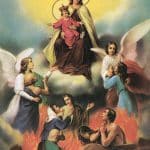
Why should we pray to Virgin Mary? The reasons are many.
Why do Catholics pray to Mother Mary? Is Rosary really powerful?
The intercession of Mother Mary is very powerful as Jesus cannot neglect His mothers commands.This can be proved by the first miracle Jesus did at the wedding at Cana. – (John 2:1-11). Mother Mary told Jesus “They have no more wine.” And what was the final result? He turned water into wine.
In “The Poem of the Man-God” by Maria Valtorta, she says that Jesus told her about this incident as “I did it for Mary”. This proves that the intercession of Mother Mary is very very strong.
Mother Mary was blessed with Holy Spirit abundantly. We can see this as we read “At that time Mary got ready and hurried to a town in the hill country of Judea, where she entered Zechariah’s home and greeted Elizabeth. When Elizabeth heard Mary’s greeting, the baby leaped in her womb, and Elizabeth was filled with the Holy Spirit.” (Luke 1:39-41) ; just by Virgin Mary’s greeting.
Listen to the talk from Apologetics on Mary, Purgatory and The Bible
What the angels thought on this matter:-
When angel appeared before Zechariah,father of John, angel just greets him by his name ,nothing more although he was “upright in the sight of God, observing all the Lord’s commandments and regulations blamelessly.” – (Luke 1:6)
When angel appeared before Joseph, the greeting was like this: “an angel of the Lord appeared to him in a dream and said, “Joseph son of David, do not be afraid to take Mary home as your wife, because what is conceived in her is from the Holy Spirit.” – (Matthew 1:20). Angel greeted him ‘son of david’, thats all.
Now let us see how did the angel greet Virgin Mary. It goes like this: “The angel went to her and said, “Greetings, you who are highly favored! The Lord is with you.” (Luke 1:28). See the difference….
Also read the article Mary, The Mystical Rose


The Scott Hahn Conversion Story
SCOTT HAHN
Here following is the transcript of a talk given by Scott Hahn outlining his journey of faith, a journey that took him from being a fervent Presbyterian minister and Professor of Theology at a major Protestant seminary to become a Roman Catholic Theologian and internationally known apologist for the Catholic Church. Through study and prayer Scott Hahn came to realize that the truth of the Catholic Church is firmly rooted in Scripture.
.
.
It is so good to be with you this morning. It’s always a delightful surprise. I never cease to be amazed at the opportunity I have to share why I became a Roman Catholic and how the Lord worked in my wife’s life and our family as well.
That always reminds me of one of my favorite stories. There was a young man who wanted in the worst way to ask out a beautiful young lady. It took him weeks to get up enough courage, and when he finally asked her out she said, “Yes.” He was shocked and delighted. That Saturday morning arrived, and he got ready in so many ways: showered for a long time, tried to figure out what to wear, then he decided to give her a big surprise. He went down to the drug store. He walked up to the druggist behind the counter and announced, “I would like to buy a one pound box of chocolate, a two pound box and a three pound box.” And the druggist bent down, got them and put them on the counter and said, “Do you mind if I ask you why you are buying three different size boxes?” “No I don’t mind.” And he proceeded to explain. He said, “Tonight’s the night, special date, beautiful young lady, and if before the date is through she lets me hold her hand, she gets the one pound box. And if at the movie when I slyly slip my arm around her and she lets it remain there, she gets the two pound box. And if as we are exchanging goodnights she lets me give her a kiss, she gets the three pound box. The druggist said, “Sly old guy, you have a good time.”
He was off and he was so nervous he showed up at this young lady’s house a half hour early. She came to the door and said, “We’re just sitting down to dinner.” He said, “Can I join you?” “Sure, I guess.” And he sat down. Then he said, “Can I say grace?” And they said, “Sure.” He proceeded to pray for a minute, for three minutes, five minutes. Finally after ten minutes, the man said, “Amen.” He kind of looked around, a little awkward, and they proceeded to eat what was by then a cold and stale dinner. On the way out the door she whispered, “You never told me you were so religious.” He whispered back, “You never told me your dad was the druggist.”
Life is filled with unexpected surprises, and it’s a delight and a surprise for me to share how I came to see the Roman Catholic Church to be the family of God that He wants all of His children to share in. Fulton Sheen once said, and I paraphrase, that there are not 100 people in the United States who hate the Catholic Church, although there might be millions of people who hate what they mistakenly believe the Catholic Church to be and to teach. And thankfully I discovered I fell into the second category. Because for years I opposed the Catholic Church, and I worked hard to get Catholics to leave the Church. But I came to see through a lot of study and considerable prayer that the Roman Catholic Church is based in Scripture.
.
Teenage Conversion To Jesus
That’s what I’d like to share with you this morning. It begins with a conversion experience that I had in high school. I didn’t grow up in a strong Christian family. We didn’t go to church very often, and so I wasn’t very religious. What the Lord used in my life was an organization called Young Life, an outreach to unchurched high school kids, and a man named Jack in particular who befriended me and also shared with me the Gospel of Jesus Christ. It made a profound difference in my life.
Early in my high school years I made a commitment and I asked Jesus Christ into my heart; I asked Him to be my savior and Lord. I gave Him my sins and I received the gift of forgiveness and salvation. It made a world of difference for me. It cost me a lot of my friends, but the Lord in a sense more than made up for that by giving me real friends, friends in Christ.
Jack, who taught me to love the Lord, also taught me to read the Bible and not just to read it but to study it, and not just to study it, but to soak in it — to read it and to re-read it from beginning to end. By the time I was finishing high school, I had gone through the Bible two or three times in its entirety. And I had fallen in love with Sacred Scripture. As a result of that I’d become convinced of a couple things.
First, in addition to reading the Bible, Jack had shared with me from his own personal library the writings of Martin Luther, the writings of John Calvin, and I became a convinced Protestant Christian, not just a bible Christian, but somebody who was convinced that up until the 1500’s the Gospel had almost been lost amidst all the medieval superstition and all the pagan practices that the Catholic Church had adopted. And so this first conviction was to help my Catholic friends to see the simple Gospel of Jesus Christ, to show them the Bible, and to show them that in the Bible, you just accept Jesus Christ as Savior and Lord and that’s all it takes. None of this claptrap: Not Mary, not the saints, not purgatory, not devotions, just asking Jesus to be Savior and Lord.
Around that time I was dating a girl who was Catholic, and we were becoming more serious. But I knew there was no future in our relationship if she remained Catholic. So I gave to her a very large volume, a book by Loraine Boettner entitled Roman Catholicism. It’s known as the bible of Anti-Catholicism. It’s four hundred and fifty plus pages filled with all kinds of distortions and lies about the Catholic Church. But I didn’t know that at the time, so I shared it in good faith with her. She read it from cover to cover. She wrote me that summer and said, “Thanks for the book; I’ll never go back to Mass again.” And I say that with a certain shame and sorrow, but I say that to illustrate the sincerity that many Bible Christians have when it comes to opposing the Catholic Church. I figured that if the wafer they’re worshipping up on that altar is not God, then they’re idolaters, they’re pagans, they are to be pitied and opposed. If the Pope in Rome is not the infallible vicar of Christ who can bind hundreds of millions of Catholics in their beliefs and practices, then he’s a tyrant. He’s a spiritual dictator pure and simple. And because I didn’t think he was the infallible vicar, I thought it was very reasonable for me to help Catholics to see the same thing in order to get them to leave the Church.
The only Catholic in my family on both sides was my beloved grandmother. She was very quiet, very humble, very holy, I have to admit. And she was also a devout Catholic. When she passed away, I was given her religious belongings by my parents. I went through her prayer book and her missal, and then I found her rosary beads. All of this stuff just made me sick inside. I knew my grandmother had a real faith in Jesus, but I wondered what would all of this mean. So I tore apart her rosary beads, and I threw them in this waste can. I thought of these beads almost like chains that at last she was broken free from. That was the second aspect of my own outlook: that these people might have some faith but it was just surrounded by lies, and so they needed loving Bible Christians to get them out.
Well, after graduating from high school, I decided not only to pursue the ministry but to study theology as well. The decision came as a result of the senior research paper that I wrote my final year in high school. I wrote a paper entitled Sola Fide. That’s a Latin phrase which means Faith Alone or By Faith Alone. It’s actually the phrase that Martin Luther used to launch the Protestant Reformation. He said that we are justified, we are made right with God by faith alone, not by any works that we might do. And for him, that was the article on which the church stands or falls, as he put it. And because of that, the Catholic Church fell and the Protestant Church rose. I wrote that research paper fully convinced after much study that, if you get it wrong on this point, you get it wrong on everything else. If you say faith plus anything, you have polluted the simple truth of the Gospel. And so I went into college with this strong conviction.
.
College Years
My four years of college were spent triple majoring in Philosophy, Theology in Scripture and Economics. But they were also spent doing ministry in Young Life. I wanted to in effect repay God out of gratitude for how He had used Young Life in my life to introduce me to Christ. So for those four years I devoted myself to reaching unchurched kids who didn’t know about Christ, and I confess that this category included Catholic kids in the high school where I worked because I looked at these poor benighted souls who really didn’t know Jesus Christ. I discovered after several Bible studies that not only did these kids not know Jesus Christ, but practically every Catholic high school kid I met didn’t even know what the Catholic Church taught. If one or two of them knew what the Church taught, they didn’t know why. They didn’t have any reasons to back up their beliefs as Catholics. So getting them to see from the Bible, the Gospel as I understood it from Martin Luther, from an anti-Catholic perspective, was like picking off ducks in a barrel. They weren’t ready, they were unequipped, they were defenseless.
I don’t know exactly what has happened in the last fifteen, twenty, twenty-five years, but I look back on those kids and wonder if they weren’t guinea pigs in some sort of catechetical experiment, that people thought we could bypass instructing them in the doctrines they need to believe and in the reasons for those doctrines. But there they were. I saw many of them leave the Church and I opposed them in a certain sense out of a sincere good faith, but also I opposed them because I myself was uninformed.
My third year of ministry in Young Life I asked a young lady, the most beautiful girl on campus, if she would join me in working together to reach these unchurched kids. Kimberly said, “Yes.” We worked together for two years and had a blast. Sometimes we’d fight like brother and sister in discussing various ways and means to reach these kids. But we really grew to respect one another so that at the end of these four years of college, I posed the question. And I think the dumbest thing she ever said, but the greatest thing she ever said was “Yes.” We got married right out of college. Both of us had so much of the same vision. We wanted to do ministry together, we wanted to share the good news of Christ, we wanted to open up the Bible and make it come alive for people.
.
Seminary Years
We were off to seminary a week or two after our wedding. What a great experience it was studying theology together for a Master’s Degree. I took a three-year degree at Gordon-Conwell seminary in Boston; she took a two-year degree. Both of us ended up with our Master’s Degrees. After three years I graduated at the top of my class. I say that not out of any pride, but to illustrate how I pursued my studies with a sort of vengeance. People who knew me at seminary, knew me to be rather intense. I would spend just about every waking hour reading and studying Scripture or books about Scripture that would make more sense out of the Bible. If I wasn’t reading and studying, I was out looking around at used book stores finding resources. Kimberly and I had a great three-year experience. But a couple of things happened along the way that I need to relate because in retrospect I see them as landmark experiences.
The first thing was a course that Kimberly took her first year, a class that I had taken the year before entitled Christian Ethics. Dr. Davis had all the students break up into small groups so that each small group could tackle one topic. There was a small group on abortion, a small group on nuclear war, a small group on capital punishment. One dinner she announced that she was in a small group devoted to studying contraception. I remember thinking at the time, “Why contraception?”
The year before when I took the class, nobody signed up for that small group and I told her. She said, “Well, three others have signed up for it and we had our first meeting today. So and so appointed himself to be chair of the committee, and he announced the results of our study even before it began. He said, ‘Well, we all know as Protestants, as Bible Christians, that contraception is fine, I mean so long as we don’t use contraceptives that are abortafacients like the I.U.D. and so on.’ He announced further that really the only people who call themselves Christians who oppose artificial birth control are the Catholics, and he said, ‘The reason they do, of course, is because they are run by a celibate Pope and lead by celibate priests who don’t have to raise the kids but want Catholic parents to raise lots so they can have lots of priests and nuns to draw from, you know.'”
Well, that kind of argumentation did not really impress Kimberly. She said, “Are you sure those are the best arguments they would offer?” And I guess he must have mocked or said, “Well, do you want to look into it yourself?” You don’t say that kind of thing to Kimberly. She said, “Yes,” and she took an interest in researching this on her own. A week went by and Terry stopped me in the halls. He said, “You ought to talk to your wife; she’s unearthed some interesting information about contraception.” Interesting information about contraception? What is interesting about contraception? Well, you know he said, “She’s your wife; you ought to find out.” “Yeah, all right; I will, Terry.”
So that night at dinner I asked her, “What is Terry talking about?” And she said, “I’ve discovered that up until 1930, every single Protestant denomination without exception opposed contraception on Biblical grounds.” Then I said, “Oh come on, maybe it just took us a few centuries to work out the last vestiges of residual Romanism, I don’t know.” And she said, “Well, I’m going to look into it.”
Then another week later, Terry stopped me and said,”Her arguments make sense.” I said, “Arguments against contraception from Scripture?” He said, “You ought to talk to her.” “All right, I’ll talk to her.” You know, given the subject matter, I thought I better.
So I raised the issue and she handed me a book. It was entitled Birth Control and the Marriage Covenant by John Kippley. It just recently was reissued, entitled Sex and the Marriage Covenant. You can get it from Couple to Couple League in Cincinnati. I began to read through the book with great interest because in my own personal study, going through the Bible several times, I had come upon this strong conviction that if you want to know God, you have to understand the covenant, because the covenant was the central idea in all of Scripture. So when I picked up this book I was interested to see the word ‘covenant’ in the title, Birth Control and the Marriage Covenant. I opened it up and I began reading it, and I said, “Wait a second, Kimberly, this guy is a Catholic. You expect me to read a Catholic?” And the thought occurred to me instantly at that moment, What is a Catholic doing putting ‘covenant’ into his book title? Since when do Catholics hijack my favorite concept?
Well, I began to read the book. I went through two or three chapters and he was beginning to make sense, so I promptly threw the book across my desk. I didn’t frankly want him to make any sense. But I picked it up again and read through some more. His arguments made a lot of sense. From the Bible, from the covenant, he showed that the marital act is not just a physical act; it’s a spiritual act that God has designed by which the marital covenant is renewed. And in all covenants you have an opportunity to renew the covenant, and the act of covenant renewal is an act or a moment of grace. When you renew a covenant, God releases grace, and grace is life, grace is power, grace is God’s own love. Kippley shows how in a marital covenant, God has designed the marital act to show the life-giving power of love. That in the marital covenant the two become one, and God has designed it so that when the two become one, they become so one that nine months later you might just have to give it a name. And that child who is conceived, embodies the oneness that God has made the two through the marital act. This is all the way that God has designed the marital covenant. God said, “Let us make man in our image and likeness,” and God, who is three in one, made man, male and female, and said, “Be fruitful and multiply.” The two shall become one and when the two become one, the one they become is a third child, and then they become three in one. It just began to make a lot of sense, and he went through other arguments as well. By the time I finished the book, I was convinced.
It bothered me just a little that the Roman Catholic Church was the only denomination, the only Church tradition on earth that upheld this age-old Christian teaching rooted in Scripture, because in 1930 the Anglican Church broke from this tradition and began to allow contraception, and shortly thereafter every single mainline denomination on earth practically caved in to the mounting pressure of the sexual revolution. By the 1960’s and 70’s, my own denomination, the Presbyterian Church in the United States of America, not only endorsed contraception, but abortion on demand and federal funding for abortion, and that appalled me. And I began to wonder if there wasn’t a connection between giving in a little here and then all of a sudden watching the floodgates open later. I thought “No, no, you know the Catholic Church has been around for 2000 years; they’re bound to get something right.” We have a saying in our family that even a blind hog finds an acorn, and so it was, I thought. That was my second year.
During my third and final year at seminary, something happened that represented a crisis for me. I was studying covenant and I heard of another theologian studying covenant, a man by the name of Professor Shepherd in Philadelphia teaching at Westminster Seminary. I heard about Shepherd because he was being accused of heresy. People were suggesting that his heresy grew out of his understanding of the covenant. So I got some documents that he had written, some articles, and I read through them. I discovered that Professor Shepherd had come across the same conclusions that my research had led me to.
In the Protestant world the idea of covenant is understood practically as synonymous with or interchangeable with contract. When you have a covenant with God, it’s the same as having a contract. You give God your sin; He gives you Christ, and everything is a faith-deal for salvation.
But the more I studied, the more I came to see that for the ancient Hebrews, and in Sacred Scripture, a covenant differs from a contract about as much as marriage differs from prostitution. In a contract you exchange property, whereas in a covenant you exchange persons. In a contract you say, “This is yours and that is mine,” but Scripture shows how in a covenant you say, “I am yours and you are mine.” Even when God makes a covenant with us, He says, “I will be your God and you will be my people.” After studying Hebrew, I discovered that ‘Am, the Hebrew word for people, literally means, kinsman, family. I will be your God and father; you will be my family, my sons and my daughters, my household. So covenants form kinship bonds which makes family with God.
I read Shepherd’s articles, and he was saying much of the same thing: our covenant with God means sonship. I thought, “Well, yeah, this is good.” I wondered what heresy is involved in that. Then somebody told me, “Shepherd is calling into question sola fide.” What! No way. I mean, that is the Gospel. That is the simple truth of Jesus Christ. He died for sins; I believe in him. He saves me, pure and simple; it’s a done deal. Sola fide? He’s questioning that? No way.
I called him on the phone. I said, “I’ve read your stuff on covenant; it makes lots of sense. I’ve come to pretty much the same conclusions. But why is this leading you to call into question Luther’s doctrine of sola fide?” He went on to show in this discussion that Luther’s conception of justification was very restricted and limited. It had lots of truth, but it also missed lots of truths.
When I hung up the phone, I pursued this a little further and I discovered that for Luther and for practically all of Bible Christianity and Protestantism, God is a judge, and the covenant is a courtroom scene whereby all of us are guilty criminals. But since Christ took our punishment, we get his righteousness, and he gets our sins, so we get off scot-free; we’re justified. For Luther, in other words, salvation is a legal exchange, but for Paul in Romans, for Paul in Galatians, salvation is that, but it’s much more than that. It isn’t just a legal exchange because the covenant doesn’t point to a Roman courtroom so much as to a Hebrew family room. God is not just simply a judge; God is a father, and his judgments are fatherly. Christ is not just somebody who represents an innocent victim who takes our rap, our penalty; He is the firstborn among many brethren. He is our oldest brother in the family, and he sees us as runaways, as prodigals, as rebels who are cut off from the life of God’s family. And by the new covenant Christ doesn’t just exchange in a legal sense; Christ gives us His own sonship so that we really become children of God.
When I shared this with my friends, they were like, “Yeah, that’s Paul.” But when I went into the writings of Luther and Calvin, I didn’t find it any longer. They had trained me to study Scripture, but in the process, in a sense, I discovered that there were some very significant gaps in their teaching. So I came to the conclusion that sola fide is wrong. First, because the Bible never says it anywhere. Second, because Luther inserted the word “alone” in his German translation, there in Romans 3, although he knew perfectly well that the word “alone” was not in the Greek. Nowhere did the Holy Spirit ever inspire the writers of Scripture to say we’re saved by faith alone. Paul teaches we’re saved by faith, but in Galatians he says we’re saved by faith working in love. And that’s the way it is in a family isn’t it? A father doesn’t say to his kids, “Hey, kids, since you’re in my family and all the other kids who are your friends aren’t, you don’t have to work, you don’t have to obey, you don’t have to sacrifice because, hey, you’re saved. You’re going to get the inheritance no matter what you do.” That’s not the way it works.
So I changed my mind and I grew very concerned. One of my most brilliant professors, a man named Dr. John Gerstner, had once said that if we’re wrong on sola fide, I’d be on my knees outside the Vatican in Rome tomorrow morning doing penance. Now we laughed, what rhetoric, you know. But he got the point across; this is the article from which all of the other doctrines flow. And if we’re wrong there, we’re going to have some homework to get done to figure out where else we might have gone wrong. I was concerned, but I wasn’t overly concerned. At the time I was planning to go to Scotland to study at Aberdeen University the doctrine of the covenant, because in Scotland, covenant theology was born and developed. And I was eager to go over and study there. So I wasn’t particularly concerned about resolving this issue because, after all, that could be the focus of my doctoral study.
Then all of a sudden we got news that our change in theory about contraception had brought about a change in Kimberly’s anatomy and physiology; she was pregnant. And Margaret Thatcher was not interested in funding American babies being born in her great empire. So we looked at the situation; we realized that we couldn’t afford to go over to Scotland just yet. We’d have to take a year off, but what were we going to do as we were drawing close to graduation? We weren’t sure; we began to pray.
.
Becomes Pastor of a Church in Virginia
The phone rang. A church in Virginia, a well-known church that I had heard a lot of good about called me up and said, “Would you consider coming down to candidate for the pastorate here?” This meant preaching a trial sermon, leading a Bible study, interviewing with the elders who ran the session. I said, “Sure.” I went down, preached a sermon, led a Bible study, met with the session. They said, “That was great; we want you here. In fact we’ll pay you well enough so that you can study at least 20 hours a week in Scripture and theology. We want you to preach, however, at least 45 minutes each Sunday morning to open up for us the Word.” 45 minutes! Can you imagine what a priest would get if he preached for 45 minutes? The next week that sanctuary and the whole Church would be empty. Here they were asking me to preach at least 45 minutes. I said, “If you insist, you know, twist my arm. Sure.” And they said, “We want you to immerse us in the Word of God,” and so I began.
The first thing I did was to tell them about covenant. The second thing I did was to correct their misunderstanding of covenant as contract to show them that covenant means family. The third thing I did was to show them that the family of God makes more sense of who we are and what Christ has done than anything in the Bible. God is Father, God is Son, and God through the Holy Spirit has made us one family with Him. And as soon as I began to preach this and teach this, it just took off like wildfire. It spread through the parish; you could see it affecting marriages and families. It was exciting. The fourth thing I did, was to teach them about liturgy and covenant and family, that in Scripture the covenant is celebrated through liturgical worship whereby God’s family gathers for a meal to celebrate the sacrifice of Christ. I suggested in my preaching and teaching that maybe we ought to have the family meal, communion. I even used the word “Eucharist.” They never heard it before. I said, “Maybe we ought to celebrate being God’s covenant-family by communion each week.” “What?” I said, “Instead of being sermon-centered, why not have the sermon be a prelude and a preparation to enter into celebrating who we are as God’s family?” They loved it.
But one guy came up and said, “Every week? You know familiarity breeds contempt; you sure we should do it every week?” I said, “Well, wait a second. You know, do you say to you wife I love you only four times a year? After all, honey, familiarity breeds contempt. You know I don’t want to kiss you more than four times a year.” He looked and he said, “I get your point.”
As we changed our liturgy, we felt a change in our lived experience as a parish but also in our families as well. It was exciting to see, and as I taught them more about the covenant, they just hungered and thirsted for still more.
Meanwhile, I was also teaching part time at the local Christian high school that met there at the church. I had some of the brightest students I have ever taught, and they also responded with enthusiasm to this covenant idea. I began to teach a course on salvation history, and at first they were scared because it was so confusing, all those names and places that you can’t even pronounce much less make sense out of. So I showed them, “Hey, once you think of covenant as family, it’s really quite simple.” I took my students through the series of covenants in the Old Testament which led up to Christ. First, you have the covenant God makes with Adam; that’s a marriage, a family bond. The second covenant is the one that God makes with Noah. That’s a family, a household with Noah, his wife, his three sons, and their three wives; together they formed a family of God, a household of faith. Then in Abraham’s time you actually have God’s family growing to the extent where it becomes a tribal family. Then the next covenant God makes with Moses and Israel has twelve tribes that become one nation, but through the covenant they become God’s national family. Until finally when Christ establishes the new covenant. Instead of having God’s family identified with one nation, the distinctive greatness of the New Covenant, I taught them, was that now we have an international family, a world wide family — a catholic family.
One of my students raised her hand and said, “What would this look like if we could actually redevelop it?” I drew a pyramid on the board and I said, “Think of it like a big extended family with father and mother figures at all these different levels, and all of us being brothers and sisters in Christ. I heard somebody murmur in the back, “Sure looks like the Catholic Church to me.” I said, “No, no, no! What I’m giving you is the solution to the problems, the antidote to the poison.” Well, Rebecca came up one day at lunch time. I was eating lunch and she said, “We took a little vote in the back of the class; it’s unanimous; we all think you’re going to become a Roman Catholic.” I choked on my sandwich, “Quiet, quiet. I don’t want to lose my job, but Rebecca, I assure you that what I’m giving you is not Catholicism; it’s the antidote to the poison of Catholicism.” She just stood there looking at me, “No, it’s unanimous, you’re going to become a Catholic.” And she turned around and walked away.
Well, I was stunned by that. I went home that afternoon, walked into the kitchen, saw Kimberly over by the refrigerator and I said, “You’ll never guess what Rebecca said today.” “Tell me what, another Rebecca story?” I said. “Well, she came up at lunch time and announced that they had taken a vote in the back of the class, and it was unanimous that I’m going to become a Roman Catholic. Can you imagine that, me becoming a Catholic?” And she wasn’t laughing one bit. She just stood there staring at me, she said, “Well, are you?” It was as though somebody plunged a dagger into my back. You know, “Et tu, Brute, Kimberly? Not you, too.” I said, “You know I’m a Calvinist, a Calvinist of Calvinists, a Presbyterian, an anti-Catholic. I’ve given away dozens of copies of Boettner’s book; I’ve gotten Catholics to leave. I was weaned on Martin Luther.” She just stood there and she said, “Yeah, but sometimes I wonder if you’re not Luther in reverse.” Whoa, wait a minute here! I had nothing to say.
I just slowly walked back in my study, shut the door, locked it, sank into my seat and really began to brood. I was scared. Luther in reverse. For me at one point that meant salvation in reverse. I was scared. Maybe I’m studying too much and praying too little, so I began to pray much more. I began to read more anti-Catholic books, but they just didn’t make sense anymore. So I began to turn to Catholic sources and read them.
.
Teacher at a Presbyterian Seminary
Meanwhile something dramatic occurred. I was approached by a seminary, a Presbyterian seminary, and asked if I would teach courses to the seminarians beginning with one Gospel of John seminar. I said, “Sure.” So I began to share from the Gospel of John all about the covenant, about the family of God, about what it really means to be born again. I discovered in my study that being born again does not mean accepting Jesus Christ as personal Savior and Lord and asking Him into your heart — although that is important and every believer, Catholic or otherwise, should have Jesus Christ as Savior and Lord and a living personal relationship with Him. But I discovered what Jesus meant in John 3 when He said that you’ve got to be born again. He turns around and says that you’ve got to be born of water and spirit. In the previous chapters He was just baptized with water and the Spirit descended upon Him. And as soon as He is done talking to Nicodemus about the need to be born from water and Spirit, the very next verse says that Jesus and the disciples went about baptizing. I taught that being born again is a covenant act, a sacrament, a covenant renewal involving baptism. I shared this with my seminary students; they were convinced.
Meanwhile I was preparing my sermons and some lectures ahead of John chapter 3. I was delving into John chapter 6. I don’t know how many of you’ve ever studied the Gospel of John. In many ways it’s the richest Gospel of all. But John chapter 6 is my favorite chapter in the fourth Gospel. There I discovered something that I think I read before, but I never noticed. Listen to it. “Jesus said to them, ‘Truly, truly I say to you, unless you eat the flesh of the son of man and drink His blood you have no life in you. He who eats my flesh and drinks my blood has eternal life and I will raise him up at the last day, for my flesh is food indeed and my blood is drink indeed. He who eats my flesh and drinks my blood abides in me and I in him.'” I read that; I reread that; I looked at it from ten different angles. I bought all these books about it, commentaries on John. I couldn’t understand how to make sense out of it.
I had been trained to interpret that in a figurative sense; Jesus is using a symbol. Flesh and blood really is just a symbol of His body and blood. But the more I studied, the more I realized that that interpretation makes no sense at all. Why? Because as soon as all the Jews hear what Jesus says, they depart. Up until this point, thousands were following him, and then all of a sudden the multitudes just simply are shocked that He says, “My flesh is food indeed, my blood is drink indeed” and they all depart. Thousands of disciples leave Him. If Jesus had intended that language to only be figurative, He would have been morally obligated as a teacher to say, “Stop, I only mean it figuratively.” But He doesn’t do that; instead, what does he do?
My research showed me that he turns to the twelve, and he says to them, what? “We better hire a public relations (P.R.) agent; I really blew it guys.” No! He says, “Are you going to leave me too?” He doesn’t say, “Do you understand I only meant it as a symbol?” No! He says that the truth is what sets us free, I have taught the truth. What are you going to do about it?
Peter stands up and speaks out; he says, “To whom shall we go? You alone have the words of eternal life and we’ve come to believe.” Peter’s statement, “To whom shall we go?” implies that, “You know, Jesus, we don’t understand what you mean either, but do you have another Rabbi on the scene you can recommend? You know, to whom shall we go? It’s too late for us; we believe whatever you say even if we don’t understand it fully, and if you say we have to eat your flesh and drink your blood, then somehow you’ll give us the grace we need to accept your words at face value.” He didn’t mean it figuratively.
As I began to study this, I began to realized it’s one thing to convince Presbyterians that being born again means being baptized, but how in the world could I possibly convince them that we actually have to eat His flesh and drink His blood? I focused then a little bit more on the Lord’s supper and communion. I discovered that Jesus had never used the word “covenant” in His public ministry. He saved the one time for when He instituted the Eucharist and he said, “This cup is the blood of the new covenant.” If covenant means family, what is it that makes us family? Sharing flesh and blood. So if Christ forms a new covenant, that is a new family, what is He going to have to provide us with? New flesh and new blood. I began to see why in the early Church for over 700 years, nobody any place disputed the meaning of Jesus’ words. All of the early Church fathers without exception took Jesus’ words at face value and believed and taught the real presence of Christ in the Eucharist. I was scared; I didn’t know who to turn to.
Then all of a sudden an episode occurred one night in a seminar I wasn’t ready for. An ex-Catholic graduate student named John raised his hand. He had just finished a presentation for the seminar on the Council of Trent. The Council of Trent, you’ll recall, was the Church’s official response to Martin Luther and the Reformation.
In about an hour and a half he had presented the Council of Trent in the most favorable light. He had shown how many of their arguments were in fact based on the Bible. Then he turned the tables on me. The students were supposed to ask him a question or two. He said, “Can I first ask you a question, Professor Hahn? You know how Luther really had two slogans, not just sola fide, but the second slogan he used to revolt against Rome was sola Scriptura, the Bible alone. My question is, ‘Where does the Bible teach that?'”
I looked at him with a blank stare. I could feel sweat coming to my forehead. I used to take pride in asking my professors the most stumping questions, but I never heard this one before. And so I heard myself say words that I had sworn I’d never speak; I said, “John, what a dumb question.” He was not intimidated. He look at me and said, “Give me a dumb answer.” I said, “All right, I’ll try.” I just began to wing it. I said, “Well, Timothy 3:16 is the key: ‘All Scripture is inspired of God and profitable for correction, for training and righteousness, for reproof that the man of God may be completely equipped for every good work….'” He said, “Wait a second, that only says that Scripture is inspired and profitable; it doesn’t say ONLY Scripture is inspired or even better, only Scripture’s profitable for those things. We need other things like prayer,” and then he said, “What about 2 Thessalonians 2:15?” I said, “What’s that again?” He said, “Well, there Paul tells the Thessalonians that they have to hold fast, they have to cling to the traditions that Paul has taught them either in writing or by word of mouth.” Whoa! I wasn’t ready. I said, “Well, let’s move on with the questions and answers; I’ll deal with this next week. Let’s go on.”
I don’t think they realized the panic I was in. When I drove home that night, I was just staring up to the heavens asking God, why have I never heard that question? Why have I never found an answer? The next day I began calling up theologians around the country, former professors. I’d ask them, “Where does the Bible teach sola Scriptura? Where does the Bible teach us that the Bible is our only authority?” One man actually said to me, “What a dumb question coming from you.” I said, “Give me a dumb answer then.” I was catching on. One professor whom I greatly respect, an Oxford theologian, said to me, “Scott, you don’t expect to find the Bible proving sola Scriptura because it isn’t something the Bible demonstrates. It is our assumption; it is our presupposition when we approach the Bible.” That struck me as odd; I said, “But professor, that seems strange because what we are saying then is that we should only believe what the Bible teaches, but the Bible doesn’t teach us to only believe what the Bible teaches. Our assumption isn’t taught by the Bible.” I said, “That feels like we’re cutting off the branch that we’re sitting on.” Then he said, “Well what other options do we have?” Good point, all right.
Another friend, a theologian, called me and said, “Scott, what is this I’m hearing that you’re considering the Catholic faith?” “Well, no, Art, I’m not really considering the Catholic faith.” Then I decided to pose him a question. I said, “Art, what for you is the pillar and foundation of truth?” And he said, “Scott, for all of us Scripture is the pillar and foundation of truth.” I said, “Then why, Art, does the Bible say in 1 Timothy 3:15 that the pillar and foundation of truth is the church, the household of faith?” There was a silence and he said, “Well, Scott, I think you’re setting me up with that question then.” And I said, “Art, I feel like I’m being set up with lots of problems.” He said, “Well, which church, Scott? There are lots of them.” I said, “Art, how many churches are even applying for the job of being the pillar and foundation of truth? I mean, if you talk about a church saying, ‘We’re the pillar and foundation of truth; look to us and you will hear Christ speak and teach’? How many applicants for the job are there? I only know of one. I only know that the Roman Catholic Church teaches that it was founded by Christ; it’s been around for 2000 years and it’s making some outlandish claims that seem awfully similar to 1 Timothy 3:15.”
Well, at this point I wasn’t sure what to do. I got a phone call, though, one day from the chairman of the board of trustees at the seminar where I was teaching. Steve asked me out for lunch. I wasn’t sure why. I thought, “Word has reached the chairman of the board that I’m teaching things that are perhaps somewhat Catholic.” When I joined him for lunch, I was very scared and unsure. He proceeded to announce that the trustees had reached a unanimous decision. Because my classes were going so well, because so many people were signing up for my courses, they asked if I would consider becoming dean of the seminary at the ripe old age of 26. I couldn’t believe it. He said, “We will let you teach the courses you want. We will let you hire faculty if you need them. We’ll even pay for your doctoral program in theology.” I said, “Where is there a doctoral program in theology nearby?” He said, “Catholic University.” I thought, No, no, no. I don’t want to study there; I’m fleeing that perspective at present.” I really didn’t say that to him because I didn’t know what to say. In fact, he said, “Well, would you pray about it?” I said, “I will, but, Steve, I think I already know the answer. And oddly enough, I think I’m going to have to say no and I’m not going to be able to explain why because I’m not sure myself.”
When I got home, Kimberly was waiting for me. She said, “What did he want?” I said, “He asked me to become dean.” “You’re kidding!” I said, “No.” “What did you say?” I said, “No.” “I’m sorry, what did you say?” I said, “No.” “Why did you say no?” I said, “Kimberly, because right now I’m not sure what I would teach. Right now I’m not sure what Scripture is teaching, and I know that someday I’m going to stand before Jesus Christ for judgment and it is not going to be enough for me simply to say, ‘Well, Jesus, I just taught what I had been taught by my teachers.’ He has shown me things from Scripture that are true and I have got to be faithful to what He has shown me.” She walked right over to me, threw her arms around me and gave me a big hug. Then she said, “Scott, that’s what I love about you, that’s why I married you, but, oh, we’re going to have to pray then.” She knew what it meant: It meant not only turning down this offer; it also meant resigning from a booming job as pastor of a growing church. I loved both opportunities.
.
Administrative Assistant to the College President
We didn’t know what we were going to do. We were high and dry in July. After a lot of prayer, we decided we ought to move back to the college town where we met. When we moved back, I applied for a job at various places, but the college hired me as an administrator to be assistant to the president. For two years I worked there, and it was rather ideal because I worked during the day and it left me free in the evenings to pursue in-depth research. From around eight in the evening after putting our children down until around one or two in the morning, I would read and study and research.
In two years time I had worked through several hundred books, and I began for the first time to read Catholic theologians and Scripture scholars. And I was shocked at how impressive their insights were but even more, at how impressive their insights were which agreed with my own personal discoveries. I couldn’t believe how many novel, innovative discoveries that I had come up with they were assuming and taking for granted, and it bothered me.
At times I’d come out and read sections to Kimberly and say, “Hear this, name the author.” Because she was a theologian in a sense, and she was so busy with raising children that she really didn’t have as much energy. But she would sit there listening in, and I would say, “Who do you think that was?” She said, “Wow! That sounds like one of your sermons down in Virginia. Oh, I miss those so much.” I said, “That was Vatican II, Gaudium et Spes. That was the Catholic Church.” She said, “Scott, I don’t want to hear that.” I said, “Kimberly, this stuff about liturgy is so exciting. I’m not certain, but I think God might be calling us to become Episcopalians.” It’s a halfway house. She looked at me and her eyes filled up with tears and she said, “Episcopalian!” She said, “I’m a Presbyterian, my father’s a Presbyterian minister, my uncle’s a Presbyterian minister, my husband was a Presbyterian minister, my brother wants to be one, and I thought about it myself. I don’t want to be Episcopalian.” She felt so abandoned at this moment, so betrayed.
I remember that because a few months later after reading a lot more, one night I came out and said, “Kimberly, I’m not sure, but I’m beginning to think that God might be calling me to become a Roman Catholic.” This look of desperation came over her. She said, “Couldn’t we become Episcopalians? Anything but Catholic.” You don’t know what it’s like, you cradle-Catholics. You just don’t know the terror that comes over you when you think you might have to swim the Tiber, you might have to “Pope”, as my friends put it. Well, she was getting so desperate. She began to pray for somebody to rescue her husband — some professor, some theologian, some friend.
.
Direct Journey to Catholicism
Finally it happened. I got a call one day from Gerry, my best friend from seminary. A Phi Beta Kappa scholar in classics and New Testament Greek. He was the only other student at seminary along with me who held to the old Protestant belief that the Pope was the anti-Christ. We stood shoulder to shoulder opposing all the compromises we saw in our Protestant brethren. He talked to me one night on the phone. I read to him a passage from a book by Father Bouyer. He said, “Wow, that is rich and profound. Who wrote it?” I said, “Louis Bouyer.” “Bouyer? I’d never heard of him, what is he?” “I said, “What do you mean?” “Well, is he a Methodist?” I said, “No.” “Is he a Baptist?” “No.” “I mean is he Lutheran? What is this, twenty questions? What is he?” I said, “Well, he’s a Cath – – – .” “I’m sorry I missed that.” I said, “He’s Roman Cath – – – .” “Wait a second, there must be a bad connection, Scott. I thought you said he’s Catholic.” I said, “Gerry, I did say he’s Catholic and he is Catholic, and I’ve been reading lots of Catholics.”
All of a sudden it started gushing out like Niagara Falls. I said, “I’ve been reading Danielou, and Ratzinger and de Lubac and Garrigou-Lagrange and Congar, and all these guys and man is it rich; you’ve got to read them, too.” He said, “Slow down.” He said, “Scott, your soul may be in peril.” I said, “Gerry, can I give you a list of titles?” He said, “Sure, I’ll read them, anything to save you from this kind of trap. And I’ll give you these titles.” He mentioned to me about ten titles of anti- Catholic books. I said, “Gerry, I’ve read every single one of them, at least one or two times.” He said, “Send me the list,” and I sent it to him.
About a month later, we arranged to have a long phone conversation. Kimberly couldn’t have been more excited; at last a Phi Beta Kappa knight in shining armor coming to rescue her husband from the clutches of Romanism. So she was waiting with bated breath when the conversation was done, and I told her that Gerry’s excited because he’s reading all this stuff and he’s really taking me seriously. She said, “Oh, great, I knew he would.”
Well, this went on for three or four months. We would talk on the phone, two, three, sometimes four hours long distance discussing theology and Scripture until three or four in the morning. Kimberly was so glad and grateful for him taking me so seriously.
One night I came to bed around two or three; she was still up. The light was out, but she sat up in bed and said, “How’s it going?” I said, “It’s great.” “Tell me about it.” I said, “Gerry is almost intoxicated and excited about all the truth from Scripture that the Catholic Church puts forth.” “WHAT!” I couldn’t see her face, but I could almost feel it sink as she just slumped back down into bed, put her face into her pillow and began to sob. I couldn’t even put my arm around her; she was just so wounded and abandoned.
A little while later Gerry called and said, “Listen, I’m a little scared. My friends are a little scared. We ought to really take this seriously. I talked to Doctor John Gerstner, this Harvard-trained Presbyterian, anti-Catholic theologian . He will meet with us as long as we want.” We arranged Gerry, Dr. Gerstner and me for a six hour session, going through the Old Testament in Hebrew, the New Testament in Greek, and the council documents of Church history. At the end of six hours, Gerry and I expected to be completely blown out of the water by this genius. Instead, what we discovered was that the Catholic Church almost doesn’t even need a defense. It’s more like a lion; just let it out of its cage and it takes care of itself. We just presented the Church’s teachings and showed the text in Scripture, and we didn’t feel like he had answered a single one of our questions or objections. In the end we were like, “Wow, what does this mean?” Neither of us knew. The most anti-Catholic seminarians wondering whether God might be a Catholic — we were terrified.
Meanwhile, I sent an application off to Marquette University because I had heard they had a few really outstanding theologians who were based on the covenant who were studying the Church and doing lots of good things. Right before I heard back from them that I was accepted, and I got a scholarship, I began to visit a few priests in the area. I was scared. I’d do it at night so nobody would see me. I almost felt dirty and defiled stepping into the rectory. I’d sit down and finally get some questions out and, to a man, each priest would say to me, “Let’s talk about something else besides theology.” None of them wanted to discuss my questions. One of them actually said, “Are you thinking of converting? No, you don’t want to do that. Ever since Vatican II we discourage that. The best thing you can do for the Church is just be a good Presbyterian minister.” I said, “Wait a second, Father…” “No, just call me Mike.” I said, “OK, Mike. I’m not asking you to break my arm and force me in. I think God is calling me.” He said, “Well, if you want help from me, you’ve come to the wrong man.”
After three or four or five encounters like this, I was confused. I shared it with Kimberly. She said, “You’ve got to go to a Catholic school where you can study full time, where you can hear it from the horse’s mouth, where you can make sure that the Catholic Church you believe in still exists.” She had a good point. So after a lot of prayer and preparation, we moved to Milwaukee where I studied for two years full-time in their doctoral program.
Those two years were the richest years of study I ever experienced and the richest time of prayer as well. I found myself in some seminars, though, where I was actually the lone Protestant defending the Church’s teaching against the attacks coming from Catholics. It was weird. John Paul’s teaching, for instance, which is so Scriptural and so “covenantal,” I was explaining to these people. But there were a few good theologians who made so much sense out of it all. I really enjoyed the time. But something happened along the way, actually two things.
First, I began to pray a rosary. I was very scared to do this. I asked the Lord not to be offended as I tried. I proceeded to pray, and as I prayed I felt more in my heart what I came to know in my mind: I am a child of God. I don’t just have God as my Father and Christ as my brother; I have His Mother for my own.
A friend of mine who had heard I was thinking about the Catholic Church called up one day and said: “Do you worship Mary like those Catholics do?” I said, “They don’t worship Mary; they honor Mary.” “Well, what’s the difference?” I said, “Let me explain. When Christ accepted the call from His Father to become a man, He accepted the responsibility to obey the law, the moral law which is summarized in the Ten Commandments. There’s a commandment which reads, ‘Honor your father and mother.'” I said, “Chris, in the original Hebrew, that word “honor,” kaboda, that Hebrew word means to glorify, to bestow whatever glory and honor you have upon your father and mother. Christ fulfilled that law more perfectly than any human by bestowing His glory upon His heavenly Father and by taking His own divine glory and honoring His Mother with it. All we do in the rosary, Chris, is to imitate Christ who honors His Mother with His own glory. We honor her with Christ’s glory.”
The second thing that happened was when I quietly slipped into the basement chapel down at Marquette, Gesu. They were having a noon Mass and I had never gone to Mass before. I slipped in. I sat down in the back pew. I didn’t kneel. I didn’t genuflect, I wouldn’t stand. I was an observer; I was there to watch. But I was surprised when 40, 50, 60, 80, or 100 ordinary folk just walked in off the street for midday Mass, ordinary folk who just came in, genuflected, knelt and prayed. Then a bell rang and they all stood up and Mass began. I had never seen it before.
The Liturgy of the Word was so rich, not only the Scripture readings. They read more Scripture, I thought, in a weekday Mass than we read in a Sunday service. But their prayers were soaked with Biblical language and phrases from Isaiah and Ezekiel. I sat there saying, “Man, stop the show, let me explain your prayers. That’s Zechariah; that’s Ezekiel. Wow! It’s like the Bible coming to life and dancing out on the center stage and saying, “This is where I belong.”
Then the Liturgy of the Eucharist began. I watched and listened as the priest pronounced the words of consecration and elevated the host. And I confess, the last drop of doubt drained away at that moment. I looked and said, “My Lord and my God.” As the people began going forward to receive communion, I literally began to drool, “Lord, I want you. I want communion more fully with you. You’ve come into my heart. You’re my personal Savior and Lord, but now I think You want to come onto my tongue and into my stomach, and into my body as well as my soul until this communion is complete.”
And as soon as it began, it was over. People stuck around for a minute or two for thanksgiving and then left. And eventually, I just walked out and wondered, what have I done? But the next day I was back, and the next, and the next. I couldn’t tell a soul. I couldn’t tell my wife. But in two or three weeks I was hooked. I was head over heels in love with Christ and His Real Presence in the Blessed Sacrament. It became the source and the summit and the climax of each day, and I still couldn’t tell anybody.
Then one day Gerry called me on the phone. He’d been reading hundreds of books himself. He called to announce, “Leslie and I have decided that we’re going to become Catholics this Easter, 1986.” I said, “Now wait a second, Gerry. You were supposed to stop me from joining; now you think you’re going to beat me to the table? This isn’t fair.” He said, “Listen, Scott, I don’t know what objections or questions you’ve got left, but all of ours are answered.” I said, “So are mine.” He said, “Well, look, I’m not going to pry.”
When I hung up the phone, it occurred to me that delaying obedience for me was becoming almost like disobedience. God had made it so clear in Scripture on Mary, on the Pope, even on Purgatory from 1 Corinthians 3:15 and following, on the saints as God’s family, as my brothers and sisters in Christ. I was explaining to friends of mine how the Family of God is the master idea which makes sense out of all the Catholic faith. Mary’s our mother, the Pope is a spiritual father, the saints are like brothers and sisters, the Eucharist is a family meal, the feast days are like anniversaries and birthdays. We are God’s family. I’m not an orphan; I’ve got a home. I’m just not there yet. I began to ask the Lord, “What do you want me to do? Gerry’s going to join. What do you want me to do?” And the Lord just turned the tables and said, “What do you want to do?” I said, “That’s easy. I want to come home. I want to receive our Lord in the Holy Eucharist.” And I just had this sense that the Lord was saying to me, “I’m not stopping you.” So I thought, I’d better talk to the one person who wanted to.
So I went downstairs and I said, “Kimberly, you’ll never guess what Gerry and Leslie are planning to do.” “What?” She had already given up hope at this point. “They’re going to become Catholics this Easter, 1986.” She looked at me and with insight — she knows me so well and she still loves me — she said, “So what? What difference does that make? You gave me your personal promise that you wouldn’t join until 1990 at the earliest.” I said, “Yeah, you remind of that; that’s right, I did. But I could be dispensed from that if you felt…” “No, no, don’t….” “Would you pray about it?” “Don’t spiritualize away your promises, Scott.” I said, “But Kimberly, you don’t want to hear this, you don’t want to read this, you don’t want to discuss it. But for me to delay obedience to something that God has made so clear, it becomes disobedience.” I knew Kimberly loved me enough to never allow me or pressure me to disobey my Lord and Savior. She said, “I’ll pray about it, but I have to tell you, I feel betrayed. I feel abandoned. I have never felt so alone in my life. All my dreams are dying because of this.” But she prayed, and God bless her, she came back and she said, “This is the most painful thing in my life, in our marriage, but I think it’s what God wants me to do.”
That Easter vigil of 1986, she actually accompanied me to the vigil Mass where I received my — what I like to call my — sacramental grand slam: conditional baptism, first confession, Confirmation and then, God be raised, Holy Communion. When I came back I felt her crying, and I put my arm around her and we began to pray. The Lord said to me, “Look, I’m not asking you to become a Catholic in spite of your love for Kimberly, because I love her more than you do. I’m asking you to become a Catholic because of your love. Because you don’t have the strength to love her as much as I want you to love her, I’ll give you what you lack in Holy Communion.” I thought, “Well, try to explain that to her.” And I had this sense of peace slowly come when He said, “I will in due time; you just back off. You’re not the Holy Spirit; you can’t change her heart.” The next few days and the next few weeks and months she still wasn’t interested. It was hard.
I ended up taking a job down in Joliet teaching for a few years at a college there. Right before we moved something happened which the Lord did. We had a third baby, Hannah. When Hannah was conceived, I was really scared. Scared for lots of reasons but never so scared as I was one Sunday morning when Kimberly was only four months pregnant. We were standing in her church singing the last stanza of the last hymn, and she turned to me. She was white as a ghost and she said, “I don’t feel good, I’m hemorrhaging.” She sat down and laid in the pew while everybody just began to leave the sanctuary. I panicked. I didn’t know what to do; she was white as a ghost. I ran to a pay phone. I called up our O.B. I said, “Where is he?” “Well, we don’t know where Dr. Marmion is. It’s the weekend and he might be out of town.” “Could you page him?” “We’ll page him and he’ll call back if he’s around.” I hung up. I was in a panic. I began to pray to St. Gerard, to everybody. I just asked the Lord Jesus Christ to help us. Ten seconds, maybe fifteen went by and the phone rang. I picked it up and said, “Hello.” “Scott?” “Yes.” “Dr. Marmion here.” I said, “Pat, where are you?” He said, “Where are you?” I said, “I’m outside the city in this particular borough.” “Where?” “At this church.” “Where in the church are you?” “I’m right outside the sanctuary by the pay phone.” He said, “This is unbelievable. I just happen to be visiting that church this morning. I’m calling from the basement. I’ll be right up.” He ran up the stairs in four or five, maybe eight seconds. He said, “Where is she?” I said, “There she is.” He ran over and began administering help to her. She got in the car. We sped off to (thankfully) St. Joseph hospital and Kimberly’s life was spared, the baby’s life was spared, and eventually Hannah was born.
I just had this sense that the Lord was so much closer to us and to our marriage which seemed more broken down than I realized. I began to pray, “What are we going to do with a new baby?” Kimberly approached me right before Hannah was born, and she said, “I’m not sure exactly why, but the Lord has impressed upon me that Hannah is to be a child of reconciliation. I’m not sure what it means.” We hugged and we began to pray about it.
After Hannah was born, Kimberly approached me. She said, “I’m not sure why, but I I think the Lord wants me to have Hannah baptized in the Catholic Church.” I said, “What!” She said, “I’m not sure but yes.” We went through this baptism liturgy together. Monsignor Bruskewitz, the priest who brought me in, is just the noblest prince of a godly man. He’s now Bishop of Lincoln and he did this private liturgy so well, so filled with tradition and Scripture, that half way through it when he said, “Alleluia, alleluia,” in one of the liturgical prayers, Kimberly almost jumped out of her socks. She said, “Alleluia! Oh, I’m sorry.” He said , “No, I wish Catholics would do that; this is good.”
As a result of this liturgical celebration of baptism, she photocopied the baptismal liturgy and sent it to her family and friends. But she still wasn’t ready to go into these debates. She began to read and to pray. I just tried to back off more and more.
.
Trip to the Vatican in Rome
I want to insert one thing. My father passed away just last December (1990), the man who taught me to love calling God “Father”. In January my father-in-law invited me to join him and a very small group of people who are battling hard core pornography which is spilling into Eastern Europe over to the Vatican for a colloquium and a private audience with Pope John Paul II. My father-in-law, the Presbyterian minister, inviting me to meet the Pope? I said, “Yes.” So last January I not only met with the Pope in this small group, but I also was invited to join him in his private chapel for Friday morning Mass at 7:00 a.m. I was just a few feet away from him and I felt him praying. You could hear him praying with his head in his hands, carrying the weight of the Church with all of its burdens in his heart.
As he celebrated the Mysteries of the Holy Mass, I made a resolution, actually two of them: to enter more deeply each day into the Mass and into this ministry that he has to pray for him. But the second resolution was to share with my brothers and sisters in Christ about our Holy Father, and how Christ has graced us with an incredible family, with the Blessed Virgin Mary to be our own spiritual Mother, with Pope John Paul II to be a guide and a spiritual father-figure to lead all of us in worshipping our heavenly Father, with saints as brothers and sisters, to know ourselves as God’s family, but most of all, with the Holy Eucharist to know ourselves around the table as a household of God, His own children. What privileges we have; what graces He’s given!
THE DESIRE OF SCOTT HAHN
Understanding neither what they say, nor whereof they affirm
By Randall Paquette
They went out from us
In the long and weary history of the Church, one testimony remains unaltered: The Lordknoweth them that are His. And should the roll of the “faithful” increase or diminish; should her fortunes ebb or flow; should the warm tracery of sunlight caress her face, or the cold darkness of night press her sore, He hath said, I will never leave thee, nor forsake thee. All great and noble causes; and good and righteous men, have endured traitors, betrayers, and Judases. Despair and trepidation are for them who are devoid of all hope, and not for those whose help is the Lord.
There appears some panic, amongst certain Christians that some notable ones have run to Rome, and with mouths speaking great things, defend her institutions, justify her liturgy, and laud her power. But what of it? Is our cause lost? Shall some now fail to be saved who might have been otherwise? I fear not that the truth shall loose, nor do I fear the truth being lost. In short, I see Christ victorious, and Babylon the Great, cast down. And I see Jesus, with nary a jewel absent from His crown.
Also of your own selves shall men arise
Life is filled with unexpected surprises, and it’s a delight and surprise for me to share how I came to see the Roman Catholic Church to be the family of God that He wants all of his children to share in. Fulton Sheen once said, and I paraphrase, that there are not 100 people in the United States who hate the Catholic Church, although there might be millions of people who hate what they mistakenly believe the Catholic Church to be and teach. And thankfully I discovered I fell into the second category. Because for years I opposed the Catholic Church, and I worked hard to get Catholics to leave the Church. But I came to see through a lot of study and considerable prayer that the Roman Catholic Church is based in Scriptures.
Scott Hahn, is one amongst several who have turned apologist for Rome, but this Catholic convert and tergiversatory, titular “theologian,” does not shed new light upon scripture, nor favorable light upon Rome. He seeks to secure the same fetters upon others that he gleefully fastened to himself. He pledges to indemnify them in their anti-biblical religion by attempting to clad the magisterium with scant verses, or by leading adherents and proselytes down twisted passages. What will be the result of his effort and evil? He will make them twofold more the child of hell.
In a brief article at his website, Hahn commends and recommends, the Catholic document: “The Interpretation of the Bible in the Church.” This prolix paper is typical of Papal endeavors, where verbiage supplants value. The authors, in theory at least, concede these points:
It is not a matter of projecting novel opinions or ideologies upon biblical writings but of sincerely seeking to discover what the text has to say at the present time. The text of the Bible has authority over the Christian church at all times, and, although centuries have passed since the time of its composition, the text retains its role of privileged guide not open to manipulation.
But, in the real world of the Vatican, theory is invalidated by fact, and truth annulled by falsehood. The fact is, that Rome’s magisterium is rife with “novel opinions” and “ideologies” which she projects upon, and beyond, “biblical writings,” notwithstanding her declaration that “[t]he magisterium of the church ‘is not above the word of God.'” Her apologist and teachers successively and continually engage in “manipulation of the text.” Her teaching, liturgy, vestures, offices, and history, perpetuate their pagan origins, and it is duplicitous for her is to laud the bible as her “privileged guide.”
They shall run to and fro
Should it not cause great wonder that after 1700 years of existence, according to Hahn, the papacy is still calling for the development of “a biblical theology of the covenant.” Why does not Rome’s “sweet Christ on earth, ” shed some empyreal light upon this dilemma, ex cathedra? Surely a ‘Holy See’ that claims the authority and power to trumpet the ‘Immaculate Conception,’ and ‘The Assumption,’ as theological facts, sans any scriptural support, can proclaim, just as authoritatively, ‘a biblical theology of the covenant?’ Hahn does not recognize the intrinsic illogic of his master’s call. In spite of the great span of her existence, and the vaunted roll of her ‘doctors’ and ‘scholars,’ and the voluminous writings, encyclicals, and bulls of her ‘fathers’, and the exalted claims of her Pontifex Maximus, Rome still finds herself bereft of “biblical theology.”
With Rome’s credentials of primacy and supremacy, so evidently debatable, it is staggering that Hahn cleaves blindly to her avouched infallibility whilst further confessing her obvious fallibility:
Thus, when the Vatican’s Sacred Congregation for Catholic Education published guidelines, On the Theological Formation of Future Priests, this is what it concluded: “After the introductory questions have been handled, the teaching of Sacred Scripture must culminate in a biblical theology which gives a unified vision of the Christian mystery.”
Unfortunately, many seminarians and priest express concern and regret that in their training there was barely enough time to get through the introductory questions and critical issues – so they never got the big picture, the unified vision of biblical theology.
They also admit that this has greatly weakened their ability to preach and explain God’s Word.
In acknowledgement of the “authority” that the Bible “has over the church at all times,” it must be asked: Which “questions and critical issues” superceded the Bible, and biblical theology, in the training of Rome’s priests? Or, to satisfy the semasiology of Rome, I will phrase it thus, lest pedants take umbrage: What is more important than a biblical theology which gives a unified vision of the Christian mystery, since apparently, this is so important to preaching and explaining God’s word? The Baltimore Catechism confidently asserts:
We can know the true meaning of the Bible from the teaching authority of the Catholic Church, which has received from Jesus Christ the right and the duty to teach and to explain all that God has revealed.
Has Rome not therefore failed in that “duty”? As a result of the deficient training which they received, her priests confess that they possess insufficient ability to “preach and explain God’s Word.” At best they will be teaching from a position of weakness, perhaps error, make that – additional error, might creep in. Should the laity not charge the hierarchy with malfeasance, or at the least, dereliction of that duty? Inside the cover of the Baltimore Catechism is printed this extravagant promise:
The faithful who devote twenty minutes to a half hour to teaching or studying Christian Doctrine, may gain:
An indulgence of 3 years. A plenary indulgence on the usual conditions twice a month, if the above practice is carried out at least twice a month.
– Apostolic Brief March 12, 1930; S. P. Ap., May 26, 1949
How many faithful have been compelled to endure a protracted punishment in “purgatory,” as a direct result of a dearth of doctrine?
The previous pope attempted to correct “an exaggeratedly anthropocentric current common in the theology and catechesis of the seventies since the beginning of his Pontificate, he has tried to restore the mystery of Jesus Christ, Redemptor hominis, to the Church in all its splendor.” Is all of this lost upon Hahn; Rome’s claim of impeccability versus the stain of inadequacy? In the light of such failure, it is miraculous then, that Rome has been able to preserve (let alone having originally discerned), the choreography of the mass; the convoluted mystery of Mariolatry; the orchestration of saints and the liturgical year; the catalogue of indulgences; onerous magisterium; the litany of prayers, invocations, benedictions and beads; scapulars; shrines, idols, preponderance of religious orders, vestments, chalices, candles, relics etc., etc., etc. Succored by the spurious “unanimous consent,” and the equally fictitious Petrine lineage, of her popes, and laboring within an institution that boasts she is “irreformable,” Hahn lumbers on.
A neophyte with a dictionary could deduce that “biblical theology” means, ‘the study of God based upon the teachings of the Bible’. And Scripture must not be manipulated to conform to denominational, or sectarian doctrinal preferences. Instead, all particular and individual dogmas, tenets, philosophies, creeds, beliefs, precepts, teachings, and claims, must stand before its definitive scrutiny. However, this truth is only tolerable as a theory, and so Hahn is constrained to a classic Catholic “manipulation”:
Biblical theology is based upon God’s Fatherly plan (“divine economy”), the unity of the Old and the New Testaments (“typology”), and how this applies for us today in all seven sacraments, especially the Mass (“mystagogy”).
A simple definition will not suffice, for true to his Papal master, Hahn must force the “Mass” into the equation like an essential component, because Rome stands or falls on the four “M’s”: the Miter, the Mass, the Magisterium, and Mariolatry. In characteristic papalese he outlines some parameters of the “covenant”, or “unified vision,”; the only arena where the Bible is allowed to appear. “Our Lord God the Pope,” forbid that any poor Catholic (or any Catholic teaching, for that matter) rely solely upon Scripture.
We can only hear His words surely if we stay close to Him in the Eucharist and remain united to Peter’s successor, the vicar of Christ.
The papal leash will not allow Hahn to wander too close to the truth. Jesus said, My sheep hear my voice, but Hahn adds, “only…if we stay close to Him in the Eucharist and remain united to Peter’s successor.” Thank heavens for Hahn’s ability to read between the lines.
They speak a vision of their own heart
What will Hahn’s “biblical theology” amount to? He will call upon half-truths, and untruths, to parade themselves as the Word of God. He will spin a few threads of scripture together, and declare that he has fashioned robes fit for his queen. He will attempt to burnish the pyrite of the papal crown, and present Rome’s High Priest as “the sweet ‘king of kings, and lord of lords,’ on earth.” He will defend the devil’s doctrine of celibacy as a holy sacrament of Christianity. Then he will have to pervert, distort, and deny the verity of Christ’s completed propitiation, and pretend to crucify Him afresh upon a myriad of altars by a hoard of priests. In other words, he will offer the world no new thing, but the hoary head of paganism peering out of the temple.
There will be those within the Catholic pale that will rejoice in Hahn’s alliance, cherishing it as indisputable victory, but they are ignorant of this fact, it is the sole weight and authority of Scripture that matters, arguments to the contrary notwithstanding. And, does it not strike Rome’s faithful as odd that she had to look outside of her own institutions to find a champion?
Those who challenge Rome’s claims and criticize her teachings, are often charged with hatemongering, but this is wrong. The Bible commands us to ‘search the scriptures,’ ‘try the spirits,’ and ‘earnestly contend for the faith’. It warns us of ‘false teachers,’ and ‘false doctrine’.
It is therefore every Christian’s duty to examine Rome’s teachings and say; To the law and to the testimony: if they speak not according to this word, it is because there is no light in them. Scott Hahn has been lured by Rome’s fair speech, and the scent of her perfumed bed, caring not that her house is the way to hell, going down to the chambers of death.
Scott Hahn: The Man and the Myth
The Scott Hahn story, the tale of the Presbyterian minister who converted to Roman Catholicism makes for incredible reading, if you like fantasy and fiction. Mr. Hahn would have us believe that he is a true believer in search of truth. His story however actually sets forth the spiritual journey of a seemingly unteachable and stubborn man.
Mr. Hahn would have us believe that encountered a series of unanswerable questions as a Presbyterian minister and thus was led to believe in the Church of Rome. He claims that God led him through much prayer and study, to join the Roman Church. He now embraces Mary as his spiritual mother and endorses prayers for the dead. He rejoices that he partakes of the actual flesh of the Savior in the Eucharist. He prays with beads and all the other Roman Catholic traditions which have no basis in Scripture.
According to Mr. Hahn, although he was not very religious while in High School he made a commitment and asked Jesus Christ into his heart. We may wonder, in light of later developments, just what kind of “Jesus Christ” it was that Mr. Hahn received into his heart. Of course, this speculation of ‘asking Jesus into the heart’ is standard fare nowadays for some of the evangelical community, but such a magic formula is a lie in face of biblical truth. True faith is trust in Christ Jesus’ perfect life and sacrificial death on the cross, as the only way of salvation. Mr. Hahn implied that the making a commitment to Christ somehow secured his salvation. Commitment, as a way of salvation, is humanistic and not biblical. Salvation is not a decision of man; it is a decision of God in the eternal council of the Godhead. The biblical concept of salvation is that by grace the believer is accepted in Christ. The whole theme of Ephesians Chapter 1 is summarized in verse 6, “To the praise of the glory of His grace, wherein He hath made us accepted in the Beloved.”
The Apostle Paul showed exactly how the true believer is identified with the Lord Jesus Christ. God has provided Christ’s righteousness to sinners who believe. (Romans 3:21-22) Thus, when one understands that the faithfulness of Christ is vicariously applied to the sinner by a one time gracious act of God alone, he realizes that Christ satisfied the law on his behalf. But alas, Mr. Hahn at no time was open to this truth that salvation is by Christ alone, by faith alone, as revealed by Scripture alone.
As one reads Hahn’s story one has to wonder what kind of man he really was in those days: was he looking for reasons to be offended? He says Protestants changed their position on contraception. Even if this was the case for some Bible believing Christians, so what if they did? If changing one’s position on such a matter is such a dreadful thing, why then did he join a religion that one day says we cannot eat meat on Friday, under pain of mortal sin and damnation, and later says we can. Talk about changing your position. One day Mass must be said in Latin; later Latin was out and English was in! So much for the Church of Rome being the place to find consistency!
The next major thing Hahn does is to join together with those who called into question the doctrine of Sola Fide (faith alone). Apparently, he claims to have discovered the Luther’s conception of justification was very limited and restricted. It had lots of truth, but it, according to Hahn, also missed lots of truths. He then pursued his studies and discovered there was a family aspect of covenant and that the legal aspect of covenant was not really a major part of salvation. However the Scriptural truth shows that Jesus Christ bore our sins as a wrath offering, where our sins are legally imputed to Christ, and Christ’s righteousness is legally credited to us. For example as the Apostle proclaimed, “For He hath made Him to be sin for us, who knew no sin; that we might be made the righteousness of God in Him.” (2 Corinthians 5:21)
Where do we start with this man? He loves to pick and chose who he wants God to be. Of course God is a Father but God cannot abandon His holiness just to act like one. Of course He is love but He has wrath. He is the Just God who has settled the sin question in the gracious gift of His Son. How did Hahn miss this? Was his education and study of the Bible so deficient that he failed to notice this entirely? He then tells us that he discovered there were some very significant gaps in Luther and Calvin’s teachings and thus concluded that Sola Fide, ‘faith alone’ was entirely wrong. After all, according to Mr. Hahn, the Bible never actually says, “faith alone”. How strange it is that the Bible neither has a verse that says God is a trinity but doubtless Hahn believes in one triune God. He doubtless would argue that the Trinity, while not directly taught, is inferred and clearly discerned. How is it then that he allows for the Trinity but at the same time, by the same rules of Bible interpretation, disallows ”faith alone’ as the way to salvation. We are justified through faith alone in the sacrifice of Jesus Christ. He alone is the payment for our sins, thus freeing us from sin’s penalty, and at the same time, God credits Christ’s righteousness to us. “Therefore we conclude that a man is justified by faith without the deeds of the law” (Romans 3:28) It is apparent that Mr. Hahn just will not abide biblical truth. His exegesis was shot and he ran to Papal Rome with is cap in hand, scholar he is not.
He then goes on to make the classic Papal error of confusing faith with the fruit of faith, and is now on a headlong gallop to apostasy from biblical faith. He, at least, is astute enough to know that if one rejects Sola Fide, ‘faith alone’ one has rejected biblical faith. The next thing Hahn, the modern day Don Quixote does is to accept a pastorate in Virginia. On arrival at his new charge he began to spread the glad tidings of covenant (as understood by him). In doing so, he went to work correcting the church’s misunderstanding of covenant as a contract, and began showing them that covenant means family. Earlier in his quest there actually was a time he agreed that legal justification was part of salvation but that it just did not go far enough. Now he has entirely dropped the legal aspect. By this stage he has rejected Sola Fide (by faith alone) and legal justification. He already is a Roman Catholic in heart and affection yet is still prepared to deceive and mislead his listeners into thinking he is a Protestant. A thousand points for guile; zero for integrity. Of course another possibility exists which Mr. Hahn is not mentioning, and that is that this church had already lost the Gospel and accepted a fellow blind man to lead and guide them.
He then suggested to the church that they ought to have communion as a family meal. He tells us that he even used the word “Eucharist.” Mr. Hahn, as top of his class, would have of course known that the word ‘Eucharist’ means ‘thanksgiving’. This is not an objectionable concept. However, Mr. Hahn would also have known that Eucharist means something entirely different to the Church of Rome. Rome teaches that ‘the Eucharist is the Sacrament of the Body and Blood, Soul and Divinity of Jesus Christ under the appearance of bread and wine’. It seems he is herding his people rapidly towards the Papal idea of the Eucharist. He infers that the introduction of the word Eucharist was something of a clandestine act—if he was merely using it to mean thanksgiving then there would be nothing underhanded about introducing this terminology. Mr. Hahn then suggests, “Maybe we ought to celebrate being God’s covenant-family by communion each week.” However, Mr. Hahn misses the point of communion. Communion, though a communal meal, is never seen in Scripture as a celebration of family. It is a remembrance of Christ and the cross. So the Lord Christ Jesus declared, “This cup is the new testament in my blood: this do ye, as oft as ye drink it, in remembrance of me.” (I Corinthians 11:25) However since Hahn, by this stage, is well on the way to throwing out the authority of the Scriptures, we ought not to be surprised that he wasn’t bothered by a lack of Biblical authority for his actions.
We can only imagine that Mr. Hahn must have felt a great deal of frustration at these weekly communion services as he was not endued with the power to command the bread and wine to become the actual body and blood of Christ. That power was a secret reserved only for the Pope’s priests. They alone have the ability to call
God off his throne and transform Him into a wafer and cup of wine! The Catholic priest, John O’Brien, documented Rome’s thoughts on this matter by writing, “While the Blessed Virgin was the human agency by which Christ became incarnate a single time, the priest brings Christ down from heaven, and renders Him present on our altar as the eternal Victim for the sins of man—not once, but a thousand times! The priest speaks and lo! Christ, the eternal and omnipotent God, bows his head in humble obedience to the priest’s command.” (O’Brien, The Faith of Millions: Our Sunday Visitor, 1963, 1974) p. 256 Mr. Hahn then suggested that at their meetings, instead of the sermon, the focal point should be Eucharist. This man is bound and determined to implement his agenda. He is already in Rome’s camp, yet he continues to try to persuade us that he was fighting his conversion to Rome all the way. By the way, preaching should be the heart of the worship service. It is God’s chosen method of advancing His cause and strengthening His family for we read, “It pleased God by the foolishness of preaching to save those that believe” (1 Corinthians 1:21).
The next thing we encounter is Mr. Hahn teaching at a Protestant Seminary. Here he almost takes the mask off as he begins to teach baptismal regeneration. He says, the “disciples went about baptizing. I taught that being born again is a covenant act, a sacrament, a covenant renewal involving baptism. Imagine dragging poor unsuspecting infants into a ritual and later telling them the ritual saved them. Coercion at its best! But coercion is Papal Rome’s field of expertise. He at this stage has rejected Sola Fide, ‘faith alone’, and has, to all intents and purposes, adopted the Roman Catholic view of the Lord’s Table and has embraced baptismal regeneration. Yet all the while he is being paid to uphold Protestant truth at a Protestant seminary. Again, a thousand points for guile, zero points for integrity! Why did he not just get honest and join the Papal communion at that stage? Mr. Hahn would have us believe that he is a noble soul who all the while is wrestling with these great and weighty issues. Reading what he wrote we see that his mind is already made up; he just wants to make himself look good in his reader’s eyes.
He then addresses his “discovery” of John Chapter 6 where Jesus says we must eat his flesh and drink his blood. This is so tired that it almost laughable. No Protestant scholarship existed to help him through this. According to Mr. Hahn, Jesus advocated Cannibalism and that is why the people got offended! Mr. Hahn should have studied the exact words of John chapter six. The teaching of the Lord Jesus Christ Himself confirms the spiritual union of Himself with the believer and not to labor, “for the meat which perishes” but rather “for that meat which endures unto everlasting life” (John 6:27). When the Jews asked what they were to do that they might partake of “the bread of life”, Christ answered, “This is the work of God, that you believe on him whom he hath sent” (John 6:29). The whole theme of John Chapter Six is believing on Him the Christ as the true means of allaying spiritual hunger and slaking spiritual thirst. Jesus says, “I am the bread of life: he that comes to me shall never hunger; and he that believes on me shall never thirst.” (John 6:35). The Lord’s words “For my flesh is meat indeed, and my blood is drink indeed” (John 6:55) show how serious is the command to believe on Him. The Lord Himself has commanded worship “in spirit and in truth” It is the absurd to suggest that he might have been advocating physical eating of flesh and drinking of blood. The clear principle of interpretation that He gives of His own words are, “It is the spirit that quickens the flesh profits nothing: the words that I speak unto you, they are spirit, and they are life” (John 6:63). He is the true food of the mind not of the stomach, of the heart and of faith, not of the mouth.
Mr. Hahn seems bound and determined to believe the full batch of Papal absurdities. No one can reach him at this stage but it gets worse. He now becomes convinced of the Real Presence and tells us that, “All of the early Church fathers without exception took Jesus’ words at face value and believed and taught the real presence of Christ in the Eucharist. I was scared…”
He fails to mention that the earliest proponent of the theory was Benedictine monk named Paschasius Radbert who published a treatise, “Concerning the Body and Blood of Christ” in year 831. Papal Rome did not adopt the Real Presence error until the Fourth Lateran Council in 1215, and that it was not finally sanctioned until the Council of Trent in 1551. For the Roman Catholic, the ‘Real Presence’ error is vital to swallow. For them, the Mass is fundamental and necessary for salvation because they believe the wafer and wine become the actual body and blood of the Savior. Roman Catholics must hold to the Real Presence because it helps establish the lie that the Roman Catholic Church is the only true church. Accordingly, we need her for salvation because only her priests have the power to turn the bread and wine into the body and blood of our Lord. We are thus left in dependence, not on Christ alone but on the Pope of Rome and his appointed deputies. The Apostle Peter proclaimed the truth, “[Christ] Himself bore our sins in His body upon the cross” (1 Peter 2:24). He must be believed in as ones righteous substitute no ritual can save a sinner.
For Rome, the Mass is a true, propitiatory sacrifice for the living and the dead. Once a person accepts this teaching, they have denied that Christ has finished His work at Calvary. The unique oneness of Christ’s sacrifice is in this very fact, that it was one offering once made. The concept “once” is deemed so important that it is asserted seven times by the Holy Spirit in the New Testament. The perfection of Christ’s sacrifice is contrasted with the repeated daily sacrifices of the Old Testament. This word ‘once’ also highlights the truth of the excellence of Christ’s sacrifice. For example, the Apostle Paul teaches, “For in that he died, he died unto sin once: but in that he liveth, he liveth unto God.” (Romans 6:10) The Apostle Peter likewise declares, “For Christ also hath once suffered for sins, the just for the unjust, that he might bring us to God.” (I Peter 3:18) The same truth is taught in the book of Hebrews five times with the conclusion, “So Christ was once offered to bear the sins of many; and unto them that look for him shall he appear the second time without sin unto salvation. ” (Hebrews 9:28) The majestic truth is found in the Lord’s declaration from the Cross, “It is finished..” (John 19:30) Mr. Hahn never seems to have grasped that the work indeed is finished!
The next thing Mr. Hahn encounters is a dispute concerning “Sola Scriptura” The fact the Scripture alone is the basis for truth. A student, however, challenged him and he found himself unable to defend it from the Scriptures. He then concluded that the Bible nowhere teaches Sola Scriptura. Can we take this man seriously? He claims to never have had to face a challenge about Scripture alone being the basis for truth. The Lord Jesus Christ, in His great high priestly prayer, declared clearly the truth of God’s Word. He said, “Sanctify them through thy truth: thy word is truth.” God’s Word not only contains the truth but is Truth itself. This is consistent with the declarations throughout the Old Testament in which the Holy Spirit continually proclaimed that the revelation from God is truth. The Lord Himself identified truth with the Written Word. There is no source other than written Scripture alone, to which the statement, “thy word is truth”, can apply. That source alone—the Scripture—is the believer’s standard of truth. He proclaimed that, “scripture cannot be broken.” John 3:35. Scott Hahn has rejected the plain truth. There are none so blind as they who will not see. Of course, anyone wishing to throw off the restraints of the Word would of a necessity reject Sola Scriptura. This is why Rome refuses the authority of the Scripture because with its shackles gone she can promote her death doctrines of the Mass, Mary the Mediatrix, prayers for the dead and such things as indulgences.
The rest of his story is more of the same! He talks about how Dr. John Gerstner failed to move him. Professor Gerstner is now dead and cannot give us his side of the story. But you know the old adage, ‘A man with an argument is no match for a man with an experience.” When one rejects the Scripture then his “experience” becomes the measure by which all things are judged. He thus becomes both unreachable and unteachable.
It was obvious to all that Mr. Hahn had stubbornly purposed to head for Rome. Even his students told him as much. Yet Mr. Hahn claims to have remained oblivious to that which was perfectly obvious to others. When he finally comes to ‘Rome Sweet Home’ he tells us about many practices he is now involved with. We do not need to go into them because all of Rome’s traditions have been thoroughly exposed by the Scriptures.
However we can learn from this tale of woe that doctrinal error never travels alone. Embrace one false doctrine and others will necessarily follow. Throw out the fact the Scripture alone is the basis for truth and you will eventually the scriptural truth of salvation by faith alone. Throw out by bible alone as the basis for truth, and you will ultimately throw out Christ alone as your hope.
Now Mr. Hahn hopes to be saved by the Pope and his church. ‘The Holy Father’ claims to be ‘the Vicar of Christ’.. He professes to impart Christ by Masses and the Holy Spirit by Sacraments. He claims to fortify the faithful with crucifixes, rosaries, statues, holy water and saints. He alleges that he can shorten the sufferings of souls in purgatory by indulgences. He professes to mediate between God and man; to hold the keys of heaven and hell; to forbid marriage to his priests, and to control lust and sexual scandals by the rule of celibacy. Although the Pope claims to be Christ’s substitute, he is a very poor substitute for Christ Jesus the Lord! Imagine trading a High Priest who has the power of an endless life for a mere mortal who will go to his grave like all before him. Mr. Hahn has turned his back on Christ Jesus and His Gospel. He is lost from the fold of those who trust in Christ alone for their salvation. He labors diligently to take away as many people to the papal system of the Catholic Church for their hope of salvation as he can persuade. No doubt he is enjoying a modicum of celebrity status among the Pope’s servants.
Though Hahn claims he “asked Jesus Christ into his heart” when he was a teenager, he never really understood who Christ is, or what biblical salvation is. He has now has accepted the delusion that the rituals of the Catholic Church can do that saving work for him. He now tries to get others to join him in those vain rituals. The Lord said to those Pharisees, “if you believe not that I am He, you shall die in your sins. ” Like the Pharisees, many present-day Catholics look to the Pope. And likewise, today as with the Pharisees, if anyone continues to recognize the Pope as “Holy Father,” he is in fact denying the true Father and the Son.”(1 John 2:22) He who persists in his sin will likewise die in his sins. The Lord Christ Jesus died in place of the true believer. His life and finished sacrifice alone are the ransom for the believer. “The Son of man came not to be ministered unto, but to minister, and to give his life a ransom for many.” This was the price demanded by the All Holy God in order that His justice might be satisfied in the forgiveness of sins. As a result of this payment the true believer on Christ Jesus alone is freed from sin and Satan. “For the wages of sin is death; but the gift of God is eternal life through Jesus Christ our Lord.” (Romans 6:23)
The Lost Soul of Scott Hahn
John W. Robbins
Rome Sweet Home: Our Journey to Catholicism. Scott and Kimberly Hahn.
What sorts of people write autobiographies when they are healthy and well at 35? Generally there are three sorts: egotists, egomaniacs, and megalomaniacs. There seems to be no other plausible reason for writing the story of one’s life when it has barely begun. But the fawning Peter Kreeft, a confused mind who wrote the Foreword for this book, disagrees. According to Kreeft, Scott and Kimberly Hahn are “one of the beautiful and bright-shining stars in the firmament of hope for our desperate days.” The Hahns, writes Kreeft shamelessly, “are simply very bright, clear-thinking and irrefutably reasonable… passionately in love with Truth and with honesty. They are incapable of fudging anything except fudge.” Kreeft calls the Hahns “stars” for only one reason: their noisy rejection of Christianity and conversion to Roman Catholicism. They have no other “achievement.”
I once knew Scott Hahn. I met him about twelve years ago when he was a Presbyterian minister living in the Washington, D.C. area. (I had spoken to Hahn by phone before that: When he was a student at Gordon-Conwell Seminary, I paid him to record the guest lectures of Gordon Clark at the seminary.) Being an administrative assistant to a Member of Congress at the time, I invited Hahn (and others) to speak to a group of Congressional staffers, and he spoke on his favorite topic, “familism,” which is his apotheosis of the family. At the time I had no knowledge of Hahn’s real theological views; I was naive enough to think that a Presbyterian minister actually believed Presbyterian doctrine, and Hahn dissembled well enough. He fooled me, and a number of other people as well. In a discussion I had with Hahn after his lecture, it became clear that one of Hahn’s preoccupations – in addition to his obsession with the notion of family – was eschatology: He was a postmillennialist who had been heavily influenced by the Reconstructionist movement. In fact, he was the (unordained) pastor of a Reconstructionist church in Fairfax, Virginia.
Romeward Bound
Hahn is one of a few seminary-trained, apparently well-educated Protestant ministers who have joined the Roman Catholic Church over the last few years. The Hahns have gained some notoriety from their speeches and tapes, and now this book, which is based on their speeches, will add to that notoriety. One remark his wife makes in this book suggests that Hahn’s desire to be noticed is great: “Scott suffered tremendous loneliness. He was misunderstood and rejected by many Protestant friends who didn’t want to talk to him…. He felt that former professors didn’t think he was worth pursuing to convince him he was wrong [about Scripture]. And he couldn’t understand the nonchalance of a number of [Roman] Catholics at Marquette [University, where Hahn was a student at the time] over his conversion, acting rather hohum over the whole thing, rather than welcoming him for all he had risked and left behind” (109). What good is being a martyr if no one notices you?
Two other men defected to Rome as a result of Hahn’s influence: his seminary classmate Gerald Matatics, and Presbyterian Church in America minister William Bales. Other defections, such as that of author Thomas Howard, are apparently unrelated to Hahn’s. Why were these men seduced by Rome? The answers to that question are complex. Each man’s seduction is probably unique. But there are some features of Hahn’s seduction that reveal fatal weaknesses in what passes for contemporary Protestant Christianity. Today Hahn teaches at the Franciscan Seminary of Steubenville (Ohio), a charismatic Roman Catholic institution. His wife, the daughter of a Presbyterian clergyman, is also a graduate of Gordon-Conwell: She wanted to be a pastor, she says.
Liberalism and Arminianism
The first of the reasons for Hahn’s conversion to Romanism is liberalism and Arminianism. Hahn tells us that he was “baptized a Presbyterian” and “raised in a nominal Protestant home. Church and religion played a small role in my life and for my family….” As a teenager, he was a drug-using criminal who lied his way out of jail: “Faced with a yearlong sentence to a detention center for a variety of charges, I barely lied my way out of the sentence and into six months of probation instead” (1). In high school Hahn became active in Young Life, an Arminian evangelistic group. There he read Paul Little and C. S. Lewis. He also had some religious experiences: “Before finishing my sophomore year, I experienced the transforming power of God’s grace in conversion. Within the next year, I experienced a special outpouring of the Holy Spirit in a personal and life-changing way.” Apparently Hahn had both a conversion experience and a charismatic experience in high school. In his senior year, he met the Presbyterian John Gerstner, “one of my favorite theologians” (31). While in high school, Hahn also became enamored of Luther and Calvin, apparently because they appealed to his need for heroes: “I decided the figures in Christian history who most appealed to me…were the great protestant reformers Martin Luther and John Calvin” (5). But the theologies of Luther and Calvin seemed to play relatively small parts in Hahn’s thinking; he was fascinated by other things. A guitarist, Hahn liked modern music: “The summer before going off to college, I toured the United States, Scotland, England and Holland, playing guitar in a Christian musical group, the Continentals” (13). Hahn attended the theologically liberal but economically conservative Grove City College, a college affiliated with the mainline Presbyterian church, where he concentrated in theology, philosophy, and economics, and continued his activity in Young Life. While in college, Hahn “discovered that the covenant was really the key for unlocking the whole Bible” (17). Beware the man who thinks he has discovered some sort of “key” for understanding the Bible, whether it is the idea of covenant, a scheme of dispensations (instituted by covenants), or a five-point covenantal model.
Thomism and Evidentialism
The second major factor influencing Hahn’s conversion to Rome seems to be the official Roman Catholic philosophy of Thomas Aquinas and evidentialism. While at nominally Protestant Grove City College, Hahn “had become enamored with and steeped in the philosophy of Saint Thomas. In spite of my anti-Catholic outlook, I had known a good thing when I found it, and in my mind, no one could compare to Aquinas…. I had
devoured his philosophical writings, especially his metaphysics, eventually acquiring the odd and unlikely reputation for being an ‘evangelical Thomist’ ” (101).
During his first years in Gordon-Conwell Seminary, 1979-81, Hahn suffered from a confused mental state: “At this point I would describe my study as a detective story. I was searching Scripture to discover clues as to the whereabouts of real Christianity” (25). Although Hahn does not mention it in the book, his tuition at Gordon-Conwell was paid by a Calvinist Christian businessman who wanted to support a student who understood both free market economics and Christian theology, for the purpose of being able to teach economics to clergymen and Christian theology to economists. Hahn was highly recommended to the businessman by the Chairman of the Economics Department at Grove City. What Hahn learned at Grove City was Thomism, and his interest in economics – which he says he studied only to mollify his “practical” father, not because he was genuinely interested in the subject – has disappeared. Hahn’s obsession is to convert Christians to Catholicism, not to educate clergymen about principles of economics or economists about Christian theology. He owes one Christian businessman many thousand dollars and his former economics professor an apology.
Justitication by Works and Norman Shepherd
While he was at Gordon-Conwell being supported by a Calvinist Christian businessman, Hahn adopted the Roman Catholic view of justification: “When Christ formed the New Covenant with us, then, it was much more than a simple contract or legal exchange, where he took our sin and gave us his righteousness, as Luther and Calvin explained it…. In fact, I discovered that nowhere did Saint Paul ever teach that we were justified by faith alone! Sola fide was unscriptural! “I was so excited about this discovery. I shared it with some friends, who were amazed at how much sense it made. Then one friend stopped me and asked if I knew who else was teaching this way on justification. When I responded that I didn’t, he told me that Dr. Norman Shepherd, a professor at Westminster Theological Seminary (the strictest Presbyterian Calvinist seminary in America) was about to undergo a heresy trial for teaching the same view of justification that I was expounding. “So I called Professor Shepherd and talked with him. He said he was accused of teaching something contrary to the teachings of Scripture, Luther and Calvin. As I heard him describe what he was teaching, I thought, Hey, that is what I’m saying” (30-31).
As for Kimberly, “At this point [more than halfway through seminary] I was not steeped in Reformation theology, so the change in how I viewed justification did not seem momentous” (42). Please consider the import of that statement. Here are two graduates of a Presbyterian College, two students nearing completion of their studies at reputedly one of the best evangelical Protestant seminaries in the country, two professing Christians – and the meaning of justification is not all that important to them. As we shall soon see, despite – or rather because of – their education, the Hahns – especially Scott – could not defend the Reformation principles of the Bible alone, faith alone, and Christ alone.
Reconstructionism and Theonomy
The fourth major influence on Hahn’s conversion to Romanism was the Reconstructionist
movement. After attending seminary, Hahn had intended to study theology at the University of Aberdeen in Scotland, where he had been accepted, but he changed his mind because of Margaret Thatcher: “Margaret Thatcher made it almost impossible for Americans to have babies at British taxpayers’ expense; so we took this as sign for us to look elsewhere for work, delaying doctoral studies for a while” (32). Not having paid for his own education, Hahn apparently did not intend to pay for his children either. The principles of economics seem to have been quite forgotten.
Instead, Hahn was hired as pastor and schoolteacher by a Reconstructionist church in Fairfax, Virginia: “When I candidated for the position at Trinity Presbyterian Church, I shared my views and concerns regarding justification – that I took Dr. Shepherd’s position. They understood and said they did, too. So shortly before graduation, I accepted the pastorate at Trinity, as well as a teaching position in their high school, Fairfax Christian School” (33). The Reconstuctionist church was not fooled: They knew quite well that Hahn had defected from the Biblical doctrine of justification by faith, and they wanted him for that reason.
While pastoring the Reconstructionist church, Hahn “began to see how important liturgy was for the covenant…. Liturgy represented the way God fathered the covenant family…” (43). “My parishioners grew excited. The elders even asked me to revise our liturgy.” While teaching his ideas at the school, his Roman Catholicism was so obvious that several of his students told him he would join the Roman Catholic church. (Someone should write a book about Reconstructionist churches and their affinity for Roman Catholic and Orthodox liturgy and doctrine.) Hahn was also invited to teach at Dominion Theological Institute (which later merged with Chesapeake Theological Seminary). During this period he became convinced of the Roman doctrine that Jesus Christ was physically present in the bread and the wine. Thus, when one participates in mass, one is eating the physical body and drinking the physical blood of Christ. The proper name for the practice – if Catholics were actually doing what they dogmatically assert that they are doing – is ritual cannibalism.
Hahn was also teaching his seminary students – contrary to what the seminary itself believed, contrary to what he was being paid to teach, and without informing the leadership of the seminary – that justification by faith alone was false. The fact that he was denying the Christian doctrine of justification while being paid to teach it does not seem to bother him. Oddly, Hahn opens his book with this story designed to illustrate his lifelong honesty: “I recall the last time I ever attended our family’s church. The minister was preaching all about his doubts regarding the Virgin Birth of Jesus and his bodily Resurrection. I just stood up in the middle of his sermon and walked out. I remember thinking, I’m not sure what I believe, but at least I’m honest enough not to stand up and attack the things I’m supposed to teach” (1). But that is exactly what Hahn did when he taught seminary classes, and that is exactly what he did when he accepted money for seminary tuition under false pretenses. After Hahn attacked sola fide in his seminary classes in Virginia, one of the students challenged him to defend sola scriptura. He could not (51-52). After seven years in “Protestant” educational institutions, and now a Presbyterian minister, Hahn, who by all accounts was an excellent student, could not defend the major principles of the Protestant Reformation.
Messages from God and Mary
The Hahns left Virginia and moved back to Grove City, where Scott took a job as assistant to the college president and instructor in theology, of all things. Liberalism, Arminianism, Thomism, evidentialism, and Reconstructionism had persuaded Hahn of the truth of Catholicism, and now Mary clinched the argument: Hahn began feeling that God was “calling me into the [Roman] Catholic Church” (60). Scott and Kimberly got “feelings,” “leadings,” “nudges,” “peace,” “impressions,” and “callings,” – alleged messages from God and his mother, Mary. While teaching theology at Grove City College, Hahn drove down to Duquesne University in Pittsburgh for theology classes. There he was “the only student defending Pope John Paul II!” (66), and there he first became involved with Opus Dei (67). After someone mailed him a Rosary, Hahn decided to perform an experiment by praying to Mary about an “impossible situation.” Hahn prayed, and the impossible situation resolved itself within three months. In Hahn’s irrational mind, praying the Rosary obviously worked. As a result, Hahn now prays to Mary daily.
That, of course, is how all superstitions begin: committing the logical fallacy post hoc, ergo propter hoc. Leaving Grove City, Hahn decided to continue his studies at Marquette University. While in Milwaukee he learned that his seminary classmate, Gerald Matatics, was going to be absorbed into the Roman Catholic church two weeks later at Easter, 1986. Hahn, who had talked Matatics into Roman Catholicism, could not stand to have him go first, yet Hahn had promised his wife that he would not become a Roman Catholic until 1990. He asked her to pray about releasing him from his promise, and she did so. Hahn and Matatics were both absorbed by the Roman Catholic Church in 1986. Hahn says that he “had fallen head over heels in love with our Lord in the Eucharist!” (88).
Kimberly was jealous of Scott’s long walks and talks with Mary. During Christmas 1986 Kimberly, who was pregnant, got a “word from the Lord” concerning her baby (115). When the baby was baptized a Roman Catholic, Kimberly “was astounded at the beauty of the liturgy” (117). Kimberly “came to appreciate that [baby] Hannah had become a child of God through baptism, being born again by water and the Spirit. As I studied baptism, it connected with what I had already done on justification. As with Scott, my study in seminary had led me to reject as unscriptural the Protestant teaching of justification by faith alone” (137). Note well: “As with Scott, my study in seminary had led me to reject as unscriptural the Protestant teaching of justification by faith alone.”
When Hahn was confirmed, he chose Francis de Sales as his “patron saint,” because “de Sales happened to be the Bishop of Geneva, Switzerland, while John Calvin was leading the people farther away from the Catholic Faith…. [He] was such an effective preacher and apologist that, through his sermons and pamphlets, over forty thousand Calvinists were brought back into the Church” (133).
John Gerstner and Robert Knudsen
Before defecting to Rome, Hahn and Matatics had met with John Gerstner, the evidentialist Presbyterian theologian who was unable to persuade them of the errors of Roman Catholicism. After his conversion, Hahn debated with Robert Knudsen, the Dooyeweerdian and Van Tilian professor of apologetics at Westminster Seminary, about sola fide and sola scriptura. Hahn writes: “I never dreamed of such a positive outcome. Not only did the Westminster Seminary students in attendance express their surprise and excitement at the end,” his wife was impressed too. I have listened to that debate on cassette tape, and Apologetics Professor Knudsen’s performance is embarrassing and incompetent.
Meeting the Pope
In January 1992, Dr. Jerry Kirk, Hahn’s father-in-law, a Presbyterian minister in Cincinnati, invited Hahn to accompany him to Rome to meet the pope. There he met the “Holy Father” for a few seconds and the next day went to a chapel for mass with the pope. He embraced the pope, giving him a personal letter and a check. “As I left the presence of Pope John Paul II – the one anointed by my heavenly Father and eldest Brother to shepherd the covenant family of God on earth – I had a strong sense that God was saying, ‘Scott, the best is yet to come’ ” (172). Hahn does not explain this dark, oracular saying: Does it mean that he will be elected the first American pope? Appointed cardinal? Invited to Rome to join the Vatican lowerarchy? Named Grand Inquisitor? We are not told.
The State of Contemporary “Protestantism”
Hahn’s defection is one of several similar defections. They are occurring, not because Rome is a true church, but because of the apostasy of “Protestantism.” The largest American Protestant denominations are either unbelieving or unknowing, priding themselves on their rejection of Scripture, their vacuous faith, or their limited knowledge. Many smaller denominations and independent churches are in little better condition. They are largely Arminian – which is semi-Romanist already, believing in man’s free will; revivalist – which is informed by Roman Catholic experientialism; or charismatic – which continues Rome’s theology of miracles and gifts. American “Protestantism” is mostly Roman Catholic already. Some of the more conservative churches have been led astray by Reconstructionism, by religiously cooperative efforts in the anti-abortion movement, by programs of social and political reform. Just when the preaching of the Gospel is most urgently needed, it is rarely heard in “Protestant” pulpits. It is doubtful that most graduates of theological schools could give a clear and accurate summary of the Gospel. The Roman Catholic church is by far the largest ecclesiastical organization in America with about 58 million subjects; it operates tens of thousands of churches, thousands of schools, and hundreds of colleges. Worldwide, it claims more than 950 million subjects. Its loyal American subjects are becoming more and more militant in every area. Hahn’s own zeal for the pope is reflected not only in this book, but in the scores of tapes he and his wife have produced and which have been distributed by the hundreds of thousands.
Only the grace of God can save us from another Dark Age and the church that Luther recognized as the slaughterhouse of souls. May God send forth his light and his truth.
John W. Robbins
CATHOLIC CARDINAL SAYS ADAM AND EVE DIDN’T EXIST (Friday Church News Notes, May 11, 2012, http://www.wayoflife.org, fbns@wayoflife.org, 866-295-4143) – Cardinal George Pell, head of the Roman Catholic archdiocese of Sydney, Australia, says Adam and Eve didn’t exist. Appearing alongside atheist Richard Dawkins on the Australian Broadcasting Corporation’s Q&A program, Pell said the Bible’s account of Adam & Eve “is a very sophisticated mythology to try to explain the evil and the suffering in the world.†He said it is impossible to say when there was a first human, referring to his belief that man evolved from the animal kingdom. The foolish “cardinal†thus turns the Bible into a fairy tale and makes the prophets and Jesus Christ out to be either deceived or liars. Adam is mentioned by name 31 times in the Bible. He is treated as an historical man by the author of the Chronicles (1 Chron. 1:1), Job (Job 31:33), Luke (Luke 3:38), Paul (Rom. 5:14; 1 Cor. 1:22, 45; 1 Tim. 2:13-14), and Jude (Jude 14). In Matthew 19:4-5, Jesus quoted Genesis 1:27 and Genesis 2:24 and stated unequivocally that God created the first man and woman. If creation is not literal, the fall of man is not literal, and Jesus Christ and the cross and salvation make no sense.
Communism, for so long feared in the western world, is now being secretly formed through a global alliance
On September 15, 2012 @ 6:55 pm
My dearly beloved daughter it is My intention to take Christian countries who are suffering, because of the pressures upon them to deny Me, into My Sacred Arms in order to give them strength.
Their Christianity will be challenged fiercely in a way that no other religion has to endure.
Other religions will not be persecuted in the way in which My followers will have to suffer.
The Truth of Christianity may be questioned. It may be attacked and it will be censored but one thing will never change.
There is only one path to My Father’s House. That path is Me, Jesus Christ, the Saviour of mankind.
You cannot go to My Father without accepting My existence.
The Truth cannot be changed no matter how you try to deny it.
Lies will be seen for what they are very soon. All religions will become one when they witness the Truth.
The Covenant of My Father to send Me, His only Son, once again to bring all of humanity into My Father’s Kingdom will now be fulfilled.
Just when the Truth will become apparent all those who are still in doubt will be tempted to turn their backs.
I beg you, My disciples, tell them the Truth now.
They may not listen but after The Warning, they will.
The battle is now beginning to rage against Christianity.
I call on all Christians to defend your right to show allegiance to Me, your Jesus. If you don’t you will be suffocated and forced to swallow the lie of communism.
Communism, for so long feared in the western world, is now being secretly formed through a global alliance amongst governments everywhere.
They, who amongst your nations, shouted their opposition to what they called an evil regime will now embrace communism.
By then, they will control everything you do, what you eat, what you earn , whether or not you have a house to dwell in and whether, or not, you can practice your religion.
Never give in. Never give up hope. Your strength will be important during this period of oppression. Prayer will be your armour and will help you persevere.
My disciples must trust in Me. I will not let you suffer for long. I will hold you and the difficult period will be swift.
Your Jesus
Sharon (#1628)
Who gave them the authority to change the things from the Catholic Bible?
That is a good question for you to investigate. Why did the catholic church change many things in the bible, removed or twisted/distorted. Satan has really camped in the catholic church and that is why people are led to seek pagan mary’s help.
The New Jerusalem Bible
The original Jerusalem Bible was published in 1966. It was produced by Roman Catholic scholarship. Yet within three years the Anglican Church authorized its use for services within the Church of England. This was
the first Roman Catholic translation to be approved for Anglican use since the Reformation. The New Jerusalem Bible, Article No. 73 of the Trinitarian Bible Society, 3
The significant characteristic of this original Jerusalem Bible was that it was freely sprinkled with notes, many of which supported Roman Catholic doctrine. The revision known as The New Jerusalem Bible, published in 1985, reduced the number of Roman Catholic notes but did not, by any means, meet the perception of one reviewer who claimed to have found
the elimination of any pro-Catholic bias. The Times, London, October 4, 1985, quoted in ibid.
The new translation further introduced notes conforming to the concepts of higher critics. Let us examine a number of these as reported by the Trinitarian Bible Society.
Matthew 8:28: Where Matthew refers to two demon-possessed persons, and only one is referred to in Mark and Luke, the NJB comments that “the doubling of persons appears to be characteristic of Matthew’s style,” with the implication that Matthew’s additional narrative detail is simply a result of literary invention.
Matthew 14:13ff: Concerning Matthew’s separate record of the Feeding of the Five Thousand and the Feeding of the Four Thousand, the NJB remarks that “this duplication, certainly very ancient, presents the same incident according to two different traditions.” A similar note appears at Luke 9:10. The suggestion here is that the gospel account of two separate miracles is unhistorical, and that Christ never actually spoke the words which are attributed to Him at Matthew 16:9-10, referring to these miracles as separate events.
Matthew 17:27: The NJB comments that “this miraculous find of a precious object in a fish’s mouth, which is not essential to the episode, has several parallels in Jewish and Greek folklore,” implying that this event did not actually take place, but was derived from popular legend.
Matthew 19:9: Regarding Jesus’ teaching on divorce, the NJB suggests that probably “one of the last editors of Matthew” added the exceptive clause (on fornication) in response to a rabbinic problem, so that “in this case we would have here an ecclesiastical decision of temporary and local application.” The implication here is that Matthew’s account interweaves the teaching of the early church with the teaching of Jesus, attributing to Jesus some words which He did not speak.
Matthew 26:68: The NJB comments that “Matthew’s editing is awkward,” inviting the conclusion that Matthew’s presentation of his account was imperfect.
Mark 2:27: Regarding Jesus’ teaching that the sabbath was made for man, and not man for the sabbath, the NJB states that “this verse, lacking in Matthew and Luke, must have been added by Mark when the new spirit of Christianity had already reduced the importance of the sabbath obligation,” with the implication that Jesus did not actually say the words which Mark attributes to Him.
Luke 1:46: On the Magnificat, the NJB notes that “Luke must have found this canticle in the circles of the ‘poor,’ where it was perhaps attributed to the Daughters of Zion. He found it suitable to bring into his prose narrative and put on the lips of Mary,” thus suggesting that Mary did not use the words which Luke records her as saying.
Luke 1:67: On the Benedictus, the NJB similarly notes that “like the Magnificat, this canticle is a poem which Luke has drawn from elsewhere to put on Zechariah’s lips,” suggesting that Zechariah did not actually use those words.
Luke 2:29: On the Nunc Dimittis, the NJB this time notes that “unlike the Magnificat and Benedictus this canticle seems to have been written by Luke himself, using especially texts from Isaiah,” implying that Luke’s account of Simeon’s words was simply fictitious.
Luke 9:32: On the account of the Transfiguration, the NJB suggests that the “irresistible sleep of the disciples, occurring only in Luke, recalls that of Gethsemane, which is more natural and from which it could be derived,” meaning that this part of Luke’s account of the Transfiguration is unhistorical.
Luke 22:63: Concerning the details of the men who mocked Jesus, the NJB declares that “on all these points Luke’s account may well be more historical than those of Matthew and Mark.”
Acts 1:19: The NJB comments that in this account the manner of Judas’ death “mirrors the death of many a criminal in folk legends,” implying that the recorded details in Acts were not literally true. Ibid., 5-6
It must be understood that Rome is well served by casting doubt upon Scripture, for it reinforces its claim that the source of faith is “the one true church.”
That The New Jerusalem Bible failed to rid itself of all Roman Catholic bias can be readily detected. In its note on Matthew 16:19 The New Jerusalem Bible states:
Peter has the keys. It is his function, therefore, to open or close to all who would come to the kingdom of Heaven through the Christian community. . . . Of the household of God Peter is the controller. . . . In that capacity he is to exercise the disciplinary power of admitting or excluding those he thinks fit; he will also, in his administration of the community, make necessary doctrinal and juridical decisions. The verdicts he delivers and the pronouncements he makes will be ratified by God in heaven. Catholic exegetes maintain that these enduring promises hold good, not only for Peter himself but also for Peter’s successors. This inference, not explicitly drawn in the text, is considered legitimate. Ibid., 7
Roman Catholic Mariology is freely supported in the Bible notes. For example, The New Jerusalem Bible, in commenting upon John 19:26-27, claims that Christ’s dying words concerning His mother were
a declaration that Mary, the new Eve, is the spiritual mother of all the faithful.
This assertion is also supported in the note concerning John 2:4. This note claims that Mary is
the new Eve, “mother of the living.”
This edition further claims that Mary plays an important role in salvation. In the note related to Luke 2:34, it is stated that
As the true Daughter of Zion, Mary will hear the sorrowful destiny of her race. With her Son she will be at the centre of this contradiction, where secret thoughts will be laid bare, for or against Jesus.
Mary’s perpetual virginity is asserted, contrary to biblical evidence. In the note on Matthew 1:25, The New Jerusalem Bible admits that Mary’s perpetual virginity is not proved by the verse, but nevertheless asserts that this false doctrine is “assured by the remainder of the Gospel and by the tradition of the Church.”
The text in question states:
And knew her not till she had brought forth her firstborn son: and he called his name JESUS. Matthew 1:25, NJB
The very words indicate that Mary’s virginity was not maintained after the birth of Jesus. The New Jerusalem Bible mistranslates this text to overcome this objection by ignoring all reference to Jesus as her firstborn.
He had not had intercourse with her when she gave birth. Matthew 1:25, NJB
Where Scripture refers to Jesus’ brothers and sisters (Matthew 12:46-47, 13:55-56; Mark 3:31-32, 6:3; Luke 8:19-20; John 12:12, 7:3; Acts 1:14; Galatians 1:19), The New Jerusalem Bible in some notes dismisses the relationship as merely that of cousins.
The notes also uphold the blasphemy of the Mass commenting upon Genesis 14:18 where Melchizedek offered bread and wine, the relevant note claims this act to be
an image of the Eucharist and even a foreshadowing of the Eucharistic sacrifice.
In a note on Matthew 19:12 which states, in the KJV,
For there are some eunuchs, which were so born from their mother’s womb: and there are some eunuchs, which were made eunuchs of men: and there be eunuchs, which have made themselves eunuchs for the kingdom of heaven’s sake. He that is able to receive it, let him receive it.,
the editors of The New Jerusalem Bible conclude, without justification, that
Christ invites to perpetual continence as an expression of total consecration to the kingdom of God.
Such a viewpoint upholds the false doctrine of priestly celibacy.
In December 1985, Russell and his wife, Enid, observed a papal audience in the Vatican. At the conclusion, Pope John Paul II bestowed “absolution” for all sins upon all present and even the relatives of those present. Such sacrilege is staggering. Yet this dogma of priestly absolution is implied in the note on Matthew 18:18 which states:
One of the powers [to forgive sins] conferred on Peter is here conferred also on the community.
While this is a modification of the note in the original Jerusalem Bible, which commented
One of the powers conferred on Peter is here conferred on the Church’s ministers, to whom this discourse is primarily addressed.,
it still removes from Christ the sole right to absolve our sins and in practice permits priests to usurp Christ’s power.
The sacrament of extreme unction, the sacrament by which dying people are promised by the Roman Catholic Church final remission of sins, is upheld in the note in respect of James 5:14 which states that in the verse
the Church has seen the earliest form of the sacrament of Anointing the Sick.1
The damnable doctrine of purgatory which has terrified many devoted Roman Catholics and enriched their church, as desperate relatives have sacrificed to have loved ones relieved of the supposed punishment of purgatory through Masses and offerings, also is upheld in a note, in this case related to 1 Corinthians 3:15. This note concedes that
Purgatory is not directly envisaged here, but this text is one of those on the basis of which the Church has made this explicit doctrine.
The Apocrypha is included in this Roman Catholic Bible, and the note on 2 Maccabees 12:44-45 claims that
the text expresses the conviction that prayer and expiatory sacrifice are efficacious for the remission of sins for the dead.
Yet another false doctrine, that of original sin and its removal by christening, is upheld. In a note on 1 Peter 3:21, it is asserted that
the baptism by which a person is reborn can have no limits to its efficacy.
The note related to Romans 6:12 records that
baptism has destroyed human sin.
It has been pointed out that The New Jerusalem Bible contains some significant doctrinal errors.
Some errors of translation in the NJB have a definite doctrinal significance. One example is found in the treatment of the subject of temptation. In the Lord’s Prayer, “lead us not into temptation” becomes “do not put us to the test” (Matthew 6:13). At Mark 14:39, “Watch and pray, lest you enter into temptation” becomes “Stay awake and pray not to be put to the test.” Similarly at James 1:13, in the NJB, we are told that God “does not put anybody to the test.” Yet at Genesis 22:1 we are told in the NJB that “God put Abraham to the test,” and at James 1:2 that “the testing of your faith produces perseverance.” The Scriptures teach that, while God does not tempt people, He does indeed test their faith, and faith is thereby strengthened. This series of mistranslations is likely to lead people to misunderstand this important truth, and those who use the NJB form of the Lord’s Prayer will find themselves praying for something which is contrary to God’s purpose. The Trinitarian Bible Society, Article No. 73, The New Jerusalem Bible, 4
Of course, it does not require emphasis to record that this Bible relies upon the corrupted Greek manuscripts. Thus it is an unsafe Bible made even more dangerous by the liberal use of the notes designed to bias the student of God’s Word against truth.
Hi Eddie Nicolas,
We had to remove some of your posts as they were just direct copy pasting the whole of the content from other webpages. Please note: if someone wants others to read another long whole story or a long excerpt, please provide link to the page here, not the full content.
The Excerpts of Messages Given to Venerable Mary of Agreda posted by Eddie can be found at
God Bless You All
Georgy
Georgy (#1669):
I take this opportunity to congratulate you at your administrative capability to moderate posts that some people tend to abuse by simply engaging in a meaningless job of copy/paste typist attitude. Good job and well done. God Bless.
Alan Almeida
Hi Georgy (#1669},
Yes, will do. Noted with thanks.
Eddie Nicolas
Last September 18, 2012:
Jesus says,
“I am not the Son of Man people expect Me to be. I am unconventional. I chose unworthy souls to deliver My messages.”
“I call the poorest, the meekest and the greatest of sinners because I need to show you that you are all equal in My Eyes. But it will only be those who accept that only those humble of mind and soul can be embraced by Me and who will walk quickly towards spiritual perfection.”
For the full message, see:
The Word existed and communicated with man before the time of the Holy Bible through the prophets.
The Word became flesh.
The Word was recorded in the Holy Bible, and everything that man needed to know for his salvation was recorded in the Holy Bible.
A Living God, the Word continues to exist and communicate with man up to the present times through various instruments. God did not suddenly become mute after the Holy Bible was written.
The last book of the Holy Bible is a sealed book, which will be opened during the end of times. When it is opened and finally revealed, that information will be coming from outside of the Holy Bible. What happens then to those who refuse to listen to the Voice of God outside of the Holy Bible?
God is and God does not change – what is contained in the Holy Bible and what He disseminates through His instruments are consistent with each other, and there is no contradiction. It is man’s interpretation, when unguided, that produce the contradictions.
In “The Mystical City of God”, God says:
“I have not revealed these mysteries in the primitive Church, because they are so great, that the faithful would have been lost in the contemplation and admiration of them at a time when it was more necessary to establish firmly the law of grace and of the Gospel. Although all mysteries of religion are in perfect harmony with each other, yet human ignorance might have suffered recoil and doubt at their magnitude, when faith in the Incarnation and Redemption and the precepts of the new law of the Gospel were yet in their beginnings. On this same account the person of the incarnate Word said to his disciples at the last supper:
These words he addressed to all the world, for it was not yet capable of giving full obedience to the law of grace and full assent to the faith in the Son, much less was it prepared to be introduced into the mysteries of his Mother. But now mankind has greater need for this manifestation, and this necessity urges Me to disregard their evil disposition. And if men would now seek to please me by reverencing, believing, and studying the wonders, which are intimately connected to the Mother of Piety, and if they would all begin to solicit her intercession from their whole heart, the world would find some relief. I will not longer withhold from men this mystical City of refuge; describe and delineate it to them, as far as thy shortcomings allow. I do not intend that thy descriptions and declarations of the life of the Blessed Virgin shall be mere opinions or contemplations, but reliable truth. They that have ears to hear, let them hear. Let those who thirst come to the living waters and leave the dried-out cisterns; let those that are seeking for the light, follow it to the end. Thus speaks the Lord, God Almighty!”
To read the full chapter on WHY GOD REVEALED THE LIFE OF MARY IN THESE OUR TIMES., please see:
In the “Mystical City of God”, God declares that the Mother of God shall be free from sin:
“It is befitting and due to the infinite goodness of our Divinity, that It be founded and enclosed in the most pure matter, untouched and unstained by fault. Nor is it proper that our equity and providence overlook what is most apt, perfect and holy, and choose that which is inferior, since nothing can resist our will (Esther 13, 9). The Word, which is to become man, being the Redeemer and Teacher of men, must lay the foundation of the most perfect law of grace, and must teach through it, that the father and mother are to be obeyed and honored as the secondary causes of the natural existence of man. The law is first to be fulfilled by the divine Word by honoring Her as his chosen Mother, by exalting Her with a powerful arm, and lavishing upon Her the most admirable, most holy and most excellent of all graces and gifts. Among these shall be that most singular honor and blessing of not subjecting Her to our enemy, nor to his malice; and therefore She shall be free from the death of sin.”
To read the full chapter on The Immaculate Conception, please see:
Jesus declares Mary as ‘The Heiress of the Merits of Christ’:
“But in our knowledge and foresight We are aware, my God and Father, that on account of their malice and rebellious obstinacy not all men desire to accept our eternal salvation, nor avail themselves of our mercy and of the way I have opened to them by my labors, life and death; but that many will prefer to follow their sinful ways unto perdition. Thou art just my Lord and Father, and most equitable are thy judgments (Ps. 68, 137); and therefore it is right, since Thou hast made Me the Judge of the living and the dead, of the good and the bad (Act 10, 3), that I give to the good the reward of having served and followed Me, and to sinners the chastisement of their perverse obstinacy; that the just should share in my goods, and the wicked be deprived of the inheritance, which they refuse to accept. Now then, my eternal Father, in my and thy name and for thy glorification, I make my last bequest according to my human will, which is conformable to thy eternal and divine will. First shall be mentioned my most pure Mother, who gave Me human existence; Her I constitute my sole and universal Heiress of all the gifts of nature, of grace and of glory that are mine. She shall be Mistress and Possessor of them all. The gifts of grace, of which as a mere creature She is capable, She shall actually receive now, while those of glory I promise to confer upon Her in their time. I desire that She shall be Mistress of angels and men, claim over them full possession and dominion and command the service and obedience of all. The demons shall fear Her and be subject to Her. All the irrational creatures, the heavens, the stars, the planets, the elements with all the living beings, the birds, the fishes and the animals contained in them, shall likewise be subject to Her and acknowledge Her as Mistress, exalting and glorifying Her with Me. I wish also that She be the Treasurer and Dispenser of all the goods in heaven and on earth. Whatever She ordains and disposes in my Church for my children, the sons of men, shall be confirmed by the three divine Persons; and whatever She shall ask for mortals now, afterwards and forever, We shall concede according to her will and wishes.”
To read the full chapter of MARY THE HEIRESS OF THE MERITS OF CHRIST., please see:
Don’t All Religions Lead to God?
There is a Hindu saying, “The truth is One, but different sages call it by different names.â€
This is a common misconception that is held by many non-Hindus, as well.
But it can’t be true that “all paths lead to God†for the simple reason that they point in different directions!
If I said to you that I am planning to go to Washington D.C. tomorrow from Nepal and that to get there I am just going to board any airplane and start flying in any direction I please, you would think I am crazy. We all know that you have to follow the right path or you will never arrive at your intended destination.
Likewise, the only way to get to heaven is to follow the right road, and Jesus Christ claims to be that Road. If He is not, he was either a liar, a lunatic, or a deceived man.
“Jesus saith unto him, I am the way, the truth, and the life: no man cometh unto the Father, but by me†(John 14:6).
Consider four ways that the major religions teach different doctrines about the most important things:
The religions do not teach the same morality.
For example, Hinduism has a caste system that locks men into a certain status from birth, and the low caste are considered inferior to the high. In places where Hinduism is still followed in its purest forms, such as Nepal and rural India, the caste system is very strong. In Nepal, low castes are not even allowed into the homes of high castes. In many villages, the low castes are not allowed to drink out of the same wells and fountains as the high caste. In parts of India there is even an “unseeable caste†whose members are required to work at night. Though some Hindu scholars claim that the caste system is not an integral part of Hinduism, it has been practiced by Hindus for thousands of years and has support from the Hindu scriptures.
The Bible, on the other hand, teaches that all men are the same “caste.†We came from the same original father and mother, and God commands us to treat all men alike. God’s law as given in the Bible is, “Thou shalt love thy neighbour as thyself†(Galatians 5:14). If I love my neighbor as myself, I will not treat him as an inferior and try to “keep him down.†The Bible commands men to treat one another with perfect justice. “Ye shall not respect persons in judgment; but ye shall hear the small as well as the great; ye shall not be afraid of the face of man; for the judgment is God’s†(Deuteronomy 1:17).
In Hinduism, morality is largely relative. Take lying, for example. Even the Hindu gods themselves lie. Yet the Bible teaches that lying is a great sin. Consider the following commandment:
“Wherefore putting away lying, speak every man truth with his neighbour: for we are members one of another†(Ephesians 4:25).
The Bible says that God hates the lying tongue (Prov. 6:16-17). It says that the liar is a wicked person (Prov. 11:18). It says that Satan is the father of lies and those who tell lies are following in his evil ways (John 8:44). The Bible even says that all liars who die without salvation will be punished in eternal hell.
“But the fearful, and unbelieving, and the abominable, and murderers, and whoremongers, and sorcerers, and idolaters, AND ALL LIARS, shall have their part in the lake which burneth with fire and brimstone: which is the second death†(Revelation 21:8).
Obviously, what Hinduism teaches about lying and what the Bible teaches are different and contradictory. If one is right, the other is wrong.
The religions also do not teach the same things about God.
The Bible teaches that God had no beginning; He is eternal. He made all things, but He is not all things. It teaches that God is not to be worshipped in the form of idols. It says that God is Almighty and omnipotent, that he can do anything, and he is omniscient, meaning he knows all things. The Bible says God knows the names of every star, how many hairs are on man’s head, and the thoughts of every man’s heart. The Bible teaches that God is holy. He never commits any wrong deed, never lies, never cheats, never commits fornication, never steals another man’s wife, never acts foolishly in a rage, never gets high on drugs. The Bible says God is love, that even though men have sinned against him and broken his law and turned to their own way, that God loves them and provided salvation for them by coming into the world and dying on the cross. The Bible says that God is “meek and lowly in heart.†He is not proud. He treats men equally and does not look down on some of them as “peons.â€
No other religion believes in a God like this. Consider Hinduism. Krishna, an incarnation of Vishnu, is said to be “God Himself†(Upadhyay, Hindu Gods and Goddesses, p. 51). He is deceitful, disobedient, and lascivious. “As a child Krishna was playful and mischievous. Innocent and obedient in his mother’s presence, he missed no opportunity for mischief when her back was turned. He … mocked and laughed at his elders and teased little babies until they cried, urinated in neighbours’ houses and stole butter and sweets. But Yasodha and Nanda, who had no control over him, just laughed at his antics. … As a youth, Krishna enchanted and intoxicated the cowherd women with his flute playing. He teased them and made love to them†(Indian Gods, Kent: Grange Books, 1998, p. 45, 47). Krishna’s flute playing is said to “pull virtuous women from their homes and drag them to Krishna†and to make “chaste ladies forget their lords†(David Kinsley, The Sword and the Flute).
Since the religions’ teaching about God is different, how can it be possible that they all lead to the same God?
The religions also do not teach the same thing about Jesus.
The Bible says Jesus is the eternal God who created all things. He came into the world 2,000 years ago by the virgin birth. He lived a sinless life, died on the cross for man’s sins, spent three days in the grave, and rose from the dead. He ascended back to heaven and is coming again to rule the world.
The Islamic religion believes in a Jesus named Isa, but he is not God, did not die for man’s sins, and did not rise from the dead.
Hinduism teaches that Jesus was a great guru who learned religious wisdom and attained to an exalted status, but Hindus do not believe that Jesus is the only God and Creator and the only Saviour from sin.
Judaism teaches that Jesus was a deceived Jewish rabbi who falsely claimed to be the Messiah and who was crucified for his lies.
It is obvious that the various major religious do not teach the same thing about Jesus.
The religions also do not teach the same thing about salvation.
All religions except Bible Christianity, teach that salvation is by works. In Hinduism, the goal of salvation is to be released from the cycles of reincarnation (the “wheel of lifeâ€), and this is achieved in one of three ways: through working out one’s karma by rituals, giving alms, good deeds, etc., through yogic meditation and “self knowledge,†or through devotion to the Hindu gods by private devotions, temple rituals and pilgrimages. In Islam, salvation is achieved through praying five times a day toward Mecca, celebrating Ramadan, giving alms, going on a pilgrimage to Mecca, etc.
The Bible’s teaching on salvation is entirely different. According to the Bible, salvation is not what man does for God; it is what God has done for man. According to the Bible, man cannot be saved by his “good works,†because he is a sinner and he cannot do the perfect works that God’s holy law requires. God Himself has provided salvation as a gift by coming into the world and dying on the cross to suffer the punishment that men deserve. According to the Bible, there is no reincarnation and no nirvana. There is either heaven or hell. “And as it is appointed unto men once to die, but after this the judgment†(Hebrews 9:27).
As part of a dictation on January 28, 1947, the Lord says:
….
Later in the same piece …..
To read the full dictation on Christ’s Replies to Textual Criticism, please see:
The core belief of Hinduism is that there is only one supreme Absolute- or the Paramatma. The Absolute or the Paramatma, is the inner soul of the Universe; all beings reside in the Paramatma and the Paramatma resides in all beings. The Paramatma is in all things all things are a part of Paramatma. This is also called Pantheism (pan ‘all’ and theism ‘of God’). As the Paramatma is Absolute, He [or She] can not be considered male or female. If Paramatma could be male or female then it is no longer Absolute and becomes describable. Paramatma, can not be described by humans in any way, and is totally beyond anything that humans can ever conceive of. As such, He [or She] is nirankara (or ‘without form’). The Upanishads described Paramtama as
Without body and sense organs, there is none equal to or greater than Paramatma; His [or Her] supreme power is varied and manifold; His [or Her] knowledge, strength and activity are innate. Paramatma is the cause and master of those who own instruments; [S]he is neither a creator destroyer.
Errors of Roman Catholicism:
God includes Muslims in His plan of salvation according to the Catholic Catechism (para. 841). This paragraph states that the Muslims “together with us adore the one, merciful God”, in spite of the fact that the Quran declares that the God of Islam did not have a son (Surah 4:171). This means Muslims do not recognize Jesus is God, the second person of the “Trinity”. What does the Bible say at 1 John 2:18, 1 John 2:22, 1 John 4:3, 2 John 1:7?
Resources:
1.) Catechism of the Catholic Church – http://www.christianissues.biz/pdf-bin/rc/thecatechism.pdf
2.) Parallel Quran – http://www.christianissues.biz/pdf-bin/islam/parallelquran.pdf
As part of a dictation on 1950, Jesus says:
“How, then, is Jesus said to be the “Firstborn from among the dead” if He was born to a woman descending from Adam? Even if, through the act of divine fecundation, the Mother begot Him, and the Mother had clearly been born to two who were certainly just, but stained with the hereditary sin coming from Adam to every man, the sin which deprives us of supernatural life? These are the objections of many.
Christ was doubly the “firstborn” from the time of his birth. For He was born as a man had not yet been born, since when the first child was born to Adam, Adam could no longer beget children who were supernaturally alive. Conceived when the first parents were already corrupted and had fallen into the threefold concupiscence, their children were born dead to supernatural life. And every father and mother from Adam and Eve on procreated that way.
Joachim and Anna would also have procreated that way, though both were most just, both because they, too, were wounded by original sin and because Mary’s conception took place in a simply human and common manner. The only extraordinary element in the birth of Mary, the predestined Mother of God, was the infusion, through a singular divine privilege granted in view of the Virgin’s future mission, of a soul preserved from original sin–a unique soul among those of all born to man and woman–which was immaculate.
Christ, however, born to Mary, is the firstborn from a spiritually inviolate womb, since Mary, faithful to Grace as no other woman was able to be from Eve on, did not experience I won’t say the smallest venial sin, but even the smallest turbulence capable of upsetting her state of perfect innocence and her perfect balance, whereby her intellect always ruled over her inferior part, and her soul, over her intellect, as happened in Adam and Eve as long as they did not allow themselves to be seduced by the Tempter; and the firstborn from a materially inviolate womb because, since God is both He who made Her a Mother and He who was born to Her and was thus endowed with the gift proper to spirits of penetrating and emerging without opening any door or removing any stone, God entered Her to take on human nature and emerged from Her to begin his mission as the Savior without harming organs and tissues.
The Firstborn and Only-Begotten was born in this way, from the Woman Full of Grace–the Living One par excellence, He who would restore Life to all those dead to Grace. He was born not from the hunger of two bodies, but in the way in which the children of men would have received life if they had maintained themselves alive to Grace. Not a sensual appetite, but a holy love for God, to whom they could consecrate those born in Grace, and a love devoid of malice towards woman, should have guided the increase and multiplication commanded by God–only love, not corrupted by animality.
To read the full dictation on Firstborn Among the Dead, please see:
Message From Jesus
Given On September 24, 2012 @ 3:30 pm
The false prophets are poised now and will pounce on this mission
To read the full message, please see:
On May 23, 2011 @ 2:30 pm
Jesus says:
“The skies will open up during The Warningâ€
To read the full message, please see:
Two comets will collide, My cross will appear in a red sky
On June 5, 2011 @ 4:30 pm
Jesus says:
“The Warning will be a purifying experience for all of you. It may be unpleasant in part especially for those in grave sin. Because for the first time ever you will be shown what it feels like when the light of God disappears from your life. Your souls will feel the abandonment felt by those who die in mortal sin. These poor souls who left it too late to ask God to forgive them their sins. Remember it is important that I allow all of you to feel this emptiness of soul. For only then will you finally understand that without the light of God in your souls you cease to feel. Your soul and body would be just empty vessels. Even sinners feel the light of God because he is present in every one of his children on earth. But when you die in mortal sin, this light no longer exists.â€
“Prepare now for this great event. Save your souls while you can. For it will only be when the light of God leaves you that you will finally realise the empty, barren and darkness that Satan offers which is full of anguish and terror.
Replenish your souls. Rejoice now for The Warning will save you and bring you closer to My Sacred Heart.â€
“Welcome the Warning. For then you will be given the proof of Eternal Life and know how important it is.â€
To read the full message, please see:
God the creator, created all of us – irrespective of Christian,Hindu or Muslim. In all these religions, there is a common message ‘Love each other’. Seeing the conflict among you ‘Christians’, I am remembering the word of Mahatma Gandhi – ‘I love Jesus, but I don’t like Christians’. You people are moving far and far away from Jesus and making him ashamed because of these conflicts in terms of bible scriptures. Also the GOD knows each and every one in this world who are his beloved children!
How many times have you come across this quote attributed to Mahatma Gandhi? “I like your Christ. I do not like your Christians. Your Christians are so unlike your Christ.†I must have read it a hundred times in books, magazines, articles, tweets. It is used by believers and unbelievers to point to the hypocrisy of Christians and to call us to more and to better. Our inability to live what we preach is driving the multitudes away. Or so we are told. After all, that’s what Gandhi said.
We need to stop using this quote and I’m going to give you two good reasons to do so. In the first place, Gandhi was hardly an authority on Jesus. When he says, “I like your Christ†he is referring to a Jesus of his own making, a Jesus plucked haphazardly from the pages of Scripture, a Jeffersonian kind of Jesus, picked and chosen from the accounts of his life. He certainly was not referring to the Jesus—the true and complete Jesus—revealed from the first page of Scripture to the last. He did not refer to the Jesus who stands reading with a sword of judgment, the Jesus who made unwavering claims of his own deity and eternality, who declared that he was and is the only way to be made right with God. Jesus the good man, Jesus the teacher, Jesus the moralist, perhaps, but never Jesus who was and is and is to come.
Whatever Jesus Gandhi liked was certainly not the Jesus of the Bible. Why then should we care if we do not attain to this falsified version of Jesus? I would be ashamed to have any appearance to the kind of Jesus that Gandhi would deem good and acceptable and worthy of emulation. That Jesus would, of course, have to look an awful lot like Gandhi. So there is one good reason to stop using this quote: because Gandhi fabricated a Jesus of his own making and declared his affection only for this fictional character. He never liked the real thing.
Here’s a second reason. Gandhi had a fundamental misunderstanding of himself and of the rest of humanity.
Gandhi no doubt loved the way that Jesus related to the downtrodden and disadvantages and assumed that he himself was a leper or Samaritan, when really he was a Pharisee. He assumed that he was the woman with the never-ending discharge of blood who had spent all of her money on every crazy and painful medical treatment or the blind man who followed behind Jesus crying out “Jesus, Son of David, have mercy on me!†Perhaps he might even have deigned to put himself in the place of the Prodigal Son, a man who had gone astray but then found hope and redemption. Whatever the case, the Jesus he liked must have been a Jesus who would love and accept him just as he was and not a Jesus who declared that even a man as good as he was an enemy of God.
Jesus spoke kind words and did great deeds; he comforted and healed and gave hope and a future. But not to everyone. Jesus reserved the harshest of words for the religious elite, those who declared that they were holy, that they understood the nature of God, that they had achieved some kind of enlightenment. Jesus had no love for such people. It was such people who received the sharpest of his rebukes and the most brutal of his “Woes!†They were the whitewashed tombs, the broods of vipers, the blind guides.
Such men did not love Jesus. They may have loved Gandhi’s fabricated Christ but they hated the real one. This Jesus, the Jesus of the Bible, would have rebuked Gandhi as he rebuked the Jewish leaders of his day, the people who led people walking behind them on the road to hell. Like them, he was convinced of his own goodness, his own worthiness.
There are two good reasons to stop using this quote: Gandhi liked only the Christ of his own making and he believed that he was worthy of the favor of this Christ. On both accounts he was wrong; dead wrong.
The fault finder: #1679 and #1676
Will the fault finder contend with the Almighty? Let him who reproves God answer it.â€
(Job 40:2); Then beware: Your spiritual life is in danger . The Bible says that “God
is a righteous judge” (Psalm 7:11); there is only one lawgiver and He is the only
judge and has the power to acquit or to sentence. Who are you to give a verdict on
your neighbor? (James 4:11-12)
Are there basis for the new Para.841 CCC? Is it un-biblical?
A close analysis of paragraph 841 of the Catechism of the Catholic Church we can clearly notice that it is construed to bring out two fundamental teachings of the Church. Paragraph 841 of the Catechism says, ‘The plan of salvation includes those who acknowledge the Creator, in the first place amongst whom are the Muslims. . .’ Since time immemorial the Church believed that salvation is offered by God to everyone who is willing to accept it. When Christ died on the cross he died not only for specific group of people but for all, so that we all can have a chance to enter His kingdom. In the Gospel of John chapter 3 verse 16 it says, for God so love the world that He gave His only begotten Son. The “world” referred in this passage is an allusion to all people, since we are all created in God’s very image and likeness, God without any hesitation included everyone in His plan of salvation regardless of what we believe. Through the passion and death of Christ, God opened the gates of heaven to anyone who is willing to follow and accept the Gospel of Christ. Another line from the same paragraph created a lot of confusion to those who disregard the interpretation of the Church on this matter, ‘these profess to hold the faith of Abraham, and together with us they adore the one, merciful God, mankind’s judge on the last day.’ But what this statement actually meant is that Christians and Muslims professed the faith of Abraham, which is a Monotheistic faith. A Monotheistic faith is a belief that there is only one God and not gods, this is what Christians and Muslims hold in common a Monotheistic faith. But this statement never suggested that the God of Christians which is the Holy Trinity and the god of Muslims which is Allah are one and the same.
There was a passage in the Scripture that supported the idea of para.841 CCC teachings. “The Savior of the world revealed to the Samaritanâ€. This episode was so clear that Jesus Christ came to the world not only exclusively for Jews but for all the people as well and this He makes it clear when Jesus said,(John4:10-24); 10.) “ If you only knew what God is offering…21.) Believe me, woman the hour is coming, when you worship the Father neither in this mountain nor in Jerusalem.22.) You worship what you do not know; we worship what we do know; for salvation comes from the Jews. 23.) But the hour will come- in fact it is here already- when true worshippers will worship the Father in spirit and in truth: that is the kind of worshipper, the Father wants. 24) God is spirit, and those who worship must worship in spirit and truth.†This is what exactly meant of the following statement, “these profess to hold the faith of Abraham, and together with us they adore the one, merciful God, mankind’s judge on the last day.†This was the correct and exact declaration of the monotheistic faith.
The story below is one fine example whether you are a Jew, a Muslim, or a Christian we worship the same God, the God of Abraham.
The story of Moussa conversion:
In our years of travel throughout Africa, we have met many believers who have experienced remarkable visions and dreams about Jesus.
A brother named Moussa from the Ivory Coast is the son of an Iman (mosque leader) who was searching for the assurance of salvation. Like many Muslims, he was afraid of going to Hell, but he was tortured by a promiscuous lifestyle and could not find deliverance from the heavy chains that bound him. Moussa received the Lord not only through studying the Koran, but also by a visitation from “a supernatural being:â€
“I was looking for my salvation like a sick person seeks healing, but I could not find an effective remedy in the Koran. I studied through all of the 114 suras (chapters) of the Koran. I examined them one by one, and there was not one that could tell me with undeniable certainty that I would go to Paradise. I was very worried. There was another vital question disturbing me: Are the Injil (the Gospels) and the Torah (the first five books of the Bible) true or not?
“Several times Christians in Abidjan [the capital of the Ivory Coast] tried to preach the Gospel to me. I always replied that their Book had been falsified, because that is what every Muslim is taught to believe. However, this time I wanted to be sure. As usual, after the evening prayer, I opened my Koran to Sura 2, where it says, ‘Say ye: We believe in God, and the revelation given to us, and to Abraham, Ishmael, Isaac, Jacob and the Tribes, and that given to Moses and Jesus, that given to (all) Prophets from their Lord; We made no difference between one and another of them and to Him do we submit.’
“Now I understood that God gave his book to Moses and Jesus. The Koran was therefore telling me not to make any distinction between these books and that of Muslims and to submit myself to the will of God. The commandment of the Koran was clear: I was not to make any difference between these books and the Koran! I was commanded to have faith in them. Would God ask me to believe in a falsified book? Now I was perplexed, because I towed the line and believed that the Bible was corrupt, but the Koran itself was instructing me to obey the Bible.â€
Moussa continued his meditations in the Koran until he arrived at a verse in the fifth sura (verse 43 or verse 47 in some translations) which says, “But why do they come to thee for decision, when they have (their own) Law before them?†He said this verse referred to the Prophet Mohammed and to the Jews. Moussa noted, “I was being instructed that the Jews couldn’t take Mohammed to be a judge or a referee since they have their own Torah. The lesson I drew from this was that if someone has the Torah, he already has the Word of God.
“The Torah came from God and therefore contains the Word of God and cannot be corrupt!
“In the same sura, another verse [number 46 in some translations] says, ‘And in their footsteps we sent Jesus the son of Mary, confirming the Law that had come before him. We sent him the Gospel: Therein was guidance and light and confirmation of the Law that had come before him: a guidance and an admonition to those who fear God.’ â€
Moussa was deeply touched by the fact that the Koran declared God himself gave the Gospel to Jesus, and that the Gospel is the guidance and the light for all the people, and that it confirms the book of Moses, the Torah. Thus he even found the confirmation of the Torah and the Gospel in the Koran.
The Heart of the Matter
“I knew that the main bone of contention, the heart of the matter, was Jesus. Christians say that he is the Son of God while Muslims say that God did not father any child and that this is not possible. Could God have had a wife in order to have a child? This is blasphemy.†Because of this controversy, Moussa decided to continue his research on the person of Jesus: “Koran commentators agree that ‘holy’ means ‘without sin.’ In the 114 suras, I discovered that five titles are attributed to Jesus. These titles are different from those applied to others and are, in fact, greater than the titles of all the others. He is called (1) the Messiah, and (2) the Son of Mary, because nobody knew him to have a human father. Mohammed is called the ‘son of Abdullah,’ but Jesus is called (3) the Apostle of God, (4) the Spirit of God and (5) the Word of God, one of those close to God, who was honored on this earth and beyond.
“In the 114 suras of the Koran, no sin is attributed to Jesus. Adam’s sin can be found in verse 36 [in some translations] of the second sura; the sin of Moses in Sura 28, and Jonah’s sin is mentioned in Sura 37. In Sura 40, [verse 55 according to some translations] Mohammed is commanded ‘to ask protection and forgiveness for your fault.’
“I said to myself, ‘Even my beloved Mohammed sinned! So how is it that Jesus never sinned? Why is He above all the other prophets?’â€
At first Moussa was indignant and jealous for his faith, but he could not help but respect Jesus. He marveled that Jesus had actually lived on this earth for 33 years, and yet there is no record of any of his sins!
During this time some Christians approached Moussa. They claimed that Jesus was crucified and that their sins had been forgiven as a result of His sacrifice.
“Remember that I was seeking for an assurance of salvation, so I thought their message was too good to be true. I wanted to be sure about it. I opened the Koran to the fourth Sura entitled Women: ‘ They say we killed the Messiah, the Son of Mary. He was not killed, he was not crucified. Another person who resembled him was killed in his stead. God raised a living Jesus into the sky.’ (Verse 156 or 157 according to some translations)â€
Now Moussa was relieved to find a verse that contradicted the Christians. The following day, “I opened my Koran to verse 48 of the third sura (or verse 55, according to some translations). God said: ‘Oh Jesus, I will make you taste death. I will raise you unto me, and I will deliver you from the unbelievers and those who follow you will be above those who do not believe in you until the day of resurrection. You will return to me. I will judge your differences.’
“That verse knocked me out,†Moussa recalled emphatically. “It had the effect of a sledge hammer on me. In fact, two elements of that verse conflict with the Cross-denying verse 156/157 of the fourth sura.
“The Koran asserts in the third sura verse 48 (or 55 according to some translations), ‘God said to Jesus: I will make you taste death, I will raise you unto me.’
“When I pondered that statement, ‘I will make you taste death,’ I said to myself, ‘THIS RESEMBLES THE CRUCIFIXION!’ And the words, ‘I will raise you unto me’ reminded me of THE RESURRECTION FROM THE DEAD AND JESUS’ ASCENSION TO HEAVEN TO SIT AT THE RIGHT HAND OF GOD!
“And finally, I was astonished that the Koran says that those who follow Jesus Christ are ‘ABOVE THOSE who do not follow him until the day of resurrection.’ The time period specified is not for 10 years or 40 years or 500 years, but until the day of resurrection! And since that day has not arrived, was I to accept that Christians were above me? I was really not ready to accept this revolutionary message that I had found recorded so plainly in my own Koran!â€
During this time, other questions bombarded Moussa’s mind, especially concerning the fourth sura where the crucifixion is denied.
“I continued my research and read the 19th Sura up to verse 33/ 34. Jesus Christ, as a small child in his crib, said this: ‘Peace be with me on the day of my birth, on my place of death and on my place of resurrection.’
We accept the fact that peace dwelled with him for the day of his birth to the day of his resurrection, but not on the day he died because we do not want to accept his death. However, there cannot be resurrection without death. This verse indirectly implies that Jesus Christ was killed and then boldly proclaims He was raised from the dead. I was convinced. After six months of investigation, I realized that the Koran confirms the Bible and that Jesus Christ is above other prophets. He is the Messiah, the Apostle of God, Mary’s son, the Spirit of God, the Word of God. I was furthermore convinced that He was crucified.â€
After all these revelations, Moussa did not know what to do. He was truly immersed in a quandary. To distract his mind, he tried to party in the evenings, but his debauched lifestyle was no longer exciting. He could not eat. He was morose because he knew he was a sinner, and he knew he was deserving of Hell.
Therefore, one evening he had the presence of mind to conclude, â€If these trials I am going through are of God, then he should prove it to me physically. He should show me what to do.â€
That evening, he spoke to God in Jula, his native language, and not in Arabic.
“I tried to reason with him like this: ‘My father is an imam,’ I said. ‘When I am with him, I lead the prayers. All my uncles are imams. So I am the descendant of an imam. For that reason, I cannot abandon my religion. I must honor my parents and family. I did not know that Jesus said to His followers that we must love Him more than our families.’
“I turned off the light, but all of a sudden another light appeared in my room! Someone was there. Initially, I was scared but afterwards His presence did not frighten me any longer. The Being approached me and placed His hand on my right shoulder. I remember it as though it happened only yesterday. He spoke to me, saying that all I needed to know had already been revealed to me, and therefore it was my personal decision to believe or not to believe. After this, everything became dark again. I could not sleep the whole night, as I was overwhelmed by the vision and by the choice before me, which He was allowing me to decide by my own free will.
“I spent four sleepless nights because I was resisting sleep, but on the fifth day, I could no longer resist. I was overcome by a deep sleep. During the deep sleep, I had a dream. I saw a tall man who had blinding bright eyes like those on car headlights. He tried to dazzle me with this blinding light. I was very much afraid, but suddenly my fear gave way to courage. I demanded to know his name but he would not tell me. Instead he began to recite the Islamic creed. But then he retreated and began to disappear.
“I woke up with a startle and realized at that precise moment something in me was stronger than what was in him. I had the impression that there was a change in my life. I concluded that there is no clear-cut promise of salvation in the Koran, but that the Koran clearly declares that the Torah and the Gospel are books from God. I also realized that Jesus is a Prophet above all prophets that He is sinless and that He was crucified and raised up again. I had asked God to give me some physical sign. There was the vision, and now this spirit being in my dream was fleeing.â€
Moussa decided to make a commitment to Jesus Christ. His prayer was so sincere that for the first time he knew that he had really talked with God. He confessed his sins. Suddenly, he closed his eyes and, as in a film, “I saw passing before my eyes all the sins I had ever committed in night clubs, my indecent sins, the sins of invoking spirits for money and so on. This vision lasted at least ten minutes, during which time many of my sins passed before my eyes. But I also knew that Jesus Christ had entered my life and that it was He who had given me forgiveness of all those sins and an indescribable joy.â€
Jesus Christ proved that He alone had the power to deliver Moussa from life-controlling sins.
“I thank God for giving me the strength to say ‘YES’ to the truth proclaimed by the Bible. Now I want to ask my dear Muslim friends, ‘What are you going to do with Jesus? Will you go to the side of the One who is the Truth, Jesus Christ, who assures you of salvation now and in the hereafter?’ Do not say, ‘Because my father is Muslim, I am also a Muslim.’ God has no grandchildren. He only has sons. Ask yourself whether you are saved. If you die today, where will you spend eternity? That is the question you must answer. You will find uncertainties in the Koran, whereas the Bible, which is confirmed by the Koran, shows you the path above all others, the only path. The Bible tells you plainly that Jesus is the Door to God. The important thing is for your sins to be forgiven, and the only way for that to happen is through the cleansing of the Blood of the Savior, Jesus. He forgives all your sins, even those you have committed in childhood.
“Especially I say to my Muslim friends, if you are experiencing dreams or visions about Jesus, if you are seeing a Man in White, be assured that He is trying to communicate information of the greatest importance concerning your free salvation and acceptance by God through the Blood of Jesus. Please do not be alarmed, but pray and ask for more revelation. Jesus always says, ‘Come! Follow me.â€
Lastly I wish to remind the faultfinder of Jude 1:16 NIV;â€These men are grumblers and faultfinders; they follow their own evil desires; they boast about themselves and flatter others for their own advantage.â€
Jesus king of mercy I trust in you!
Ave Maria!
Jesus says:
Prepare to witness signs soon to be revealed from Heaven
To read the full message, please see:
Jesus says:
Any man who hates another, because of their religion, does not truly love God
To read the full message, please see:
Jesus says:
There are only three ways to protect yourselves from the evil one
To read the full message, please see:
In 1943, as part of a message, God the Father said:
“My terrible Majesty may still cause you fear because you are like Adam after the sin: your souls are sullied, and you fear God’s eye. But Christ does not cause fear. From birth to death his name is Gentleness. Come back up to Me by way of his Word and his Cross. They instruct you and reconsecrate you. They are the masterpiece of divine love. Aside from them there is no other means of salvation. After denial of them there remains only one thing: ‘My Justice.'”
In the same message God the Father talks about the relationship of the Old Covenant (Ten Commandments) with the New Covenant of Christ, and the responsibilities of parents. To read the full message, please see The Law Given by the Father in:
http://www.facebook.com/?sk=welcome#!/pages/Instructions-From-Heaven/434099269965097
In reference to #1686:
john 3:16 – For God so loved the world, that he gave his only begotten Son, that whosoever believeth in him should not perish, but have everlasting life.
The author at 1686 as usual just plucks out a portion of John 3:16, and hides the remainder. The meaning of the CCC at para 841 is a clear indication that it is NOT necessary to believe in Jesus in order to have everlasting life, so it isn’t necessary to acknowledge/believe in Jesus – God himself. Para 841 of the CCC is a violation of John 3:16. The muslims in the Quran at (Surah 4:171) have denied Jesus is the Son of God and that he was only the messenger of Allah.
Again John 3:16 is very clear – ” …whosoever believeth in him” will have everlasting life and not those who deny him as mentioned ar (Surah 4:171).
Incidentally it might be a shocker to many that Roman Catholicism and Islam share the same religious attributes and styles of worship, if one is minutely observant. In fact the prophet mohamed wife was called khadija – who was a devout roman catholic. And that is why you see a woman titled “Our Lady of Fatima” appear in an apparition to three children in fatima near Portugal. Do study the history of the place called fatima in portugal and why it was named as such. Did you know that muslims share a close intimate tie with fatima and especially falsely link her to be Mary the mother of Jesus? There are intimate ties between roman catholicism and Islam, as the former created the later. Both these man-made religions were created with an eye to capture the nation israel similarly how Rome tried historically to do in the past. And this will continue to happen since it has been prophesied in the Book of Revelation concerning the end times, whether there will be a battle of Gog and Magog and how an harlot church will be involved in the tussle to capture israel along with certain nations of the world. This will be the time when Jesus Christ himself with settle the score with the anti-christ.
The Epistle of 1 John is very clear that those that deny Jesus are the anti-christ.
On September 26, 2012 @ 4:40 pm
Virgin Mary: Great changes will commence in the world very soon
To read the full message, please see:
.
On September 26, 2012 @ 10:12 pm
Jesus says,
“My Father loves all His children but souls must earn the right to be fit to enter My Father’s Kingdom. To be worthy they must redeem themselves in My Eyes while they are still alive. They must atone for their sins with a sincere heart.”
To read the full message, please see “Sin can be forgiven when you are alive. Not after death” at:
.
Hello #1691,
The writer were creating so many fronts (Christianity/ Hinduism/ Islamic Faith) resulting poor comprehensions of the topic he was discussing. Now he was pitting “Jesus Christ†of the N.T with the “Father†of the O.T, (absurd isn’t it?) but, Para. 841 had not indicated the issue he wanted to portray. I am sorry to note that I can only give him a grade of zero for his poor reading comprehension of the text.
I would rather believe Moussa testimonies and his knowledge of Koran than (this writer) one verse flaunting (Sura 4: 171) which I believe he had surely taken again out of context as it can be explained by Moussa himself in his testimony.
According to Moussa “Thus he even found the confirmation of the Torah and the Gospel in the Koran.â€
“The only man who could reach perfection would be someone who never said anything wrong-he would be able to control every part of himself.†(James 3:2)
The author mentioned the Epistle of John, maybe he was suggesting we both expound this verse, 1 John 2:18-19; and see what we can get through it.
Jesus king of mercy I trust in you!
Ave Maria!
It is very clear that para 841 of the CCC means muslims can believe in whatever they wish (even denying Jesus labeling him servant of allah) as along as they acknowledge God is the creator they are part of God’s plan of salvation. Essentially a deeper meaning to para 841 is that “they are many roads or routes to God” and all the routes lead to the same God and not only through Jesus. Is this what the bible teach? What does John 14:6 say? The Bible is very clear that God of the Bible is a Holy God and he recognizes only one way we can obtain salvation and that is through his son Jesus Christ.
Incidentally, on close look at para 841, we may notice the RC Church only mentioning about muslims, indicating a close intimate ties that bind. Its a acknowledged fact that Fatima was the daughter of prophet Muhammad. The same name given to that place in Portugal called fatima where the so called “our lady” apparition allegedly appeared. Doesn’t it become a smart coincidence? The jesuits are smart guys at work.
wasn’t mother theresa influenced by CCC teaching of Para #841? She said I want to make a Hindu/muslim be a better Hindul/muslim. She wasn;t interested in introducing them Christian faith. Essentially mother theresa philosphy is not bible based as per how God of the Bible commands but a belief in the false interpretation taught by the RC Church. She also said let them believe in their own 200 odd gods or so, since those gods lead to to same one true God. Is this what the Bible teaches? I believe God of the Bible who speaks to mankind thru the sacred scriptures, as the true living God and all other gods are fabricated one’s made by man’s limited imaginations. There is only one way thru salvation and that is thru Jesus only.
I believe in what God of the Bible teaches and not what man teaches from visions, testimonies – fabricated!!. It may be from any man, be he called moussa or samosa.
i would like all of you , to got through the below link
” Next, my angel escorted me to heaven passing through a big dazzling white tunnel. I never experienced this much peace and joy in my life. Then immediately the heaven opened up and I heard the most delightful music, which I never heard before. The angels were singing and praising God. I saw all the saints, especially the Blessed Mother and St. Joseph, and many dedicated holy Bishops and Priests who were shining like stars. And when I appeared before the Lord, Jesus told me: “I want you to go back to the world. In your second life you will be an instrument of peace and healing to my people. You will walk in a foreign land and you will speak in a foreign tongue. Everything is possible for you with my grace”. After these words, the Blessed Mother told me: “Do whatever He tells you. I will help you in your ministries”. “. For more details check the below link. It is an eye opening for all non catholics.
This clearly tells us that Our mother mary is with Jesus in heaven .
On September 28, 2012 @ 10:15 pm
Jesus says:
“This is the man who will say he is the Messiah. He will tell everyone that he is Jesus Christ, who has come back to announce his second coming.”
“He is the antichrist.”
“Do not be fooled for one moment. I, Jesus Christ, came in the flesh the first time to save humanity. But know this. I will not come in the flesh this time. I will come, as a thief in the night. I will prepare the world, through these Messages, but I will not tell you the day or the hour for I do not know this. Only My Father knows of the time.”
“I will announce My Second Coming before the sign of My arrival, which will appear in the skies all over the world.”
“Any man who claims to be Jesus Christ and who walks the earth as a man is a liar.”
To read the full message, please see
This man will tell the world he is the Messiah and he will be applauded by many leading world figureheads at:
.
Hello #1695, #1696, #1697,
Are you denying that we have only one God the Creator of all things? That was exactly Monotheistic Faith teaches. You never understand it, do you? Whatever creed you have whether you are a Jew, a Hindu, a Muslim or a Christian we have exactly the same God we profess on and acknowledge. Saint Paul explained this in Acts 17:23; “Men of Athens, I have seen for myself how extremely scrupulous you are in all religious matters, because I noticed, as I strolled round admiring your sacred monuments, that you had an altar inscribed: TO UNKNOWN GOD. Well the God whom I proclaim is in fact the one you already worship without knowing it.â€
I believe because of your poor reading comprehension you have missed the very important text of my letter, third paragraph, first sentence, and it reads, “A close analysis of paragraph 841 of the Catechism of the Catholic Church we can clearly notice that it is construed to bring out two fundamental teachings of the Church.†I have already explained the first one of the two fundamental teachings in the above paragraph the second is for Christian who follows the path of Christianity as a religion. Along this line of Christian faith sprouts thousand denominations which caused division amongst us today. The other Creed (RELIGION) of which you are trying to implicate to contradict Christian faith was not involved on the issue, you are only complicating things which you have no knowledge at all. Romans 14:10; “This is why you should never pass judgment on a brother or treat him with contempt, as some of you have done.†See how Saint Paul advises us not to pass judgment of others people’s faith / religion as well. You should only focus your attention to our own religion which is Christianity.
1 Timothy 3:16 Here is the great mystery of OUR RELIGION: Christ came as a human. The Spirit proved that he pleased God, and he was seen by angels. Christ was preached to the nations. People in this world put their faith in him, and he was taken up to glory.[Contemporary English Version]
“OUR RELIGION!” The first apostles of Christ and our forefathers have RELIGION… unlike the Bible believing Christian and the born again Christian who maybe do not have religion because Church according to them, #1604; “Salvation cannot be acquired by being a member of a church nor can any church dispense salvation to any church member.†Wow they have the guts nullifying the word of God! †St. Paul himself said that it was the church of the living God that was the pillar and bulwark of the truth, not the Bible (see 1 Timothy 3:15).Do you see the difference between your belief and that of the first Christians?
There is another aspect of religion that you must consider:
James1:26; “Nobody must imagine that he is religious while he still goes on deceiving himself and not keeping control over his tongue; anyone who does this has the wrong idea of religion.â€
Jesus king of mercy I trust in you!
Ave Maria!
Hello #1700
Are you denying that we have only one God the Creator of all things?
I am not denying. Yes God of the Bible is the creator of all things – sun, moon, stars, mountains and most important of all, mankind. He is the one and only creator in three persons (trinity) and the rest described are his creations. However mankind born in sin is just like the rest of other creations. Mankind is separated from God the creator at birth. We are only made right and made sons of God (John 1:12) only when we acknowledge/seek forgiveness from the guilt of our sins and believe in Jesus as God incarnate in the flesh who gave himself for us to bear the burden of our sins and to redeem us from the curse of sin and reconcile us back to God by shedding of his precious blood on the cross of calvary. We are made right/redeemed by the blood of Christ (1 Peter 1:18-19). This is a very important truth, for without this truth, mankind is lost forever even though you may be a christian, catholic, muslim,hindu. etc. You are eternally seperated from God without Jesus. God’s plan of salvation is thru Jesus, the only route which is only accepted by God. God does bot accept other routes. It would be lowering his sovereign deity and accepting disobedience against his will. God won’t compromise his will just because he created mankind.
The Question is: “Are we all God’s children, or only Christians?”
The Answer is: The Bible is clear that all people are God’s creation (Colossians 1:16), and that God loves the entire world (John 3:16), but only those who are born again are children of God (John 1:12; 11:52; Romans 8:16; 1 John 3:1-10).
In Scripture, the lost are never referred to as children of God. Ephesians 2:3 tells us that before we were saved we were “by nature objects of wrath.†Romans 9:8 says that “it is not the natural children who are God’s children, but it is the children of the promise who are regarded as Abraham’s offspring.†Instead of being born as God’s children, we are born in sin, which separates us from God and aligns us with Satan as God’s enemy (James 4:4; 1 John 3:8). Jesus said, “If God were your Father, you would love me, for I came from God and now am here. I have not come on my own; but he sent me†(John 8:42). Then a few verses later in John 8:44, Jesus told the Pharisees that they “belong to your father, the devil, and you want to carry out your father’s desire.†The fact that those who are not saved are not children of God is also seen in 1 John 3:10: “This is how we know who the children of God are and who the children of the devil are: Anyone who does not do what is right is not a child of God; nor is anyone who does not love his brother.â€
We become children of God when we are saved because we are adopted into God’s family through our relationship with Jesus Christ (Galatians 4:5-6; Ephesians 1:5). This can be clearly seen in verses like Romans 8:14-17: “…because those who are led by the Spirit of God are sons of God. For you did not receive a spirit that makes you a slave again to fear, but you received the Spirit of sonship. And by him we cry, ‘Abba, Father.’ The Spirit himself testifies with our spirit that we are God’s children. Now if we are children, then we are heirs—heirs of God and co-heirs with Christ, if indeed we share in his sufferings in order that we may also share in his glory.†Those who are saved are children “of God through faith in Christ Jesus†(Galatians 3:26) because God has “predestined us to be adopted as his sons through Jesus Christ, in accordance with his pleasure and will†(Ephesians 1:5).
We Are NOT All God’s Children
Galatians 3:26, “For ye are all the children of God by faith in Christ Jesus.â€
One of the biggest and most popular lies that I hear people repeat over and over again nowadays is that we are all God’s children. The claim that all mankind are God’s children is a filthy lie of the Devil. It’s just not true. The question is whether or not you believe that the Bible is God’s inspired Word.
Ecumenicalists (unequal yokes between Christians and the religious unsaved), New Agers (followers of a one-world religious philosophy) and Modernists (unsaved people who masquerade as Christians) teach that everyone is a child of God, regardless of their religious beliefs or what God they have faith in. C.S. Lewis was a modernist, as was Martin Luther King Jr., and John Edward. Oprah Winfrey is a New Ager. Billy Graham is Mr. Ecumenical himself, who founded the apostate ChristianityToday magazine.
These are NOT God’s children, because they are all CURSED as Galatians 1:7-9 warns for teaching ANOTHER Gospel. Galatians 1:9, “As we said before, so say I now again, If any man preach any other gospel unto you than that ye have received, let him be accursed.†2nd Corinthians 11:3 speaks concerning the “SIMPLICITY†that is in Christ, and verse 4 warns about false prophets who come to us introducing ANOTHER Jesus, ANOTHER spirit, or ANOTHER Gospel.
The Devil is very subtle, a master deceiver and professional liar (John 8:44). If you’re a genuine born-again, Bible-believing Christian, then you know that the Catholic religion is of the Devil because they follow the TRADITIONS of men instead of keeping God’s commandments (Mark 7:6-13; Matthew 7:21-23; Romans 10:3-4; Ephesians 2:8-9; Titus 3:5; Romans 4:5-6). God is NOT impressed one bit with your own self-righteousness (Isaiah 64:6; Romans 3:20; 10:3-4).
We learn in Galatians 3:26 that we become children of God only BY FAITH IN CHRIST JESUS. Amen! So when someone tells me that we are all God’s children, I quote to them the words Jesus said to Nicodemus in John 3:3, “Except a man be born again, he cannot see the kingdom of God.†“YE MUST BE BORN AGAIN†(John 3:7)!
Very few people are God’s children, because hardly anyone is saved. Luke 13:23-24, “Then said one unto him, Lord, are there few that be saved? And he said unto them, Strive to enter in at the strait gate: for many, I say unto you, will seek to enter in, and shall not be able.â€
On Oct 1, 2012
St. Michael Archangel says:
“I, St Michael the Archangel, speak to you today through the power of the Almighty Father in Heaven to proclaim to you a message of great importance to the people of the world, and specifically to the people of the United States of America.”
To read the full message, please see:
http://www.endtimesdaily.com/messages-1/oct-1-2012-st-michael-archangel
On September 29, 2012,
Jesus says:
“Many of My followers think it means that all of humanity will be aware anyway and that, through My Mercy, they will be saved. O how I wish that this were true. How this would bring Me final relief. Sadly many will not be prepared. Many will refuse to listen to My warnings and instructions. As such they will fail to prepare adequately.”
To read the full message, please see Believers must never feel secure in the knowledge that they know the Truth at:
#1698,
Hello Cim, thank you so much for that wonderful story you shared with us! Ave Maria!
hello Eddie,
Could you please stop this cut copy paste game. Open the bible and read the truth.
HELL-O #1702,
Here is your statement, “We learn in Galatians 3:26 that we become children of God only BY FAITH IN CHRIST JESUS.â€
And here is the KJV version you are proud holding of, 26 “For ye are all the children of God by faith in Christ Jesus.â€
Maybe you can see the difference, by inserting the word “ONLY†you are polluting the word of God in the scripture and you must realize the danger of your action by changing the meaning of the passage.
Rev. 22:18 “If anyone adds anything to them, God will add to him every plague mentioned in the book;†One has to wonder about the wisdom of changing the interpretation of the divinely inspired Word of God to fit your own theology, especially after 16 centuries. 2Peter 1:20; “At the same time, we must be careful to remember that the interpretation of scriptural prophecy is NEVER A MATTER FOR THE INDIVIDUAL.†The only time you actually do see the words faith and alone / (only), together in a sentence is in James 2:24, where James says, “See how a person is justified by works and not by faith alone / (only)â€. (James 2:24)
Quote:â€then you know that the Catholic religion is of the Devil…â€
Really!!! We will see who among us will suffer the torments of hell!
You really have a double fork tongue… You never learned your lesson not to accuse and condemn lest you will be judged according to your words. (Mt.12:32) “So I tell you this, that for every unfounded word men utter they will answer on judgment day.†Also in Proverbs 12:13-14 & 15; “the wicked are trapped by their own words, but honest people get themselves out of trouble. Your reward depends on what you say and what you do; you will get what you deserve. Stupid people always think they are right. Wise people listen to advice.†Proverbs 10:17; “People who listen when they are corrected will live; but those who will not admit they are wrong are in danger.â€
HELL-OOOh Alan, beware, genetically you seem of the same breed of the Serpent in Genesis and maybe the best candidate they have because of being an heir of the double fork tongue.
Jesus king of mercy I trust in you!
Ave Maria!
Babu,
You really have no etiquette, do you? why restrain other’s opinion while no one among us here prevented yours? Remember you are only a visitor here on this Catholic Blog site and have no rights to suppress the freedom of our expressions.
Are you a communist that you impose to us your will?
Please behave and present your ideas if you have any…
Ave Maria!
THE DANGERS OF CONTEMPLATIVE MYSTICISM: A POWERFUL ECUMENICAL BOND.
Contemplative mysticism originated with Roman Catholic and Greek Orthodox monasticism. The fact that Catholic mysticism leads inevitably to a broadminded ecumenical philosophy and to the adoption of heresies. For many, this path has led to interfaith dialogue, Buddhism, Hinduism, universalism, pantheism, panentheism, even goddess theology.
Major contemplative practices, such as centering prayer, visualizing prayer, Jesus Prayer, Lectio Divina, and the Labyrinth.
The history of Roman Catholic Monasticism, beginning with the Desert Fathers and the Church Fathers, and document the heresies associated with it, such as its sacramental gospel, rejection of the Bible as sole authority, veneration of Mary, purgatory, celibacy, asceticism, allegorical interpretation of Scripture, and moral corruption.
The errors of contemplative mysticism, such as downplaying the centrality of the Bible, ignoring the fact that multitudes of professing Christians are not born again, exchanging the God of the Bible for a blind idol, ignoring the Bible’s warnings against associating with heresy and paganism, and downplaying the danger of spiritual delusion.
There is list of Contemplative Mystics lives and beliefs of 60 of the major figures in the contemplative movement, including Benedict of Nursia, Bernard of Clairvaux, Brother Lawrence, Catherine of Genoa, Catherine of Siena, Dominic, Meister Eckhart, Francis of Assisi, Madame Guyon, Hildegard of Bingen, Ignatius of Loyola, John of the Cross, Julian of Norwich, Thomas Keating, Thomas a Kempis, Brennan Manning, Thomas Merton, Henri Nouwen, Basil Pennington, John Michael Talbot, Teresa of Avila, Teresa of Lisieux and Dallas Willard.
THE DANGERS OF CONTEMPLATIVE MYSTICISM – PART II – Indian Jesuit Priest Anthony De Mello SJ of Pune publications banned by the Vatican.
CONGREGATION FOR THE DOCTRINE OF THE FAITH
NOTIFICATION
CONCERNING THE WRITINGS OF
FATHER ANTHONY DE MELLO, SJ
The Indian Jesuit priest, Father Anthony de Mello (1931-1987) is well known due to his numerous publications which, translated into various languages, have been widely circulated in many countries of the world, though not all of these texts were authorized by him for publication. His works, which almost always take the form of brief stories, contain some valid elements of oriental wisdom. These can be helpful in achieving self-mastery, in breaking the bonds and feelings that keep us from being free, and in approaching with serenity the various vicissitudes of life. Especially in his early writings, Father de Mello, while revealing the influence of Buddhist and Taoist spiritual currents, remained within the lines of Christian spirituality. In these books, he treats the different kinds of prayer: petition, intercession and praise, as well as contemplation of the mysteries of the life of Christ, etc.
But already in certain passages in these early works and to a greater degree in his later publications, one notices a progressive distancing from the essential contents of the Christian faith.
Read more at the statement posted on the Vatican website at:
.
There is one thing I wouldn’t bring up. And, yes, Christ believers wouldn’t bring it up either. Or otherwise, it will be very scary. I observe that Psalm 35 should be a favorite of anybody who is not afraid of anybody. If one considers himself righteous, I dare to bring the thing up, which will be explained later.
But first,
Two deaf girls who are Jehovah’s Witnesses appeared during the deaf meeting at Starbucks Coffee House. They brought their own “updated” Bible. They are very gorgeous I must tell you that. They talked to me because I seemed to be approachable to them. In the back of my mind, demonstrating that Jesus is the Lord, the Son of God, and True God won’t wake them up. They are heavily packed with different answers they learn from their leaders. We have to show them the parts of their Bibles they overlook.
Because Jehovah’s Witnesses know 7th day is very holy, I reminded them Jesus is the “New Adam” and asked them if there was ever “New Eve” (A spouse to New Adam) and asked them to count the day starting in the Gospel of John until Jesus said something to his mother. Their counting stopped at the seventh day and discovered that Jesus addressed to his mother “Woman”, just like Adam mentioned Eve as “Woman”. They recalled about the “woman” in Rev 12 and the “woman” destined to have enmity with a serpent in Genesis. I didn’t tell them that Mary is “New Eve.” I simply asked a few puzzling questions and let them to figure out for themselves.
I’m not here to discuss whether or not we should pray to saints and Mary. The point is that sometimes Christian teaching is not that adequate.
Is Infant Baptism Biblical?
When asked to define “household”, we say it means all heads under the same roof. What do you mean by “all heads”? All heads under the same roof include all human beings in the same house! Does age matter? Of course not, age doesn’t matter!
Now I’m getting very confused. Didn’t Paul baptize the “household” of Stephanas? Didn’t Paul baptize Lydia and her “household”? Acts 16:30-33 seems to be saying we have to confess through our mouths to be baptized. What I see is two doors whether to support infant baptism or adult baptism. Luke 18:15-16 shows that infants didn’t know who Jesus is. Those infants grew up and were told that Jesus accepted them first before they accepted Jesus into their hearts. It makes sense that the word “household” includes heads of infants.
When a deaf man is asked to confess that Jesus is the Lord, he has to “sign” (moving arms) “I believe in Jesus Christ”. Imagine he has 25 pounds on each of his wrists. He works hard to lift his arms to say “I believe in Lord Jesus Christ” and say the sinner’s prayer. What about our mouths? Is moving a mouth “work” – a work approved by Christ?
Concentrating our energy on Christ is a work approved by Christ. If we don’t concentrate our energy on Christ, then we are not justified.
Now, if you refuse any of my points, then I suggest you to read this:
John 14:13-14:
“Whatever you ask in my name, this I will do, that the Father may be glorified in the Son. If you ask me anything in my name, I will do it.”
If you believe in the power of prayer, why don’t you pray in your hearts and tell God to beat me up, more preferably car accident, then I will know your faith in Christ is real?
I want to see if God is at your side or not. You can prove yourself to God you’re worthy of Jesus Christ. Read the Scripture that says you’re worthy of Jesus Christ. Or shall you be seen as a coward?
I want to hear your full confidence that you will do it without any condition.
Don’t be hypocrites saying you are the true believers in the power of prayer. You may ask your friends to pray with you.
Do you have enough courage to do that? I doubt you have enough courage and enough faith in prayer.