Christian Music Download Free Wallpapers And Videos

June 11th, 2009

Corpus Christi – Presence of Christ in the Eucharist

Christ-in-Eucharist

Today we celebrate Corpus Christi feast. It is held on the Thursday after Trinity Sunday.

Corpus Christi (Latin for “Body of Christ”) is a Western Catholic feast. Its purpose is to honour the Eucharist, the Body and Blood of Christ, and as such it does not commemorate a particular event in Jesus’ life.

Its celebration on a Thursday is meant to associate it with Jesus’ institution of the Eucharist during the Last Supper, commemorated on Maundy Thursday. The feast is officially known as the Solemnity of the Body and Blood of Christ. At the end of the Mass, it is customary to have a Procession of the Blessed Sacrament (often outdoors), followed by Benediction of the Blessed Sacrament.

This way of being present corresponds perfectly to the sacramental celebration of the Eucharist. Jesus Christ gives himself to us in a form that employs the symbolism inherent in eating bread and drinking wine. Furthermore, being present under the appearances of bread and wine, Christ gives himself to us in a form that is appropriate for human eating and drinking. Also, this kind of presence corresponds to the virtue of faith, for the presence of the Body and Blood of Christ cannot be detected or discerned by any way other than faith.

That is why St. Bonaventure affirmed: “There is no difficulty over Christ’s being present in the sacrament as in a sign; the great difficulty is in the fact that He is really in the sacrament, as He is in heaven. And so believing this is especially meritorious”.

By his Real Presence in the Eucharist, Christ fulfils his promise to be with us “always, until the end of the age” (Mt 28:20). As St. Thomas Aquinas wrote, “It is the law of friendship that friends should live together. Christ has not left us without his bodily presence in this our pilgrimage, but he joins us to himself in this sacrament in the reality of his body and blood”.

With this gift of Christ’s presence in our midst, the Church is truly blessed. As Jesus told his disciples, referring to his presence among them, “Amen, I say to you, many prophets and righteous people longed to see what you see but did not see it, and to hear what you hear but did not hear it” (Mt 13:17). In the Eucharist the Church both receives the gift of Jesus Christ and gives grateful thanks to God for such a blessing. This thanksgiving is the only proper response, for through this gift of himself in the celebration of the Eucharist under the appearances of bread and wine Christ gives us the gift of eternal life.

——————————————————————

Many questions will arise on this topic. Some of them are

1. Why does Jesus give himself to us as food and drink?

2. Why is the Eucharist not only a meal but also a sacrifice?

3. When the bread and wine become the Body and Blood of Christ, why do they still look and taste like bread and wine?

4. Does the bread cease to be bread and the wine cease to be wine?

5. Is it fitting that Christ’s Body and Blood become present in the Eucharist under the appearances of bread and wine?

6. Are the consecrated bread and wine “merely symbols”?

7. Do the consecrated bread and wine cease to be the Body and Blood of Christ when the Mass is over?

8. Why are some of the consecrated hosts reserved after the Mass?

9. What are appropriate signs of reverence with respect to the Body and Blood of Christ?

10. If someone without faith eats and drinks the consecrated bread and wine, does he or she still receive the Body and Blood of Christ?

11. If a believer who is conscious of having committed a mortal sin eats and drinks the consecrated bread and wine, does he or she still receive the Body and Blood of Christ?

12. Does one receive the whole Christ if one receives Holy Communion under a single form?

13. Is Christ present during the celebration of the Eucharist in other ways in addition to his Real Presence in the Blessed Sacrament?

14. Why do we speak of the “Body of Christ” in more than one sense?

15. Why do we call the presence of Christ in the Eucharist a “mystery”?

Go to Answers Explained to get answers to all the above questions , explained in detail.


Tags: , , , , , , ,

June 7th, 2009

Trinity Sunday

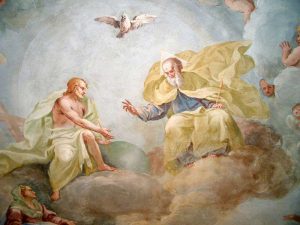
Trinity Sunday - Picture of Trinity

Today, we celebrate the ‘Trinity Sunday’.

Trinity Sunday commemorates and honors not an event, but a reality: the Holy Trinity.

Trinity Sunday falls on the Sunday after Pentecost.

It is celebrated in all the Western liturgical churches: Roman Catholic, Anglican, Lutheran and Methodist.

Trinity Sunday, officially “The Solemnity of the Most Holy Trinity,” is one of the few feasts of the Christian Year that celebrates a reality and doctrine rather than an event or person. On Trinity Sunday we remember and honor the eternal God: the Father, the Son, and the Holy Spirit. Trinity Sunday is celebrated the Sunday after Pentecost, and lasts only one day, which is symbolic of the unity of the Trinity.

The Trinity is one of the most fascinating – and controversial – Christian dogmas. The Trinity is a mystery. By mystery the Church does not mean a riddle, but rather the Trinity is a reality above our human comprehension that we may begin to grasp, but ultimately must know through worship, symbol, and faith. It has been said that mystery is not a wall to run up against, but an ocean in which to swim.

The common wisdom is that if you talk about the Trinity for longer than a few minutes you will slip into heresy because you are probing the depths of God too deeply. The Trinity is best described in the Niceno-Constantinopolitan Creed, commonly called the Nicene Creed.

Essentially the Trinity is the belief that God is one in essence (Greek ousia), but distinct in person (Greek hypostasis). Don’t let the word “person” fool you. The Greek word for person means “that which stands on its own,” or “individual reality,” and does not mean the persons of the Trinity are three human persons. Therefore we believe that the Father, the Son, and the Holy Spirit are somehow distinct from one another (not divided though), yet completely united in will and essence.

How can this be? Well, think of the sight of two eyes. The eyes are distinct, yet one and undivided in their sight. Another illustration to explain the Trinity is the musical chord. Think of a C-chord. The C, E, and G notes are all distinct notes, but joined together as one chord the sound is richer and more dynamic than had the notes been played individually. The chords are all equally important in producing the rich sound, and the sound is lacking and thin if one of the notes is left out.


Tags: , , ,

June 4th, 2009

No prayer request is too small for Him

No prayer request is too small

While I was talking with someone the other day, she mentioned something going on in her life. I asked if she’d prayed about it. She replied no, she didn’t think God was concerned about something like that…..she prays about the important things but not anything as small as this.

I could identify with this thinking, and at one time my thinking was….after all, God has a lot to do all the time!

Then one day I happened to be visiting a church. After the worship service the pastor asked if anyone would like to come up for prayer.

Several people did. Clearly some had physical ailments; others may have had financial, family, or work situations they were seeking God’s help in. One woman had a cold, and she went right up for prayer along with the others. The pastors and prayer team prayed for each person that came, including the woman with the sniffles.

————————————————————————-

No prayer request was too large, or too small.

There is nothing under the sun that is not important to God. All we have to do is look at our solar system, the starry universe, how a baby is perfectly put together before birth, the cell structure in our bodies, right down to a perfectly and intricately made bumble bee in a minutely detailed single flower.

He is most definitely and assuredly in details. And He is totally interested in the details of our lives. The Word of the Lord is truth, and it says that even the hairs of our head are numbered by God. He knows every single solitary detail about us. He IS interested and involved in our lives.

No prayer request is too small for Him. He already knows what is in our hearts and minds, and longs for us to come to Him, our Heavenly Father, to ask and to talk things over. Through the Holy Spirit, we can come to Him, trusting and believing.

What an awesome and amazing God we have, that HE would be interested in every detail concerning us. So “give all your worries and cares to God, for he cares about you.” (1 Peter 5:7)

How wonderful! We serve a God of details. That is good news.

- written by Sally I. Kennedy


Tags: , , , , ,

Page 8 of 77« First...678910...203040...Last »
Also check out our - - - Featured Posts | Recent Posts